

1. A Human Story
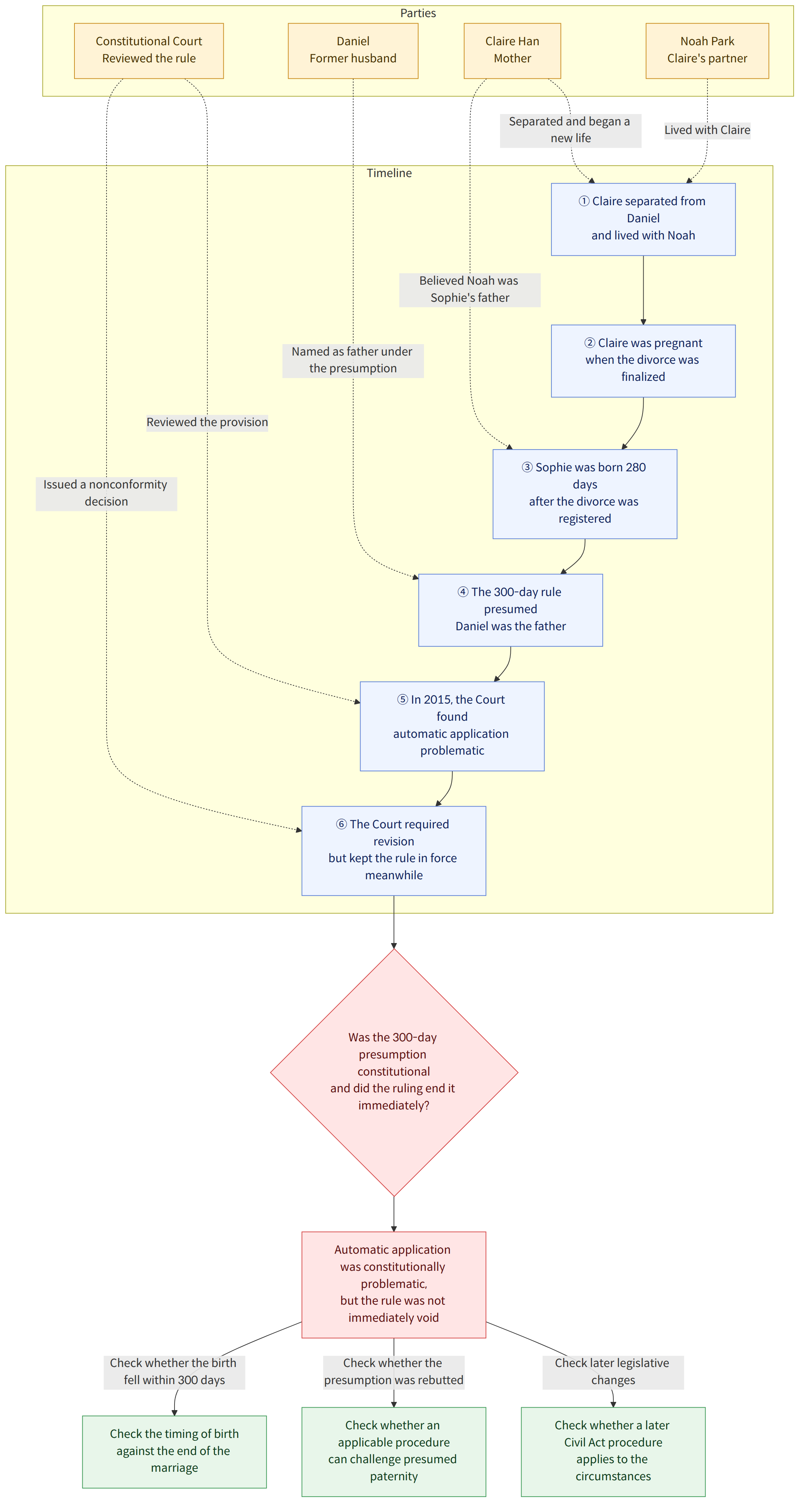
In the spring of 2015, Claire Han was settling into a new life with Noah Park, the partner she had lived with since separating from her husband, Daniel. The divorce from Daniel had taken longer than Claire expected to complete. By the time the paperwork was final, she was already pregnant. Their daughter, Sophie, was born 280 days after the divorce was registered.
Claire believed the circumstances were straightforward: Daniel and she had been apart, and Noah was Sophie’s father. But when she began sorting out the paperwork after the birth, she learned that the law presumed a child born within 300 days of the end of a marriage to be the former husband’s child. The rule did not first ask who Sophie’s biological father was. Claire wondered whether a rule written for another era could still determine her daughter’s legal status—and whether the Constitution allowed it.
2. The Legal Question
Could South Korea constitutionally presume that a child born within 300 days after a marriage ends is the former husband’s child, even when the parents had separated and modern evidence could identify the biological father? And did the Constitutional Court’s ruling immediately remove that presumption?
3. What Korean Law Says
South Korea’s Civil Act has traditionally used a legal presumption to give a child a clear family status from birth. Under Article 844, a child born during a marriage is presumed to have been conceived during that marriage. The provision also extended that presumption to a child born within 300 days after the marriage ended.
In plain language: The 300-day rule treated a child born soon after a marriage ended as the former husband’s child for legal purposes, unless the presumption was properly overturned. It did not itself determine biological paternity through a scientific test.
In 2015, the Constitutional Court reviewed the 300-day provision in a case involving the rights to personal dignity and to form and maintain family life. It concluded that the provision, applied automatically, had become constitutionally problematic.
The Court’s central concern: A fixed time period could no longer reliably reflect the likelihood of paternity in every case. Divorce and remarriage had become more common, restrictions on women’s remarriage had been removed, divorce proceedings could take a long time, and scientific methods could establish biological paternity with great accuracy.
The Court did not, however, declare the provision immediately void. It issued a nonconformity decision—a ruling that a law conflicts with the Constitution but that lawmakers must revise it. The reason was the risk of leaving children without a settled legal status if the presumption vanished at once.
- The ruling concerned the 300-day presumption’s effect on the constitutional right to family life grounded in human dignity and equality.
- The Court rejected other constitutional claims in the case, including claims framed around privacy, freedom to marry, sexual self-determination, property, and equality.
- Because the Court did not make the rule immediately ineffective, it continued to apply while legislative changes were awaited.
- Later amendments to the Civil Act created court procedures intended to address certain cases in which the former husband was plainly not the father. The 2015 ruling itself should not be mistaken for a complete, automatic change of parentage.
4. How Korean Courts Approach This
The Constitutional Court’s majority recognized two interests that can pull in opposite directions. On one side is a person’s ability to live in a family relationship that reflects reality, without an outdated presumption determining that relationship automatically. On the other is a child’s need for a stable legal status from birth, rather than a period in which the law identifies no father.
The majority concluded that applying the same 300-day period to every family was no longer a satisfactory way to balance those interests. Changes in marriage and divorce, together with reliable scientific testing, weakened the reasoning for treating the time period as conclusive in practice. But the Court was also unwilling to create an immediate legal vacuum for children whose presumed parentage might be correct.
Three justices disagreed. Their position emphasized that the presumption worked together with the rules for challenging paternity. In their view, the more appropriate constitutional question was whether those challenge procedures offered a sufficiently reasonable way to rebut the presumption—not whether the 300-day rule itself should be the focus of the case. That disagreement illustrates the central difficulty: legal certainty for a child matters, but so does a fair and workable route to correct an inaccurate legal assumption.
5. Applying the Law to Claire and Daniel’s Case
- The timing triggers the presumption. Sophie was born 280 days after Claire’s divorce from Daniel was registered. Under the law considered in the 2015 case, that placed her within the 300-day period. The fact that Claire and Daniel had been separated did not, by itself, cancel the statutory presumption.
- The presumption concerns legal status, not a scientific finding. Claire’s account of her relationship with Noah—and any biological evidence—might matter in a proper legal process. But neither her belief nor a test result automatically erased Daniel’s presumed legal status under the rule then in force.
- The constitutional ruling did not give Claire an immediate exemption. Although the Court found the rule constitutionally defective, it did not make it disappear at once. In 2015, the provision remained effective pending legislative action, partly to prevent a gap in children’s legal status.
- The decision called for a better system, not an instant answer to every family’s case. The Court’s reasoning challenged a one-size-fits-all presumption. It did not itself decide who Sophie’s biological father was or replace the legal procedures needed to resolve parentage. Later statutory changes introduced additional court procedures for certain cases, so a family facing this situation today must check the current law and the route that applies to its facts.
A reader dealing with a similar issue could ask [[lawyer]] to review the marriage and divorce records, the child’s birth documents, and any paternity evidence, and to identify which current court procedure may apply. The dates and wording on those documents can be important to understanding the child’s legal status.
A review of the marriage and divorce records, birth documents, and any paternity evidence may help clarify the child’s present legal status and which procedure is relevant. You could ask attorney Ji-sun Ahn of Ijun Law Firm to examine those documents in light of the specific dates and family circumstances.
6. Conclusion: What Happened, and What Should You Do?
In Claire’s story, the 2015 ruling did not immediately remove Daniel’s presumed legal status as Sophie’s father. The presumption continued to apply while the legislature was expected to improve the law. That did not establish biological paternity; it meant that Claire could not treat the constitutional decision alone as having changed the legal record.
For families facing a similar situation now, the practical lesson is to separate three questions: what the law presumes, what biological evidence may show, and what legal procedure is required to change parentage. Later amendments created additional court procedures, but the applicable route depends on the circumstances and current law.
- Keep copies of the marriage and divorce records, the child’s birth documents, and any relevant paternity evidence.
- Do not assume that a constitutional ruling or a DNA result, by itself, changes a child’s legal parentage; check the procedure currently available.
- Before taking action, get advice based on the specific dates, documents, and family circumstances involved.
















