
A Human Story
In 2011, Daniel and Emily Carter had been married for years and had given up hope of having a child. A young unmarried woman, Hannah Lee, gave birth and agreed that the Carters could raise her newborn. She signed a document saying she consented to the adoption and was giving up her claims to the child. The couple took the baby home, but instead of completing a formal adoption, they registered the child as though Emily had given birth.
They named him Noah. The Carters changed diapers, sat through fevers, paid school fees, and built a life around him. Noah grew up believing they were his parents. Then, years later, Hannah reappeared. She said she wanted her child back. Daniel and Emily were left with a question that no birth certificate could answer on its own: had they become Noah’s legal parents, or had they only cared for a child who could now be taken away?
The Legal Question
Can a birth registration that falsely names adoptive parents as a child’s biological parents nevertheless have the legal effect of an adoption under Korean law—and can the child’s biological mother later demand that the child be returned?
What Korean Law Says
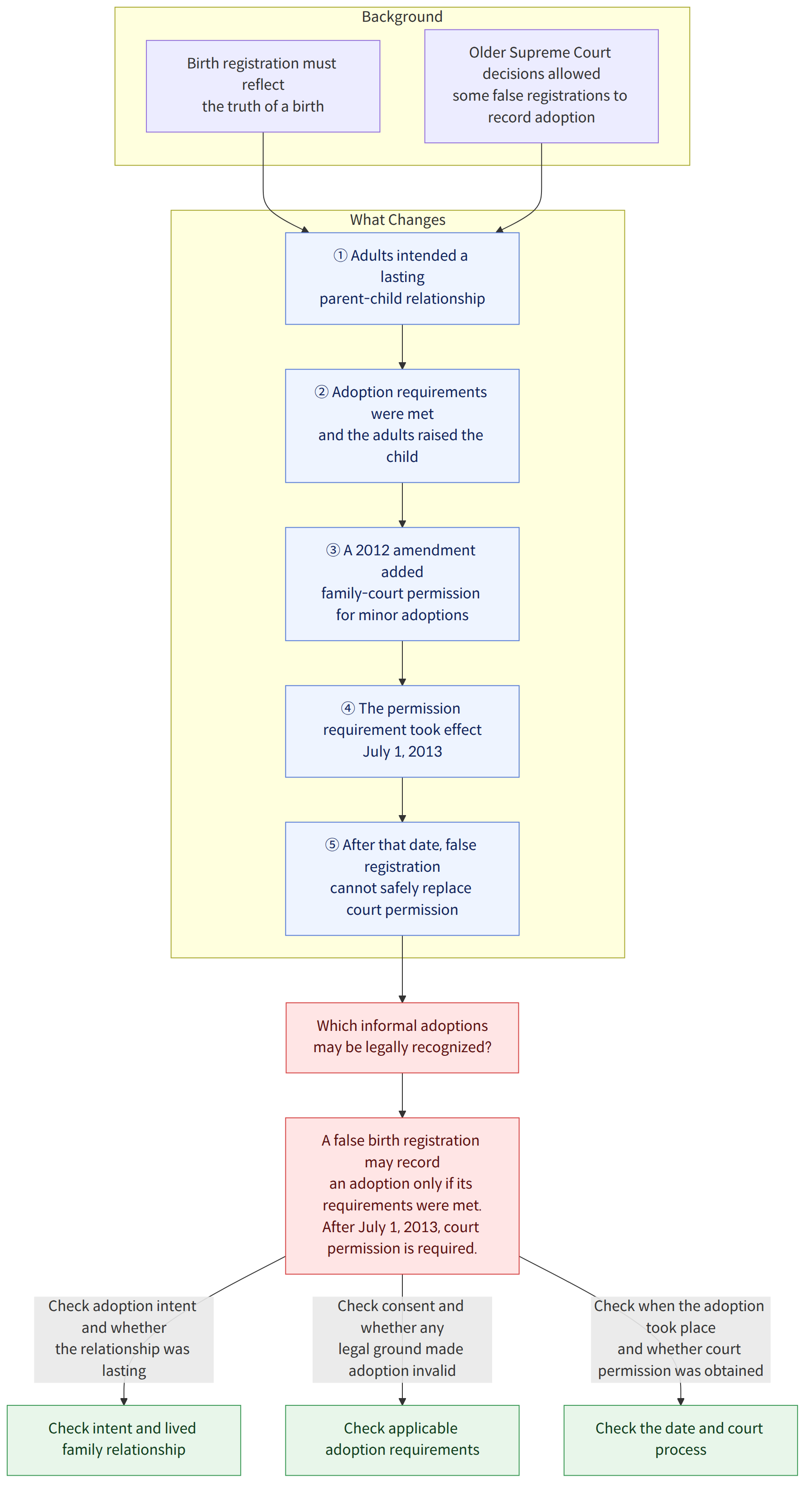
A birth registration must reflect the truth of a birth. A couple who did not give birth to a child cannot make the child their biological child simply by registering the child as one. Ordinarily, that kind of registration is invalid as a record of biological parentage.
But Korean Supreme Court decisions have recognized a distinction between biological parentage and a legal adoptive relationship. Where the adults intended to adopt, and the essential conditions for adoption were present, a false birth registration could, in certain circumstances, function as an adoption registration instead.
A registration that is inaccurate as to biological birth may still publicly record an adoptive parent-child relationship if the parties intended to create that relationship and the substantive requirements for adoption were met.
For that principle to apply, the court examines matters including:
- Mutual intent to adopt: The adults must have intended to create a lasting legal parent-child relationship, not merely arrange temporary care.
- Required consent for a young child: For a child under 15, consent on the child’s behalf by the legal representative was among the relevant substantive requirements under the law applicable to the older cases.
- No statutory ground making the adoption void: The relationship must not fall within the Civil Act’s grounds for invalidity, such as certain prohibited family relationships.
- A real family life: The adults must have actually cared for and raised the child as their own. A paper declaration alone is not enough.
Where these elements are established, the legal relationship is generally treated like that between an adoptive parent and child. It is not biological parentage, but it is a legal family relationship that cannot ordinarily be erased simply because the original paperwork used the wrong form.
If the false birth registration serves as the record of a legally effective adoption, a claim seeking to deny the existence of the parent-child relationship will generally not be allowed merely to erase that record. A legally recognized relationship must be ended through the procedures and grounds applicable to ending an adoption.
The timing of the adoption matters. Earlier Supreme Court decisions applied this approach when court permission was not a necessary condition for adopting a minor. A 2012 amendment to the Civil Act introduced a requirement for family-court permission in the adoption of minors, effective July 1, 2013. For an adoption made on or after that date, a false birth registration cannot safely be treated as a substitute for the required court process. The older decisions may therefore be difficult to apply.
How Korean Courts Approach This
Korean courts look beyond the label written on a document. They ask what relationship the adults meant to create and what relationship they actually lived. That approach reflects the importance of stable family status: where adults and a child have formed a genuine parent-child relationship and have continued it without objection, undoing it solely because the original registration was defective could harm the family and others who relied on the official record.
This does not mean that every false birth registration becomes an adoption. Courts distinguish between a genuine adoption carried out through an incorrect form and an arrangement that never met adoption’s substantive requirements. They also take account of the law in force when the adoption took place. Since July 1, 2013, the statutory requirement of family-court permission for a minor’s adoption presents a major obstacle to relying on the older doctrine where that permission was never obtained.
Nor does a biological parent’s later change of heart automatically dissolve an adoption that has already taken legal effect. The relationship must be challenged or ended through the appropriate legal process; a demand to hand over the child is not, by itself, a court order or a legal termination of the adoptive relationship.
Applying the Law to the Case
First, the birth registration does not make Emily Noah’s biological mother. She did not give birth to him, so the registration cannot establish biological parentage merely by saying that she did.
Second, the court would consider whether the registration had the effect of an adoption. Daniel and Emily took Noah with the intention of raising him as their child, and Hannah signed a document expressing consent to the adoption. Those facts support the existence of an adoption agreement and the necessary consent. The decisive question would be whether all legal requirements applicable at the time were satisfied.
Third, the years of care are important evidence. The Carters raised Noah from infancy as their son. That sustained family life is not a substitute for every legal requirement, but it strongly supports the argument that the registration recorded a real adoptive relationship rather than a temporary caregiving arrangement.
Fourth, the date places the case under the earlier legal framework. The fictional adoption took place in 2011, before the family-court-permission requirement for adopting a minor took effect on July 1, 2013. The older Supreme Court approach is therefore relevant. If a court found the adoption agreement, required consent, absence of a statutory invalidity ground, and genuine parent-child life, the false birth registration could have the effect of an adoption registration.
Finally, Hannah’s request would not itself end that relationship. If the adoption was legally effective, she could not simply reclaim Noah because she is his biological mother or because she later regrets the arrangement. The adoptive relationship would have to be addressed through the legal procedures for ending an adoption, and the existence of a signed consent and many years of family life would be significant facts. The result could be different if the adoption’s substantive requirements were not met.
If you are dealing with a similar issue, attorney Ji-sun Ahn of Ijun Law Firm can review the birth and family registration records, any adoption order or consent, and the child’s current living arrangements with you. These details can help clarify which options apply to your situation.
Conclusion: What Happened, and What Should You Do?
On these facts, a Korean court would have a strong basis to recognize that Daniel and Emily’s 2011 registration functioned as an adoption, even though it was not a truthful record of biological birth. If the required consent and other substantive conditions were satisfied, Hannah’s demand alone would not require the Carters to hand Noah over. Their legal relationship would be an adoptive one, not a biological one, and it could be ended only through the applicable legal process.
That conclusion depends heavily on timing. If the child was adopted on or after July 1, 2013, the absence of required family-court permission may make it much harder to establish that a false birth registration created a valid adoption. Anyone facing that situation should obtain advice based on the exact dates, documents, and history of care rather than assume the older cases resolve the issue.
- Keep every document: Preserve the consent or relinquishment paper, the birth-registration records, messages, and evidence of who cared for the child and when.
- Do not arrange a private handover under pressure: Seek prompt advice from a Korean family-law attorney and use the proper court process to clarify the child’s legal status.
- Check the adoption date and required approvals: The law changed on July 1, 2013, and that date may determine whether the older court approach can apply.

















