

1. A Human Story
Daniel Lee had spent months helping residents at a local public service office. When parliamentary elections approached, he became convinced that one candidate understood the needs of his neighborhood better than anyone else. Daniel wanted to help—not during his shift, he thought, but on evenings and weekends, handing out leaflets and urging voters to support the candidate.
A supervisor warned him that campaigning could bring a formal warning and extend his service. Daniel was puzzled. He was not a civil servant, he reasoned, and he would be off duty. Surely his time after work belonged to him. But the rule he had been told about did not draw that distinction.
2. The Legal Question
May a social service agent be prohibited from campaigning for a candidate even during personal time, and can a warning for doing so lawfully lead to an extension of service?
3. What Korean Law Says
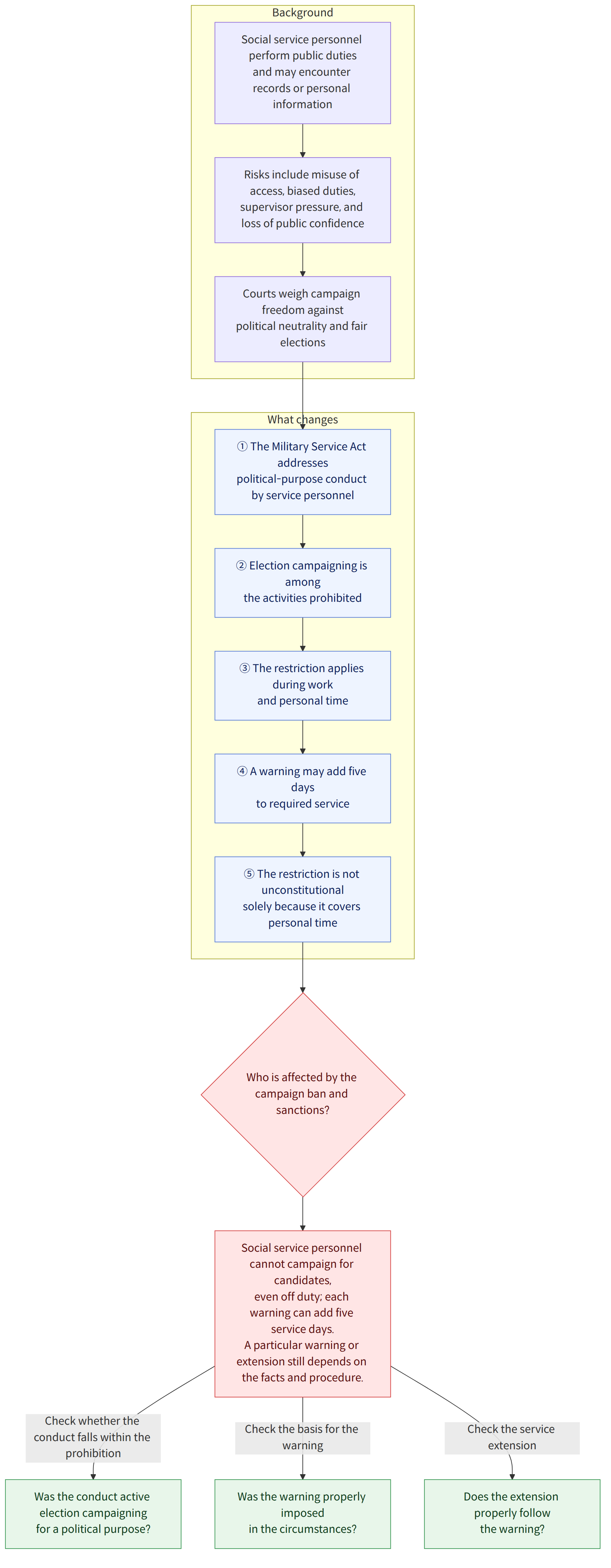
The Military Service Act addresses political activity by social service personnel. Under Article 33(2)(2), a person who engages in conduct for a political purpose may receive a warning. Each warning can add five days to the person’s required service. Election campaigning is among the activities covered by the prohibition at issue here.
The restriction applies to election campaigning whether it takes place during working hours or outside them. Being off duty does not, by itself, make campaigning permissible.
The rule is grounded in the public role social service personnel occupy while fulfilling their service obligation. They may assist public institutions, local governments, or public organizations with administrative or social-service work. Even when they are not decision-makers, they may encounter administrative records or personal information through their duties.
The concerns behind the prohibition include:
- Misuse of access: information obtained through public work could be used to benefit a candidate or campaign.
- Biased performance of duties: a person might perform assigned work in a way that favors a candidate or affects voters.
- Pressure from supervisors: a supervisor or service manager could influence personnel to campaign, even against their wishes.
- Public confidence: campaigning by people in a public-service setting could undermine trust in the political neutrality of public institutions and their staff.
The law therefore does not make the permission to campaign turn solely on whether the person is at work at the moment. The election period is short and campaigning is concentrated during it, so activity outside a shift may still be connected to a person’s public role or create pressure and appearances of partiality.
4. How Korean Courts Approach This
In reviewing this kind of restriction, the Constitutional Court has weighed the individual’s freedom to campaign against the state’s interest in preserving political neutrality and fair elections. It has recognized that social service personnel are not necessarily civil servants in the ordinary sense, but they perform public duties and may be subject to the influence of institutional supervisors.
The Court’s general reasoning is that a ban on campaigning can be necessary even outside working hours: public access to information, the possibility of biased official conduct, and the risk of pressure from supervisors do not necessarily end when a shift does.
The Court has also considered the practical character of elections. Because campaigning intensifies over a limited period, it cannot simply be assumed that after-hours campaigning has no connection to official duties or public confidence. On that reasoning, the restriction has not been treated as unconstitutional merely because it also covers personal time.
That conclusion concerns the validity of the general restriction. It does not mean that every warning or service extension is automatically correct. Whether particular conduct falls within the prohibition, and whether the sanction was imposed properly, may still depend on the facts and procedure.
5. Applying the Law to Daniel’s Situation
Daniel’s plan was not simply to hold a private political opinion. He intended to urge voters to support a particular candidate by distributing campaign material. That is the kind of active election campaigning addressed by the prohibition.
The fact that Daniel planned to campaign after his shift would not resolve the issue in his favor. The law’s concern is broader than interruption of work. A person serving at a public office may have access to information that voters do not, may be perceived as speaking with institutional authority, or may feel pressure from people responsible for managing the service. Those risks can persist outside the workplace.
The election’s timing matters as well. Campaigning is concentrated in a short period, and the public may have difficulty separating a social service agent’s campaign activity from the public position the person holds. The restriction is therefore aimed at protecting both the agent’s political neutrality and confidence in the neutrality of public institutions.
If Daniel nevertheless campaigned and received a warning, the statute provides for a five-day service extension for each warning. He should not assume that the extension is invalid simply because the activity took place during personal time. But he should carefully check what conduct the notice describes, what evidence supports it, and whether the applicable procedure was followed. Those details could matter even though the general ban covers off-duty campaigning.
If you have received a warning or a notice extending your service, attorney Ji-sun Ahn of Ijun Law Firm could review the notice, the evidence it cites, and any messages or instructions relevant to how the alleged campaigning occurred. That document-specific review may help clarify whether the stated facts and procedure match the rule.
6. Conclusion: What Happened, and What Should You Do?
Daniel decided not to campaign for the candidate while serving as a social service agent. His belief that evenings and weekends were automatically exempt was understandable, but it did not match the rule’s reach. Korean constitutional reasoning permits the restriction to apply outside working hours because the public role, possible access to information, risk of pressure, and need for public confidence do not disappear at the end of a shift.
For anyone in a similar position:
- Read the notice closely. If you receive a warning, keep the written decision and check exactly what conduct and legal basis it identifies.
- Preserve relevant records. Save messages, schedules, instructions, and other materials that may clarify what happened and whether anyone pressured you.
- Get an individual review before challenging the sanction. The general restriction may be valid, but the facts and process behind a particular warning or service extension still deserve careful examination.

















