

A Human Story
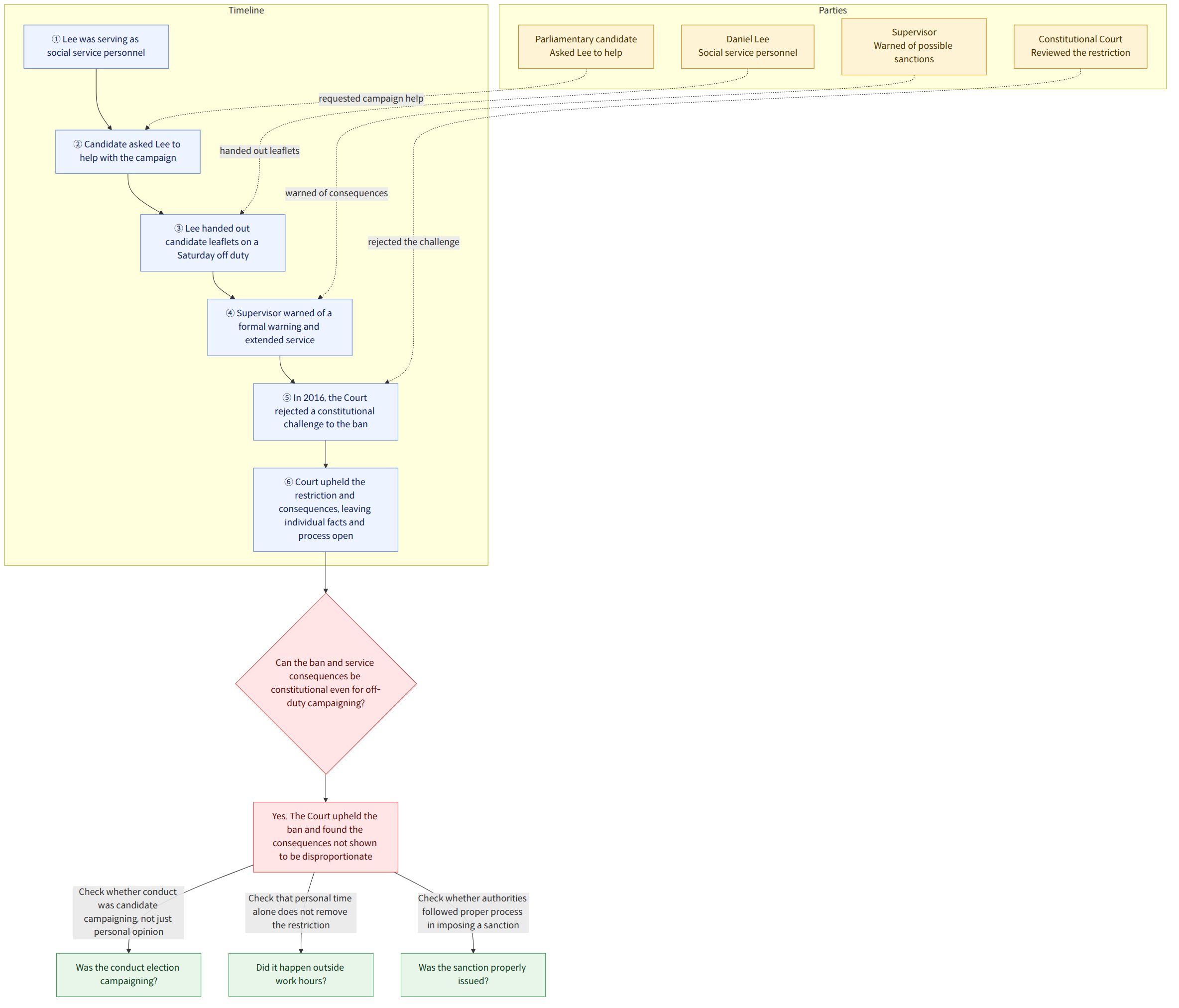
Daniel Lee had spent months balancing his public-service assignment with the rest of his life. When a parliamentary candidate he supported asked for help during an election, Daniel agreed to hand out leaflets on a Saturday. He was not in uniform, was not on duty, and did not mention his workplace. To him, it felt like a private act of citizenship.
A few weeks later, his supervisor called him in. Daniel was told that campaigning while serving as a social service personnel member could bring a formal warning and an extension of his service. He wondered whether the government could really restrict his political freedom simply because he was completing an alternative form of military service.
The Legal Question
Can Korea prohibit social service personnel from campaigning for election candidates—and impose a warning and extended service for doing so—without violating their constitutional freedom to participate in elections?
What Korean Law Says
Korea’s Constitutional Court has upheld the restriction. Its reasoning begins with the particular public role of social service personnel: they are not civil servants, but they perform public duties while fulfilling a compulsory service obligation. The Court considered that status sufficiently public in nature to require political neutrality.
Social service personnel carry out public functions and hold a public status comparable, in relevant respects, to that of public officials. Maintaining political neutrality protects confidence in the fairness of elections and in the impartial performance of their duties.
The Court identified several purposes behind the prohibition:
- Election fairness: A person performing public duties could use work-related information or public resources to assist a candidate.
- Impartial public service: A worker might perform duties in a way that favors a candidate or political side.
- Public confidence: Even campaigning outside work could undermine trust that public duties are being carried out neutrally.
- Consistency across forms of service: Many other people serving compulsory or alternative service, including active-duty personnel, are also restricted from campaigning.
The restriction is not confined to campaigning during work hours. The Court reasoned that political campaigning can take many forms, making it difficult to list every prohibited activity in advance. It also found that a rule limited to working hours would not fully protect public confidence in neutrality.
The Court concluded that the public interests served by the restriction outweighed the individual burden on social service personnel, and that a warning and extension of service were not shown to be disproportionate consequences.
That does not mean every political opinion or private conversation is automatically election campaigning. The question is whether the conduct amounts to campaigning for a candidate or election, rather than simply expressing a personal view. But once conduct is found to be campaigning, the fact that it happened on personal time does not, by itself, take it outside the restriction.
How Korean Courts Approach This
In a 2016 decision, the Constitutional Court rejected a constitutional challenge to the ban. It applied a familiar balancing approach: the Court considered whether the restriction pursued legitimate aims, was capable of advancing them, went further than necessary, and imposed a burden disproportionate to the public benefit.
The Court accepted that campaigning can create risks beyond the workplace. A social service personnel member may have access to administrative or personal information through the job, and the public may reasonably question whether public duties are being performed impartially if that person openly campaigns for a candidate. The Court also considered the restriction alongside similar limits applying to other people performing military or alternative service.
The Court therefore found the ban and its service-related consequences constitutionally permissible. That conclusion addresses the validity of the rule; it does not settle every dispute about whether a particular person actually campaigned or whether the authorities followed the proper process in issuing a sanction.
Applying the Law to Daniel’s Situation
Daniel’s case turns first on what he did. Handing out a candidate’s leaflets is a direct form of support intended to influence voters. On those assumed facts, it is much more likely to be treated as election campaigning than as a private discussion of political views.
Second, the timing does not resolve the issue in Daniel’s favor. He acted on a Saturday, outside his assigned hours, and without wearing a uniform. Those details may show that he did not use his workplace or act while performing his duties. But the restriction upheld by the Court is not limited to working hours or to conduct in uniform.
Third, the constitutional challenge is unlikely to succeed. The Court has already concluded that the aims of protecting election fairness, political neutrality, and public confidence justify the burden on social service personnel. It also found that a warning and extension of service were not excessive compared with those public interests.
Finally, Daniel should distinguish between challenging the rule and challenging how it was applied to him. The constitutional ruling makes a broad challenge to the ban difficult. But if he disputes the sanction, the exact conduct identified, the evidence relied upon, and the explanation given in the notice may still be important. The key practical question would be whether the authorities correctly characterized his actions as campaigning and handled the decision properly.
If you receive a warning or a notice extending your service, attorney Ji-sun Ahn of Ijun Law Firm could review the notice alongside the messages, posts, or other evidence it relies on, to help you understand the documents and the decision.
Conclusion: What Happened, and What Should You Do?
Daniel’s leafleting was campaigning, even though it happened on his day off. Under the Constitutional Court’s approach, the prohibition is not unconstitutional merely because it reaches conduct outside working hours, and a warning accompanied by extended service may be imposed under the applicable rules. Daniel should therefore expect a constitutional challenge to the restriction itself to face a substantial obstacle. If he disputes the finding or the way the sanction was imposed, however, that is a separate issue worth examining on its own facts.
For anyone in a similar position:
- Avoid campaigning while serving. Do not assume that personal time, ordinary clothes, or social media activity places election campaigning outside the rule.
- Preserve the record. Keep the notice, any explanation of the alleged conduct, and relevant messages, posts, or other materials.
- Separate the legal questions. A challenge to the constitutionality of the ban is different from a dispute over what happened or whether the individual decision was properly made.

















