
1. A Human Story
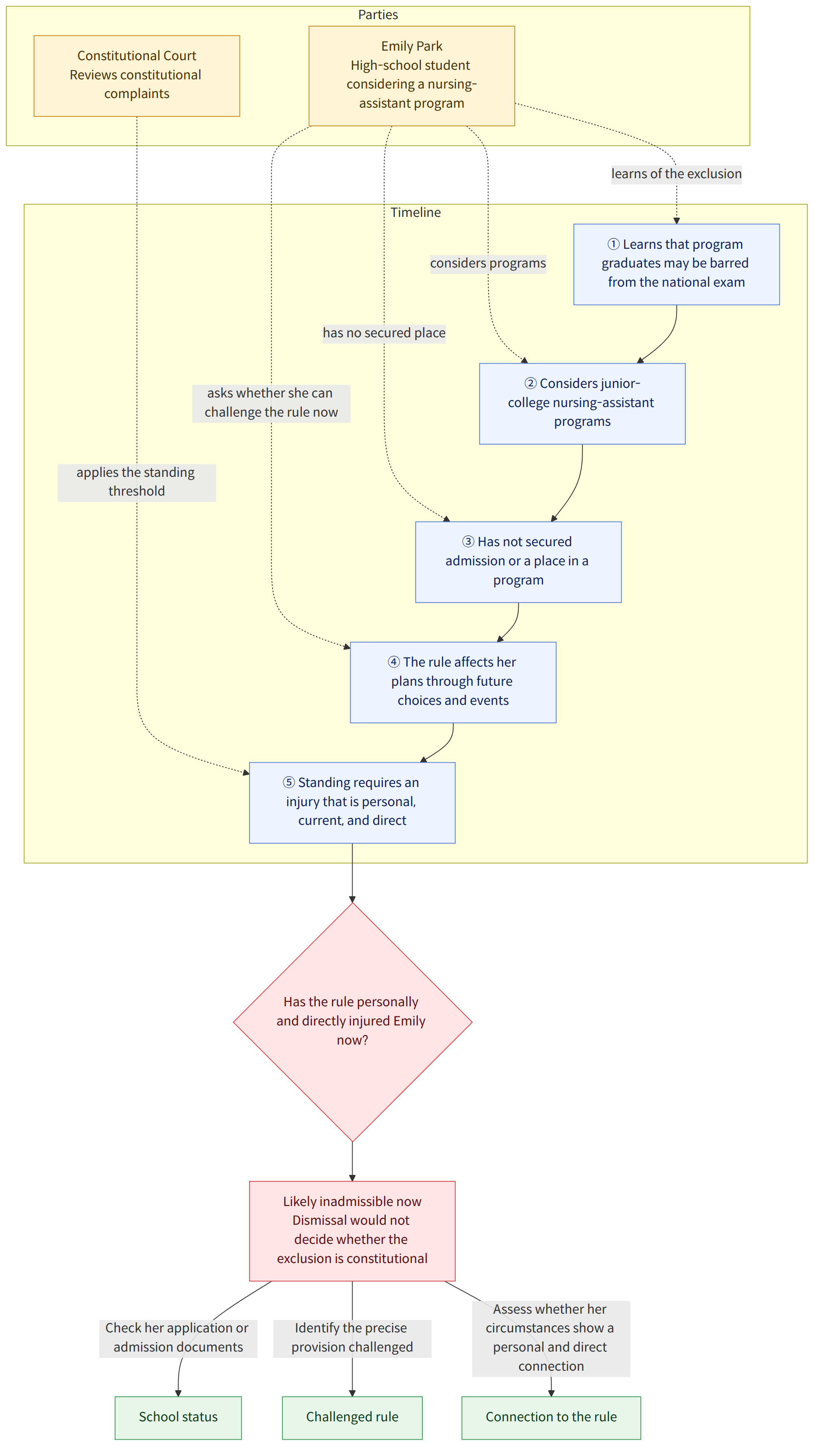
Emily Park had spent months imagining a future in healthcare. In her final year of high school, she began looking at junior colleges with nursing-assistant-related programs, comparing course lists and picturing herself working in a clinic. Then she discovered that a provision of Korean medical law excluded graduates of such college programs from eligibility to sit for the national nursing assistant examination.
The news made Emily feel that a door had been shut before she had even chosen a school. She wanted to know whether she could ask Korea’s Constitutional Court to strike down the rule now, while it was still shaping her plans. But a serious concern about a future career is not always the same as a present legal injury.
2. The Legal Question
Can a high-school student who is considering a junior-college nursing-assistant-related program bring a constitutional complaint against a law that excludes graduates of that program from taking the national examination, even though she has not yet secured admission or a place in the program?
3. What Korean Law Says
Article 68(1) of the Constitutional Court Act allows an individual to bring a constitutional complaint when an exercise or failure to exercise public power infringes a constitutionally protected fundamental right. The right to complain is not available to everyone who objects to a law or expects that it may affect them someday.
Under Article 68(1), the complainant must be a person whose own fundamental right is infringed by the challenged exercise or non-exercise of public power.
Korean constitutional procedure therefore asks whether the person has a sufficiently personal and immediate connection to the challenged rule. In practical terms, the complainant must generally show that:
- The alleged injury is their own. A person cannot ordinarily bring a case solely on behalf of other people who are affected by the law.
- The injury is current. A possible disadvantage that may arise only after future events does not necessarily qualify.
- The injury is direct. A merely indirect, factual, or economic interest is generally not enough.
These requirements are often described as self-relatedness, presentness, and directness. They concern whether the person is entitled to bring the case, not whether the challenged law is ultimately constitutional.
4. How Korean Courts Approach This
The Constitutional Court applies standing requirements carefully. A complainant must show more than a strong personal interest in the outcome or a reasonable fear that a law could affect a future choice. The court asks whether the challenged public measure has already acted upon that person’s legal position in a sufficiently direct way.
A person affected only indirectly, or with a factual or economic interest in the issue, is not the same as a person whose own fundamental right is currently and directly infringed.
This distinction can feel formal, particularly when a law is already influencing someone’s education or career plans. But the standing inquiry is a threshold step: the court can dismiss a complaint without deciding whether the underlying law is constitutional if the complainant has not shown the required personal connection.
5. Applying the Law to the Case
Emily’s concern is genuine, but the legal question is whether the exclusion has yet changed her own legal position.
- The rule may affect graduates of the program. If the challenged provision excludes graduates of a junior-college nursing-assistant-related program from taking the national examination, those graduates may have grounds to argue that the rule affects their rights. That does not automatically give every prospective student the right to bring the same complaint.
- Emily has not secured a place in the program. As a high-school student still considering her options, she has not yet acquired a confirmed status as a student in the relevant course of study. The rule’s effect on her remains tied to future choices and events.
- Her present interest is therefore prospective. The provision may shape her plans, but at this stage its impact on her is not sufficiently current and direct under the standing test described above.
- The court could stop at that threshold. If Emily filed a complaint now, the likely result would be dismissal as inadmissible for failure to meet the procedural requirements—not a ruling that the exclusion itself is constitutional.
A lawyer could review Emily’s school application or admission documents, along with the precise provision she intends to challenge, to assess whether her circumstances establish the personal and direct connection required to bring a constitutional complaint. [[lawyer]] can also help identify which facts are relevant to that procedural question.
A lawyer could review Emily’s school application or admission documents, along with the precise provision she intends to challenge, to assess whether her circumstances establish the personal and direct connection required to bring a constitutional complaint. attorney Ji-sun Ahn of Ijun Law Firm can also help identify which facts are relevant to that procedural question.
6. Conclusion: What Happened, and What Should You Do?
Emily’s constitutional complaint would likely be dismissed if she filed it while she was still only considering the program and had not secured a place in it. That outcome would not resolve the constitutionality of the exclusion; it would mean only that she had not yet shown that the law infringed her own rights in the required present and direct way.
For readers facing a similar issue:
- Separate the merits from the right to sue. A law may raise a serious constitutional question, but you must also show that it affects your own legal position in the required way.
- Keep records of your status. Preserve relevant application, admission, enrollment, and official eligibility documents; they may help establish what the law means for you personally.
- Get advice before filing. Ask a Korean lawyer to review the challenged provision and your specific circumstances, including whether the alleged injury is current and direct.

















