
1. A Human Story
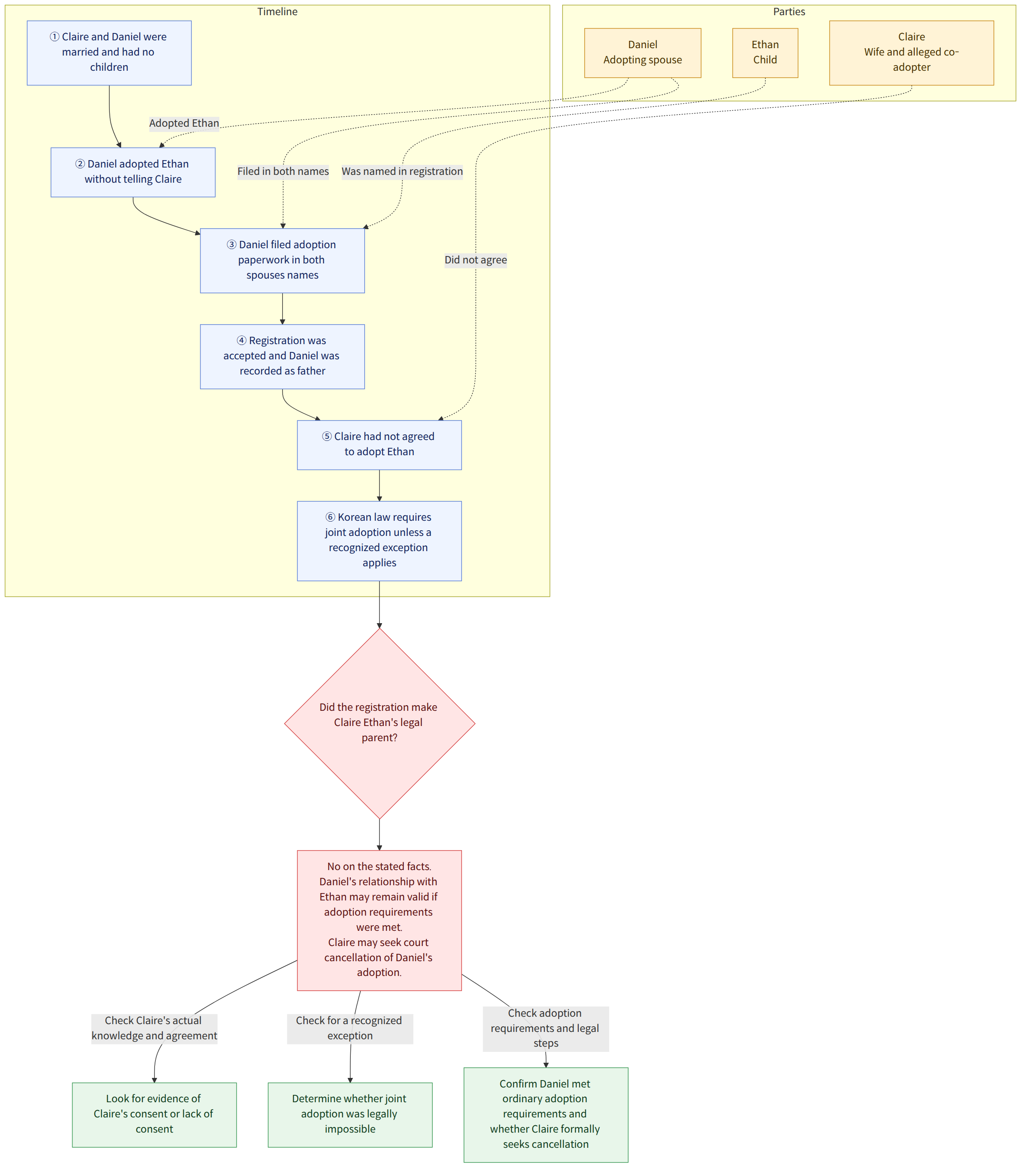
Claire and Daniel had been married for years and had no children. When Daniel told Claire he had been handling “some family paperwork,” she thought little of it—until a relative mentioned that Daniel had adopted a child named Ethan. Claire had never discussed adoption with him, met Ethan as a prospective parent, or agreed to become his mother.
The paperwork had been filed in both spouses’ names. The registration was accepted, and Daniel was now legally recorded as Ethan’s father. Claire was left with a painful and practical question: had a decision made without her knowledge created a parent-child relationship between her and Ethan as well?
2. The Legal Question
When a married person adopts a child without the other spouse’s agreement, does the adoption make both spouses legal parents? And can the nonconsenting spouse challenge the adopting spouse’s legal relationship with the child?
3. What Korean Law Says
Korean law generally requires spouses to adopt jointly. Article 874(1) of the Civil Act provides:
“A person who has a spouse shall adopt jointly with his or her spouse.”
The rule is not merely about whose names appear on the paperwork. A joint adoption must reflect the required legal conditions for each spouse. In particular, the nonconsenting spouse must have agreed to the adoption, unless the circumstances fall within an exception—such as a situation in which joint adoption was not possible because that spouse was absent or for another legally relevant reason.
The key principles are:
- Each parent-child relationship is considered separately. An adoption creates a legal relationship between the child and each adopting person; the couple’s shared status does not merge those separate relationships into one.
- A spouse’s consent matters. If one spouse files in both names without the other spouse’s agreement, the adoption generally does not create a valid parent-child relationship between the nonconsenting spouse and the child.
- The other spouse’s relationship may remain in effect. If the adopting spouse and the child otherwise met the requirements for adoption, their relationship may remain valid even though the joint-adoption requirement was not met.
- The nonconsenting spouse may seek cancellation. The spouse can ask a court to cancel the adopting spouse’s adoption. Unless that cancellation is granted, the adopting spouse’s legal relationship with the child continues.
An accepted adoption registration does not, by itself, turn a spouse’s lack of consent into consent or resolve every question about the legal relationship.
4. How Korean Courts Approach This
Korean courts treat adoption as a legal act involving the individual parties, not as a single indivisible act belonging to the married couple. That means a court can reach different conclusions about the child’s relationship with each spouse.
Where one spouse acted alone and the other did not agree, the courts’ general approach is to distinguish between the two relationships. The adoption is ordinarily ineffective between the child and the spouse who did not consent, because the necessary agreement between them is missing. But the adopting spouse’s relationship with the child may still stand if the ordinary adoption requirements were met. The nonconsenting spouse may then seek its cancellation.
This analysis can change if the facts show that joint adoption was legally impossible for a recognized reason, or if there is a dispute about what the spouse knew or agreed to. The court will look beyond the fact that a form was accepted and examine the circumstances and the parties’ actual agreement.
5. Applying the Law to the Case
Claire’s situation has two separate legal questions.
- Did Claire become Ethan’s legal parent? On the facts described, no. Claire did not agree to adopt Ethan, and there is no indication that she was absent or that another circumstance made joint adoption impossible. Filing the adoption in her name could not substitute for her agreement. The adoption therefore does not create a valid parent-child relationship between Claire and Ethan.
- Is Daniel Ethan’s legal parent? For now, likely yes, assuming Daniel and Ethan met the ordinary requirements for adoption. The failure to obtain Claire’s consent does not automatically erase Daniel’s relationship with Ethan.
- Can Claire challenge Daniel’s adoption? Yes. Korean law allows the nonconsenting spouse to seek cancellation of the adopting spouse’s adoption when the joint-adoption requirement was not met. Claire would need to take formal legal steps; the relationship between Daniel and Ethan does not disappear simply because Claire objects.
- What does the registration mean in practice? It is important evidence of what was filed and accepted, but it does not settle whether Claire agreed or whether the legal requirements were satisfied. Claire should obtain the adoption and family-register documents and get advice on the appropriate court procedure and any relevant deadlines.
So, while Claire may have been listed on the paperwork, the facts do not make her Ethan’s legal mother. Daniel’s legal relationship with Ethan is a separate matter and remains in place unless Claire successfully obtains its cancellation.
If you are dealing with a similar issue, attorney Ji-sun Ahn of Ijun Law Firm can review the birth and family registration records, any adoption order or consent, and the child’s current living arrangements with you. These details can help clarify which options apply to your situation.
6. Conclusion: What Happened, and What Should You Do?
Claire did not become Ethan’s legal parent merely because Daniel filed the adoption in both their names. On the stated facts, there is no valid adoption relationship between Claire and Ethan. Daniel’s relationship with Ethan, however, remains legally effective for now if the ordinary adoption requirements were met. Claire can ask a court to cancel that adoption, but until cancellation is granted, Daniel remains Ethan’s legal father.
If you face a similar situation:
- Get the records. Obtain copies of the adoption filing and relevant family-register documents, and preserve messages or other evidence showing whether you agreed.
- Act promptly. Ask a Korean family-law lawyer about the proper court application and any applicable time limits; do not assume that an objection alone changes the child’s legal status.
- Keep the relationships distinct. The nonconsenting spouse’s relationship with the child and the adopting spouse’s relationship with the child may have different legal outcomes.

















