

A Human Story
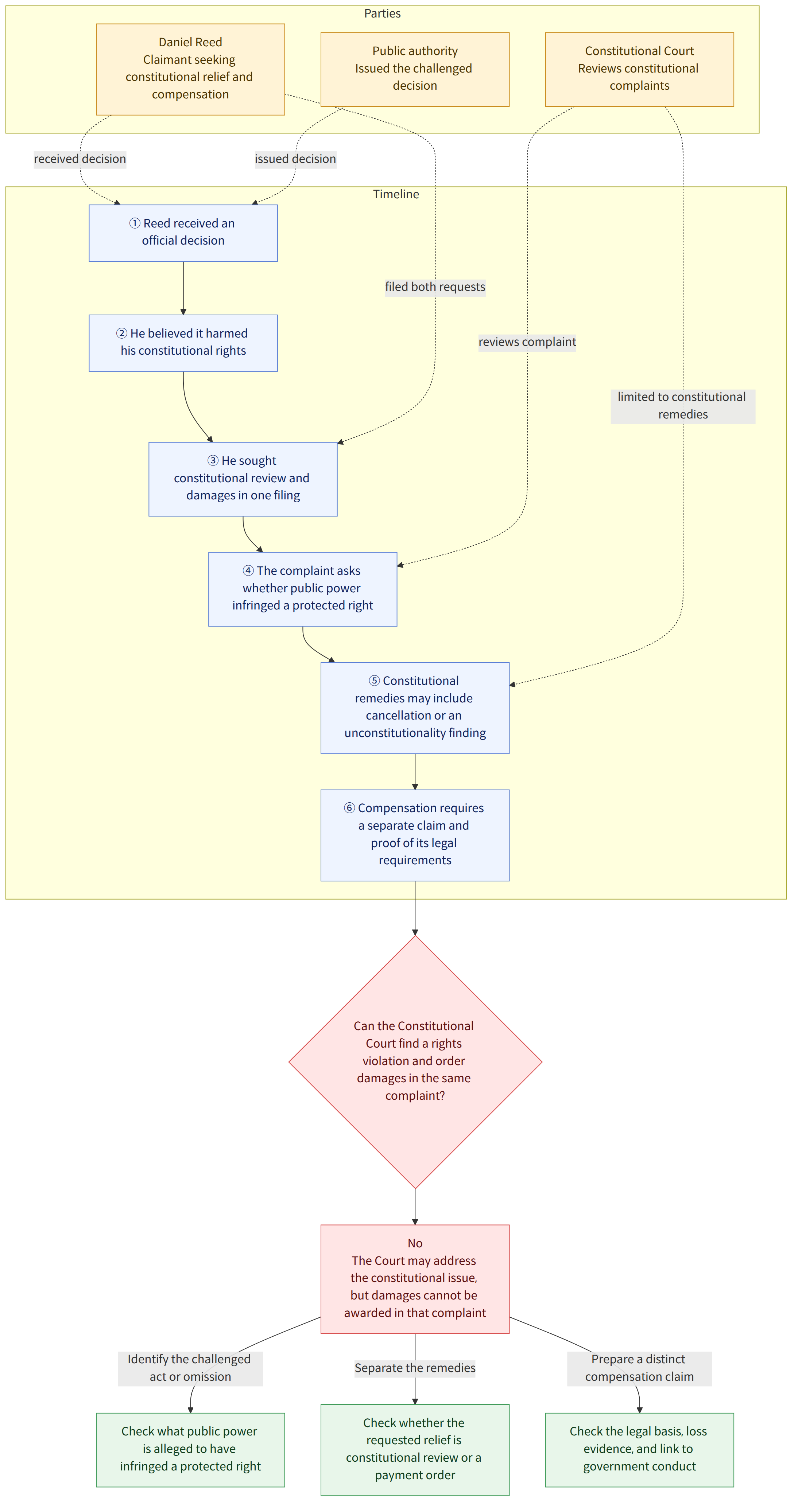
When Daniel Reed, an engineer living in Korea, received an official decision that he believed had seriously harmed his rights, he wanted a remedy that would address both the principle and the personal cost. He prepared to challenge the government action before the Constitutional Court—and included a request that the state compensate him for the losses he said he had suffered.
To Daniel, the two requests belonged together. If the government had violated his constitutional rights, he reasoned, the same proceeding should be able to recognize the violation and require payment. But Korean law treats those as different kinds of relief, entrusted to different legal procedures.
The Legal Question
Can a person ask the Korean Constitutional Court, through a constitutional complaint, both to find that a public authority violated a constitutional right and to order the state to pay damages?
What Korean Law Says
A constitutional complaint is a special procedure for challenging an exercise or failure to exercise public power that allegedly infringes a constitutionally protected right. It is not a general-purpose lawsuit for every remedy a person may want.
The Constitutional Court Act describes the effect and scope of a decision accepting a constitutional complaint:
An acceptance decision binds all state agencies and local governments.
When accepting a constitutional complaint, the Court identifies the constitutional right infringed and the exercise or non-exercise of public power that caused the infringement. It may cancel the challenged exercise of public power or declare that the failure to act was unconstitutional.
In practical terms, the procedure can provide constitutional relief such as setting aside a challenged public act or formally identifying an unconstitutional failure to act. But an order requiring the state to pay a claimant a sum of money is an enforcement claim: it asks a court to compel the respondent to perform a specific obligation.
The distinction is important:
- A constitutional complaint asks whether public power has infringed a protected right and seeks relief within the Constitutional Court’s constitutional-review role.
- A damages claim asks for an order requiring compensation, which must be pursued through a separate legal process.
- A constitutional decision does not, by itself, award damages. A claimant seeking compensation must separately establish the legal basis and requirements for state liability.
How Korean Courts Approach This
Korean constitutional adjudication is designed to protect constitutional rights and safeguard the constitutional order. The Constitutional Court can give an accepted decision binding effect across public institutions and, where the law allows, cancel an act or declare an omission unconstitutional.
But the Court does not serve as a substitute for the ordinary courts or their procedures. The general judicial principle is that the Constitutional Court’s remedial powers remain within the limits set by the Constitutional Court Act. Because that framework authorizes constitutional remedies—not an order to pay damages—the Court treats a damages demand included in a constitutional complaint as procedurally improper.
That does not mean compensation is necessarily unavailable. It means that the question of compensation must be brought separately, through the appropriate legal process, and assessed on its own requirements and evidence.
Applying the Law to Daniel’s Case
Daniel’s filing contains two requests, and the law requires them to be considered separately.
- His constitutional challenge: Daniel may ask the Constitutional Court to examine whether the government action or omission infringed a constitutional right. Whether that complaint succeeds depends on the applicable procedural rules and the facts of the alleged infringement.
- His request for damages in that same proceeding: Even if Daniel describes real losses and believes the government caused them, the Constitutional Court cannot use the constitutional complaint to order the state to pay him. That request asks for an enforceable payment order, a form of relief outside the Court’s role in this procedure.
- The possible compensation route: If Daniel wishes to seek money, he must pursue a separate claim and establish the legal requirements for compensation. The evidence relevant to that claim—such as the official decision, records showing the losses, and material connecting those losses to the government’s conduct—will need to be assessed independently.
The result is not that Daniel’s grievance is automatically rejected in every forum. Rather, the damages portion cannot be decided as part of his constitutional complaint. The Constitutional Court can address the constitutional issue within its authority, while a separate proceeding is needed to determine whether compensation is legally justified.
If you are considering both a constitutional complaint and a separate compensation claim, attorney Ji-sun Ahn of Ijun Law Firm could review the official decision, your account of the alleged infringement, and the documents supporting your claimed losses to help clarify which issues belong in each process.
Conclusion: What Happened, and What Should You Do?
Daniel’s request for damages was not something the Constitutional Court could grant through his constitutional complaint. The damages portion would be treated as procedurally improper, even though the constitutional challenge itself could still be considered under the rules governing that procedure. To pursue compensation, Daniel would need to bring a separate claim and prove its legal basis; neither filing the constitutional complaint nor obtaining a constitutional decision automatically entitles him to payment.
If you face a similar situation:
- Separate the remedies. Identify what you want the Constitutional Court to decide and what you want a court to order in a separate compensation claim.
- Preserve the record. Keep the challenged official decision, correspondence, proof of financial or other losses, and documents showing how you believe the public action caused them.
- Check the correct procedure before filing. A review of the specific decision and supporting evidence can help clarify which issues belong in a constitutional complaint and which require a separate claim.
















