
1. A Human Story
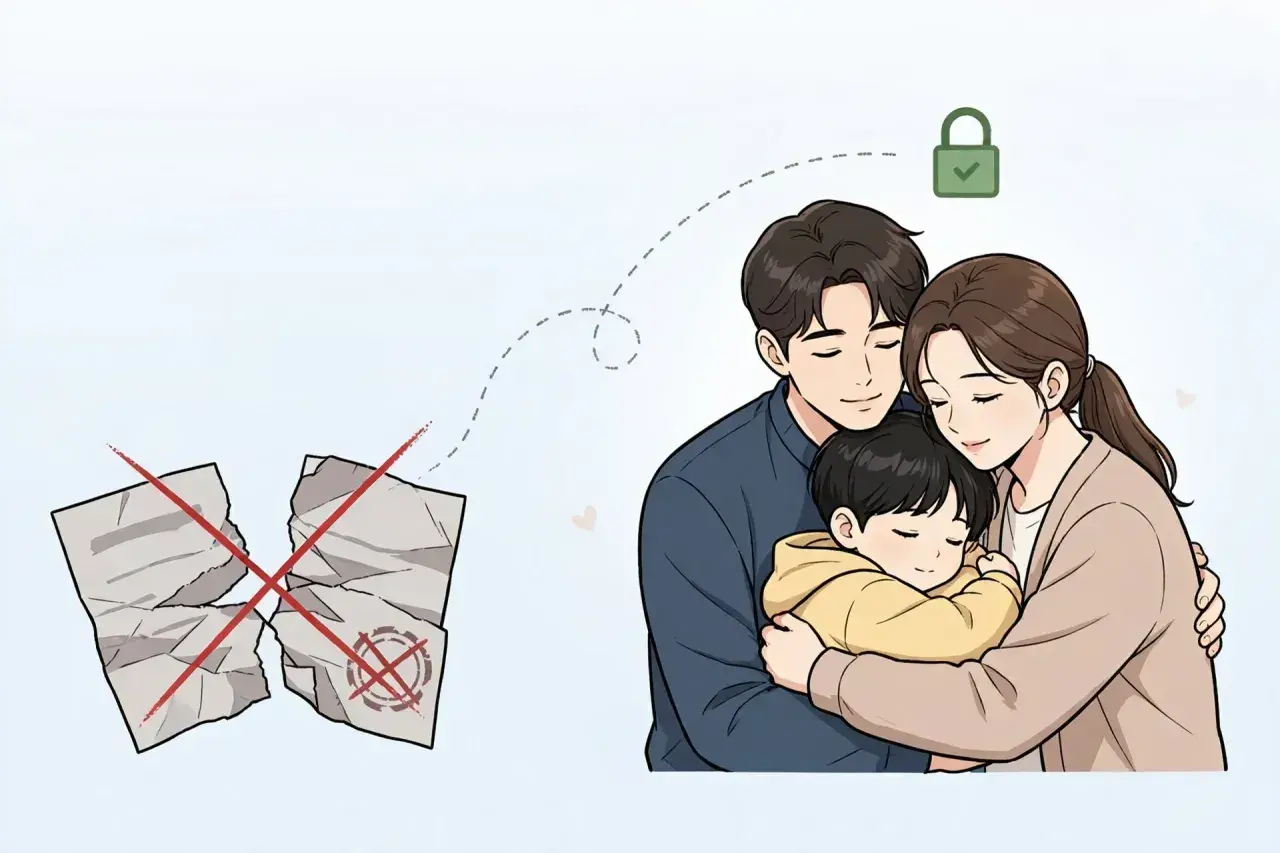
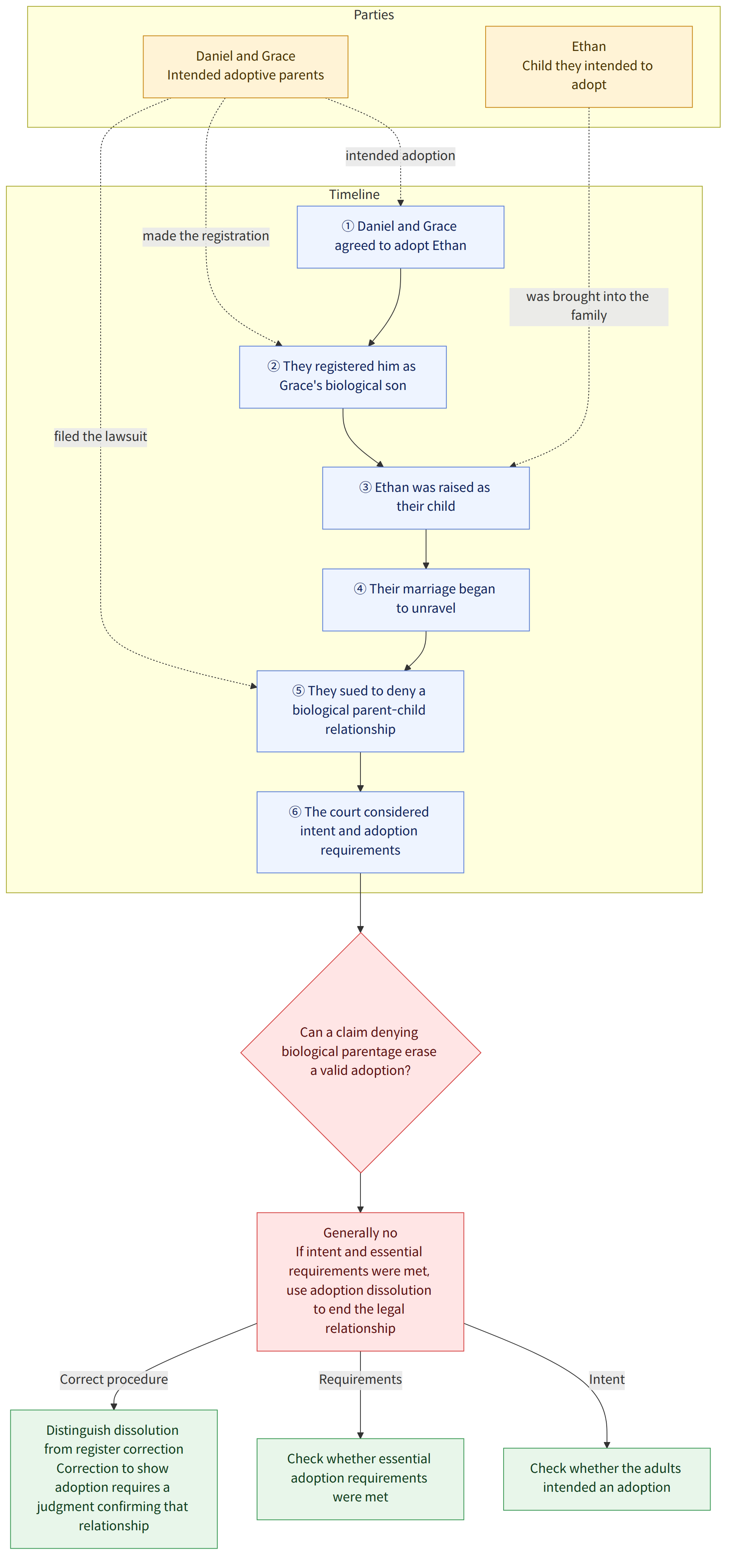
When Daniel and Grace Lee brought Ethan home, they had spent years hoping to raise a child. They agreed to adopt him, but instead of filing an adoption report, they registered him as though Grace had given birth to him. The family register showed Ethan as their biological son, even though everyone understood that he had joined the family through adoption.
For years, that distinction seemed like paperwork. Then the marriage began to unravel. Daniel and Grace decided they no longer wanted to be legally tied to Ethan and filed a lawsuit asking the court to confirm that no biological parent-child relationship existed. Their argument focused on the record: Ethan was not their biological child, so, they said, the entry should be removed.
But their claim blurred two different questions. Ethan was not their biological child; that did not necessarily mean he was not their legal child. The court had to consider whether the couple’s decision to adopt him had already created a legal parent-child relationship, despite the false description in the birth registration.
2. The Legal Question
Can adoptive parents who registered a child as their biological child later use a lawsuit denying a biological relationship to erase the legal relationship created by the adoption?
The answer is generally no if the parents intended to adopt the child and the essential legal requirements for adoption were satisfied. In that situation, the registration may operate as an adoption in law, and ending the relationship requires the proper adoption-dissolution procedure—not a claim that the parties are not biologically related.
3. What Korean Law Says
Korean courts look beyond the title or form of a document to the parties’ actual intent and the substance of what they did. A birth registration may be inaccurate as a statement of biology, yet still have legal effect as an adoption report when the adults intended to create an adoptive parent-child relationship and the adoption’s substantive requirements were met.
When parties intend to create an adoptive relationship and the substantive requirements for adoption are satisfied, a birth registration made in the wrong form can nevertheless take effect as an adoption. The resulting adoptive relationship has the legal substance of a parent-child relationship, except that it can be ended through adoption dissolution.
That principle has an important consequence: a lawsuit seeking confirmation that no biological parent-child relationship exists is not ordinarily a way to undo an adoption that was validly created. Such a claim challenges biological parentage; it does not substitute for the legal process for dissolving an adoptive relationship.
The key points are:
- Intent matters. Did the adults intend to take the child as their own through adoption, rather than merely make an inaccurate entry?
- The adoption requirements matter. The court examines whether the essential legal conditions for adoption were present.
- The legal relationship matters more than the label. If the registration functioned as an adoption report, the relationship may be legally adoptive even though the family register describes the child as biological.
- Ending and correcting are different tasks. Adoption dissolution concerns whether the legal relationship continues. A family-register correction concerns how that relationship is recorded.
Korean family-registration guidance also distinguishes these procedures. Where a false birth registration is to be corrected to show an adoptive relationship, a judgment confirming the existence of the adoptive relationship is required. A dissolution judgment alone is not the route for changing the register from a biological relationship to an adoptive one.
A false description of how a family relationship began does not, by itself, make the legal relationship disappear. The proper legal procedure depends on whether the issue is the existence of the adoption, its termination, or the accuracy of the register.
4. How Korean Courts Approach This
Korean courts generally focus on whether a real adoption took place in substance. If the adults intended to adopt the child and the adoption’s essential requirements were fulfilled, courts treat the incorrectly styled birth registration as capable of creating an adoptive relationship. The fact that the register calls the child biological does not automatically turn the adoption into a legal nullity.
Courts also distinguish between biological truth and legal parentage. A child can have no biological connection to the adults who raised them and still be their legal child by adoption. Once that legal relationship exists, a parentage nonexistence action cannot normally be used to bypass the procedures for ending it.
There may be special circumstances requiring a court to address whether a legal parent-child relationship exists, and the outcome depends on the facts. But where the facts show a genuine intention to adopt and the required elements were present, the usual route is not to erase the relationship through a biological-parentage lawsuit. It is to pursue adoption dissolution under the applicable rules.
5. Applying the Law to the Case
The court would likely analyze Daniel and Grace’s situation in several steps.
- It would identify their intention when Ethan joined the family. They had decided to take Ethan as an adopted child. The false birth registration was used as the form of recording that family relationship; it was not evidence that they believed Grace had actually given birth to him.
- It would ask whether the adoption’s essential requirements were met. The facts say that Daniel and Grace brought Ethan into their family as their child through adoption. If the required substantive conditions were satisfied, the registration could have legal effect as an adoption despite its inaccurate description.
- It would identify the relationship the registration created. On those facts, Ethan’s entry in the register may have served as the formal record of an adoptive relationship. The legal issue is therefore not simply whether he is biologically related to Daniel and Grace. He is not—but he may still be their legal child.
- It would consider what the lawsuit actually asks the court to do. Daniel and Grace sought to remove the legal parent-child relationship by claiming that no biological relationship existed. That claim does not ordinarily undo an adoption that took effect in law. Their wish to end the relationship does not change the procedure required to do so.
- It would separate dissolution from record correction. If Daniel and Grace want to end the adoption, they must use the legally available adoption-dissolution process. If the family register must then be brought into line with the legal status, that is a separate registration issue handled through the appropriate procedure.
On these facts, the court would generally reject the attempt to use a biological-parentage nonexistence action as a substitute for adoption dissolution. The result could differ if the essential requirements for adoption were not satisfied or if other exceptional circumstances were established, but the stated facts point to a genuine adoption recorded in the wrong form.
If you are dealing with a similar issue, attorney Ji-sun Ahn of Ijun Law Firm can review the birth and family registration records, any adoption order or consent, and the child’s current living arrangements with you. These details can help clarify which options apply to your situation.
6. Conclusion: What Happened, and What Should You Do?
Daniel and Grace’s lawsuit would not ordinarily end their legal relationship with Ethan. Because they intended to adopt him and the adoption’s substantive requirements were met, the birth registration could operate as an adoption in law. A court would generally not allow them to erase that relationship simply by establishing that Ethan was not their biological child.
If they wished to end the relationship, they would need to pursue the proper adoption-dissolution procedure. Any correction to the family register would then need to follow the rules for recording the legal status; it would not be accomplished simply by relabeling the adoption as a biological-parentage dispute.
For readers facing a similar situation:
- Get advice before filing. Ask a Korean family-law professional to assess whether the original registration created a valid adoption and which dissolution procedure applies.
- Keep the issues separate. A lawsuit about biological parentage, a proceeding to dissolve an adoption, and a request to correct the family register serve different purposes.
- Gather the original records. Preserve documents and evidence showing the parties’ intentions, the circumstances of the child’s placement, and what was filed. These facts may determine whether the relationship was legally created and how it can be changed.

















