
1. A Human Story
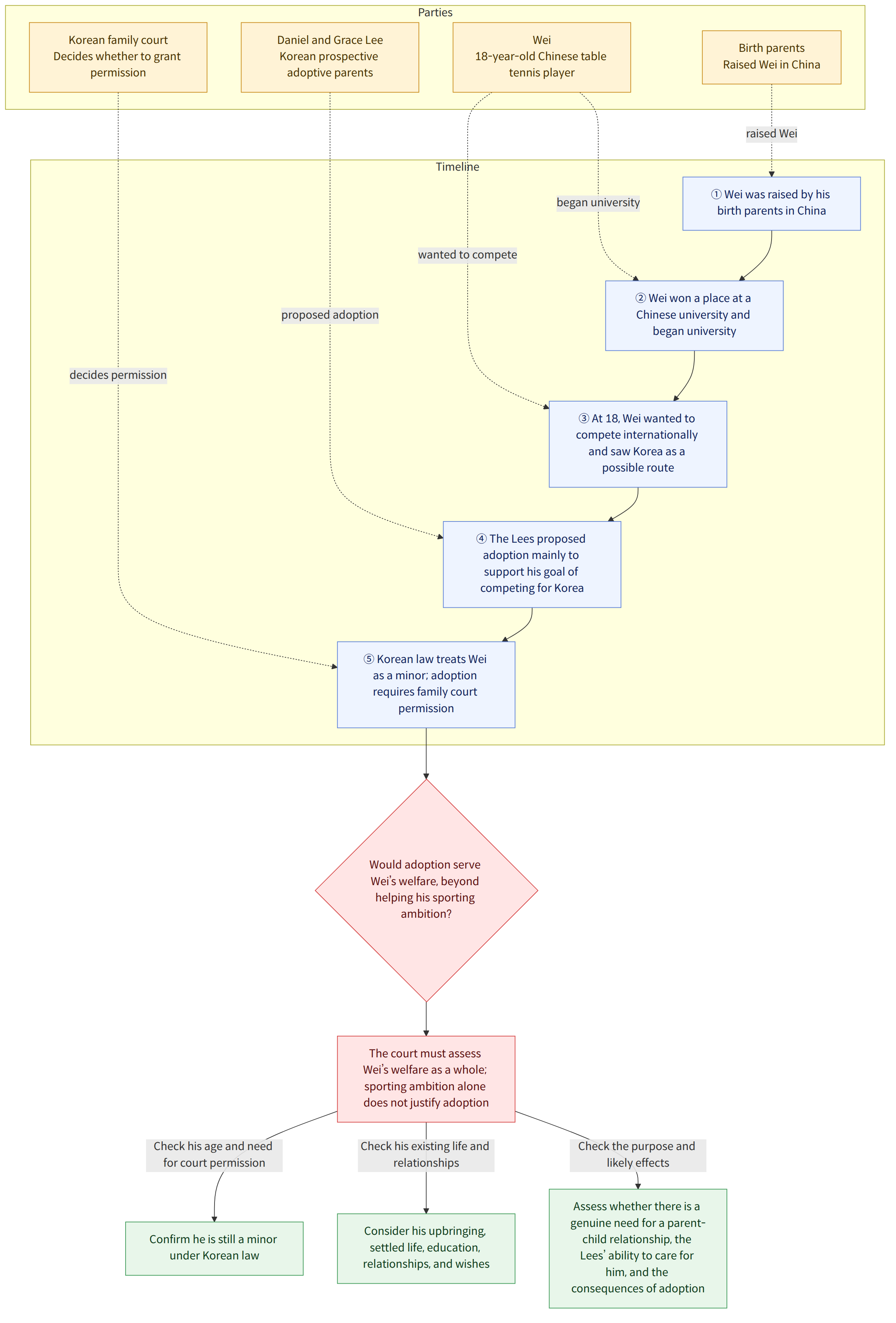
When Lin Wei won a place at a Chinese university, his parents celebrated with him. He had grown up in China with their care, built a life among friends and teammates, and developed into an unusually gifted table tennis player. At 18, he was already thinking beyond university: he wanted to compete on the international stage, and he believed Korea might offer a route to that ambition.
Daniel and Grace Lee, a Korean couple who admired Wei’s talent and wanted to help, proposed adopting him. They hoped that becoming their son could help him pursue the possibility of competing for Korea. Wei was enthusiastic too. The plan sounded like a practical answer to a difficult sporting obstacle—but it would also make a profound change to the legal and personal ties of a young man who had so far been raised by his birth parents and was beginning university.
2. The Legal Question
Can a Korean family court approve the adoption of an 18-year-old foreign national when the main reason for adopting him is to help him compete for Korea, even though he has been raised successfully by his birth parents and has recently begun university in his home country?
3. What Korean Law Says
Under Korean law, a person remains a minor until reaching the age of 19. So, although Wei is 18, he is still a minor for this purpose. An adoption of a minor requires permission from the family court.
Civil Act, Article 867(1): A person who wishes to adopt a minor must obtain permission from the family court.
The court is not required to approve an application simply because the prospective parents and the young person want the adoption. It must consider whether the adoption serves the minor’s welfare, taking account of the circumstances surrounding the child and the proposed family.
Civil Act, Article 867(2): In deciding whether to grant permission, the family court may consider the minor’s circumstances and upbringing, the reasons for the adoption, the prospective adoptive parents’ ability to care for the minor, and other relevant matters. It may refuse permission if adoption is not consistent with the minor’s welfare.
In practical terms, the court’s inquiry may include:
- The young person’s existing life: who has raised them, whether they are safe and settled, and what relationships and plans they already have.
- The reason for adoption: whether it responds to a genuine need for a parent-child relationship or is primarily intended to achieve another objective.
- The proposed parents’ circumstances: whether they can provide appropriate care and support.
- The consequences for the young person: whether the adoption would protect or disrupt their interests, relationships, and future.
The court’s focus is not whether adoption would be useful to the adults or helpful to a sporting career. It is whether this particular adoption would benefit the minor as a whole person.
4. How Korean Courts Approach This
Korean courts treat the minor’s welfare as the central consideration, rather than treating adoption as a private agreement that a court must simply confirm. The applicants’ intentions matter, but the court examines what those intentions mean for the young person and how the adoption fits with the life they already have.
A court may be especially cautious where the young person has been raised without difficulty by their birth parents, has established social relationships, and is pursuing education in their own country. If the main purpose is to enable international sports participation or facilitate a change in nationality, the court may find that this objective does not, by itself, justify the lasting change adoption would make to the person’s family status and existing life.
A young person’s strong sporting ability and sincere desire to compete for another country do not automatically make adoption consistent with their welfare. The court must weigh those wishes against the young person’s upbringing, relationships, and broader needs.
That does not mean a young person’s wishes are irrelevant. Their views and ambitions can be important. But they are part of the welfare assessment—not a substitute for it.
5. Applying the Law to the Case
The court would likely approach Wei’s application step by step.
- Wei is still a minor. At 18, he has not yet reached the age of majority in Korea. The Lees therefore need the family court’s permission; their agreement with Wei cannot complete the adoption on its own.
- The stated purpose raises a serious concern. The Lees want to adopt Wei mainly to help him compete internationally for Korea. That may be an understandable sporting ambition, but the court can distinguish between a desire to support an athlete and a need for a new parent-child relationship. On these facts, the sporting objective would not itself establish that adoption is in Wei’s interests.
- Wei already has a stable family and social foundation. He has been raised by his birth parents in China without significant problems and has recently entered university there. Those facts suggest that he already has parental care, an established community, and an educational path. The court would consider whether adoption could damage or unsettle those ties.
- His wishes and talent count, but they do not decide the case. Wei’s commitment to table tennis and his desire to compete for Korea are meaningful. Still, the court must look beyond his athletic potential and assess whether adoption benefits his welfare in the broader sense.
- The overall balance points against approval. If there is no additional, compelling reason for a new legal parent-child relationship, the court may conclude that the adoption would impose substantial personal consequences without meeting a genuine need in Wei’s life. On these facts, the sporting and nationality-related aim is unlikely to outweigh his stable upbringing and existing connections.
If you are dealing with a similar issue, attorney Ji-sun Ahn of Ijun Law Firm can review the birth and family registration records, any adoption order or consent, and the child’s current living arrangements with you. These details can help clarify which options apply to your situation.
6. Conclusion: What Happened, and What Should You Do?
In this fictional case, the family court denies the Lees’ application. It recognizes Wei’s talent and his determination to compete for Korea, but concludes that adoption is not shown to serve his welfare when he has grown up safely with his birth parents, has established relationships in China, and has just begun university there. The court is not deciding whether Wei should pursue table tennis abroad; it is deciding whether changing his legal family relationships through adoption is justified for his benefit.
Anyone considering a similar application should keep three points in mind:
- Be candid about the purpose. Explain the real reasons for adoption and be prepared to show how it would benefit the young person beyond a sporting, immigration, or nationality objective.
- Document the full circumstances. The court will need a clear picture of the young person’s upbringing, existing family relationships, education, wishes, and care arrangements.
- Explore the right route for the goal. Before considering adoption, seek advice from qualified Korean legal counsel and the relevant sports or immigration authorities about lawful options for competition eligibility and nationality. Adoption should not be treated as a shortcut.

















