

1. A Human Story
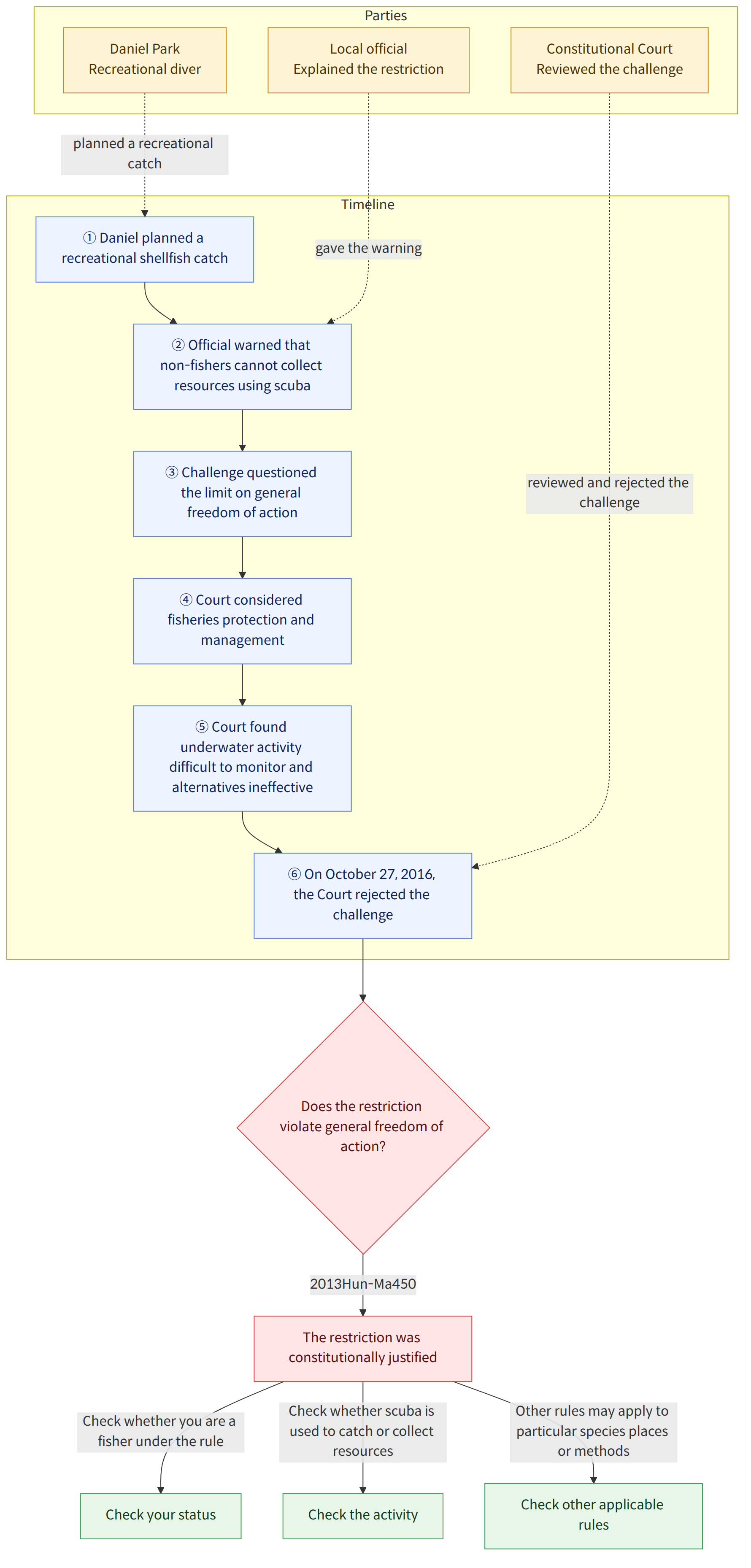
On a clear Saturday morning off Korea’s southern coast, Daniel Park zipped into his wetsuit and checked his scuba gear. He was not a commercial diver, and he had no plan to sell anything. He hoped to bring home a few shellfish for dinner, treating the outing as part of a long-standing hobby.
Before he entered the water, a local official told him that, as someone who was not engaged in fishing, he could not use scuba equipment to catch or collect marine resources. Daniel was baffled. He understood why endangered species or commercial stocks might need protection, but he wondered why a modest recreational catch should be forbidden altogether. Wasn’t that an excessive limit on ordinary freedom?
2. The Legal Question
The issue is whether Korea may bar non-fishers from catching or collecting marine resources with scuba-diving equipment, including for recreation or personal consumption, without violating the constitutional right to general freedom of action.
3. What Korean Law Says
Korea’s Fisheries Resources Management Act Enforcement Rule, Article 6, prohibits people who are not fishers from using scuba-diving equipment to catch or collect fisheries resources. The restriction concerns the use of scuba equipment for taking marine resources; it does not, by itself, mean that every form of diving or every underwater activity is prohibited. Other rules may also apply to particular species, places, or methods.
The constitutional question is assessed through the principle of proportionality. In accessible terms, a restriction on freedom must pursue a proper public goal, be capable of advancing that goal, avoid unnecessary interference where a workable less restrictive measure exists, and strike a fair balance between individual freedom and the public interest.
The Constitutional Court has treated the protection and effective management of fisheries resources as a legitimate public purpose. It has also recognized that a recreational motive does not, on its own, remove an activity from reasonable regulation.
The Court’s reasoning focused on practical enforcement. A person underwater with scuba equipment may be difficult to detect from the surface, can remain submerged for a considerable time, and may be hard to monitor closely. That can make it difficult for authorities to determine what was collected, how much was taken, or where the activity occurred.
The Court concluded that allowing scuba use while restricting only particular tools, species, quantities, or locations would not provide an effective alternative. It found that the restriction met the constitutional requirement of using no more restrictive a measure than necessary.
In a decision dated October 27, 2016, in case 2013Hun-Ma450, the Constitutional Court rejected the challenge to the rule. Its conclusion was not that the rule imposes no burden. Rather, it found the burden constitutionally justified in light of the difficulty of monitoring scuba-based collection and the importance of managing fisheries resources.
4. How Korean Courts Approach This
Korean courts generally do not decide proportionality disputes by asking only whether a particular person intended to do harm. They examine how a rule operates in practice and whether the government’s chosen approach is reasonably connected to its public purpose.
In this context, the Court focused on the problem of enforcement across many individual divers—not simply on whether Daniel would take a small amount. If officials allowed scuba use but tried to regulate only the species collected, the quantity, or the location, they would still need a practical way to observe and verify underwater conduct. The Court considered that control difficult to achieve.
The decision also reflects a broader judicial principle: when a less restrictive alternative would be ineffective in real-world conditions, the Constitution does not necessarily require the government to adopt it. The Court therefore found that the ban did not unconstitutionally violate the general freedom of action.
5. Applying the Law to the Case
Applying the proportionality analysis
Daniel’s recreational purpose is relevant to how he views the rule, but it does not create an exception under the restriction described here. The rule applies to non-fishers using scuba equipment to catch or collect fisheries resources; it is not limited to commercial harvesting.
The conservation and management of fisheries resources supply the public purpose. The restriction is also connected to that purpose: limiting scuba-based collection addresses an activity that officials may struggle to observe and regulate while it is happening.
The harder question is whether a narrower rule could work. Daniel might propose allowing small personal catches while banning commercial-scale activity, or permitting collection of some species but not others. The Constitutional Court considered similar possibilities and concluded that, with scuba equipment, such limits would be difficult to enforce effectively. Authorities could have trouble confirming what a diver collected, how much was taken, and whether the diver complied with a location or species restriction.
That reasoning answers Daniel’s constitutional objection even though his own intended catch may be small. The Court assessed the practical design of the rule, not only the intentions of an individual hobbyist. On the facts described, Daniel’s argument that the ban is unconstitutional simply because he is acting for recreation or personal consumption is unlikely to succeed.
What the ruling means for Daniel
Daniel should not enter the water intending to collect marine resources with scuba equipment on the assumption that a small personal catch is exempt. If he has already received a warning or notice, the precise wording matters: he should identify the rule cited, the conduct alleged, and the location and equipment involved. Those details can show whether the restriction actually applies and whether any separate issue needs to be addressed.
If you have received a warning or notice like the one Daniel faced, attorney Ji-sun Ahn of Ijun Law Firm could review the document alongside the details it records about your equipment, location, and conduct, and help you understand what issue it raises.
6. Conclusion: What Happened, and What Should You Do?
Daniel put his collecting gear away and continued to dive without taking marine resources. He could still question whether the rule applied to particular facts, but the broad constitutional argument he had in mind—that a recreational, non-commercial purpose makes the scuba restriction excessive—had already been rejected by the Constitutional Court. The court’s central concern was that allowing scuba-based collection while relying on narrower limits would be too difficult to monitor effectively.
For readers in a similar position:
- Check the rule before collecting anything. Confirm whether you are treated as a fisher, what equipment you plan to use, and whether the species or location is subject to additional restrictions.
- Read any warning or notice closely. Keep a copy and note the date, location, equipment, and conduct described. Do not assume that a small catch or personal use creates an exemption.
- Get advice based on the actual facts. If you receive a notice or believe the rule has been applied incorrectly, have the relevant document and a clear account of what happened reviewed before deciding how to respond.

















