

1. A Human Story
Daniel and Grace Lee had spent months choosing a name for their daughter. They settled on a name with a sound they loved and a particular Chinese character that carried a family meaning. At the district office, however, they learned that the character was not among those permitted for official registration. The clerk explained that the name could not be entered in the family register with that character.
The Lees felt that a small but intimate choice had been taken out of their hands. They wondered whether the state could really restrict the characters parents use when naming a child—and whether insisting on a government-approved list violated their freedom to choose a name. The answer turns on an important distinction: what a family may call its child in everyday life, and what the public registration system must be able to record and use.
2. The Legal Question
May Korean law limit the Chinese characters that can appear in a child’s official registered name, or does that restriction unconstitutionally interfere with a parent’s freedom to name the child?
3. What Korean Law Says
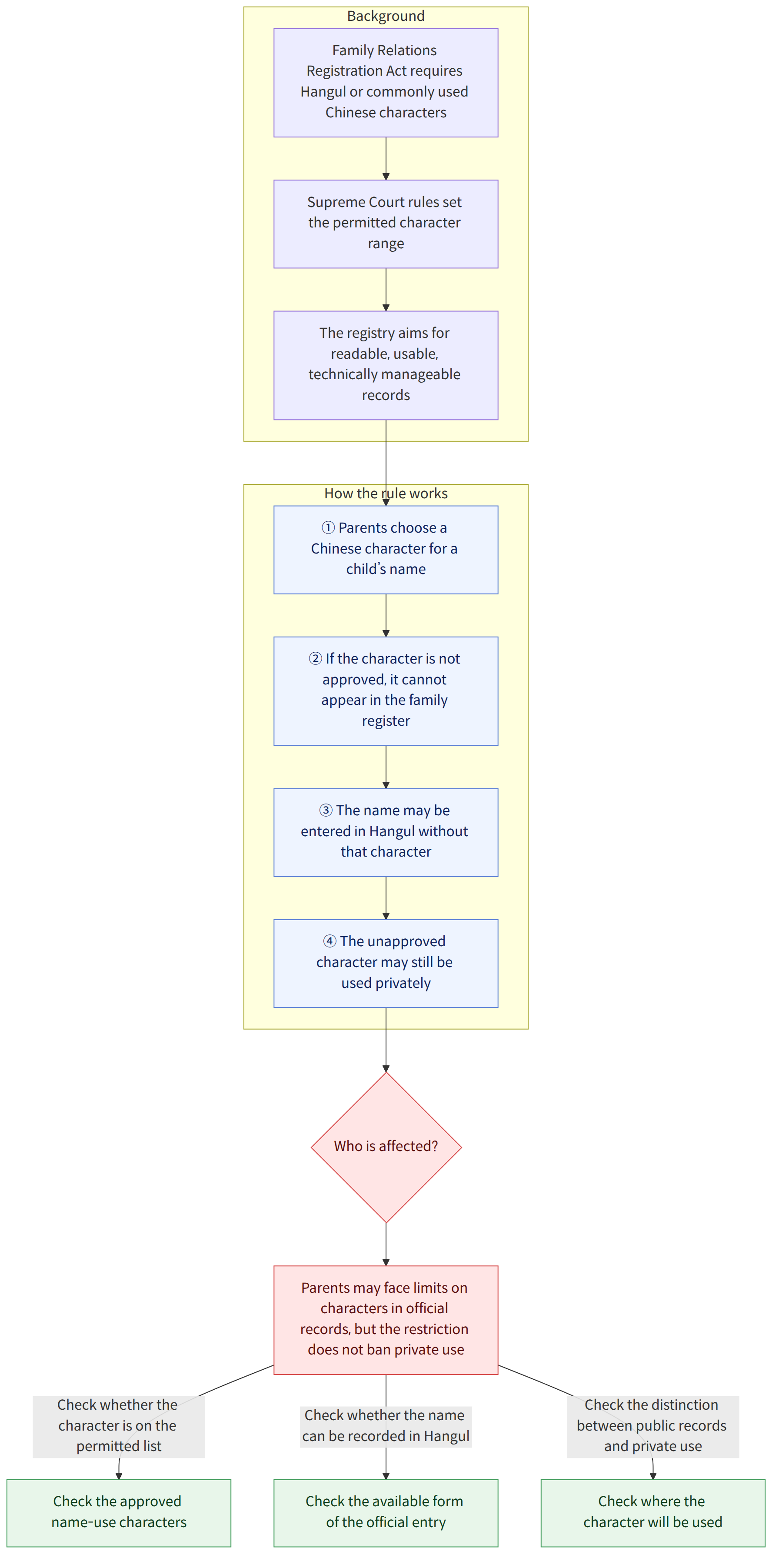
Korea’s Family Relations Registration Act provides that a child’s name must be written in Hangul or in Chinese characters commonly used for names. The detailed range of permitted characters is set by Supreme Court rules.
Under Article 44(3) of the Family Relations Registration Act, a child’s name must use Hangul or commonly used Chinese characters, with the permitted range determined by Supreme Court rules.
The approved characters are often referred to as the “name-use characters.” The list is intended to make official names readable and usable in government records, rather than to dictate every name a family may use in private. The Constitutional Court has recognized several considerations behind the restriction:
- Chinese characters are numerous, and the boundaries of the full set are difficult to define.
- Many people are less familiar with Chinese characters, making rare or obscure characters harder to recognize and use in legal and social dealings.
- Public registration systems need to store and display names consistently; adding every possible character can be technically and administratively impractical.
- The approved list is not necessarily fixed forever. The Court noted that it can be expanded through established procedures.
- If a chosen character is not approved, the child’s birth registration or name is not automatically rejected. Instead, the family register may record the name in Hangul without the character.
- The registration restriction does not itself prohibit using the unapproved character in private life, outside the family register and related public records.
The Constitutional Court’s central reasoning is that limiting characters in official records can be justified by the need for legible, usable, and technically manageable registration. The restriction does not erase the family’s ability to use the character privately.
4. How Korean Courts Approach This
Korean courts weigh the personal importance of naming a child against the public need for a registration system that can reliably identify people. A name is closely connected to identity and personal life, so a limit on naming choices deserves serious consideration. But the courts also recognize that a public registry serves everyone who must read, process, or rely on its records.
In a constitutional challenge to the character restriction, the Constitutional Court accepted that the legislature could draw a boundary around the characters used in official registration. It pointed to the size and uncertain limits of the broader Chinese-character set, the practical difficulties of using rare characters, the capacity of electronic records, and the substantial number of characters already permitted at the time of its decision. It also considered the possibility of expanding the list and the fact that an unapproved character can still be used privately.
The Court therefore did not treat the official list as a complete ban on a family’s preferred character. It viewed the rule more narrowly: the state may decide what its formal registration system can record, while leaving room for private use beyond that system.
5. Applying the Law to the Case
First, the character chosen by Daniel and Grace is not on the list permitted for official registration. Under the statutory rule, they cannot insist that the family register display that particular character as part of their daughter’s registered name.
Second, that does not necessarily mean the child cannot be registered under the name the parents chose. The key distinction is the form of the official entry. If the name can be entered in Hangul, the registry may record it in Hangul alone, without including the unapproved Chinese character. The restriction concerns the character in the public record, not an automatic rejection of the birth registration itself.
Third, the constitutional argument is unlikely to succeed simply because the parents prefer a character outside the approved range. The Constitutional Court has already considered the tension between naming freedom and the practical demands of public records. Its reasoning supports the view that an approved-character limit is a permissible administrative measure, particularly because the list can be expanded and private use is not prohibited.
Finally, the Lees retain a choice. They can use the Hangul form in the official register and continue using their chosen character in private, or they can select a character that appears on the permitted list if they want the Chinese character included in the public record. The legal consequence is therefore narrower than the parents first feared: the state controls what appears in the register, but does not generally control the family’s private use of the character.
6. Conclusion: What Happened, and What Should You Do?
The Lees’ constitutional objection would probably not overturn the character restriction. Their daughter’s name can be registered in Hangul, but the unapproved Chinese character will not appear in the family register. The parents may still use it in private settings. That result follows the distinction Korean law draws between a name’s official recorded form and the broader ways a family may express its identity.
For parents facing the same issue:
- Check the current approved list before settling on a character you want included in the official record.
- Ask the registration office to explain whether the name can be recorded in Hangul even if the chosen character is not approved.
- Keep copies of any registration notice or written explanation, and clarify whether you are challenging the name itself or only the character’s inclusion in the public register.
If the registration office has issued a notice or given an explanation about how your child’s name will be recorded, you can ask [[lawyer]] to review that document and the chosen character’s status. That review can help clarify whether the issue concerns the child’s registration itself or only the Chinese character in the official record.
If the registration office has issued a notice or given an explanation about how your child’s name will be recorded, you can ask attorney Ji-sun Ahn of Ijun Law Firm to review that document and the chosen character’s status. That review can help clarify whether the issue concerns the child’s registration itself or only the Chinese character in the official record.

















