
1. A Human Story
For ten years, Hannah Lee and Ethan Park had imagined what it might be like to raise a child. When they began the adoption process, they met Noah, an eleven-year-old boy whose surname was different from Ethan’s. Hannah and Ethan did not want Noah to feel like a visitor in their household. They hoped that, if he became their son, he could also take Ethan’s surname, Park.
The couple soon discovered that a shared surname is not simply a matter of preference or paperwork. Korean law distinguishes between different kinds of adoption, and the legal effect of one kind may be very different from another. Hannah and Ethan would need to understand which route could give Noah the family identity they hoped to build—and whether they were eligible to take it.
2. The Legal Question
Can a child adopted by a married couple who has a different birth surname take the adoptive father’s surname in Korea?
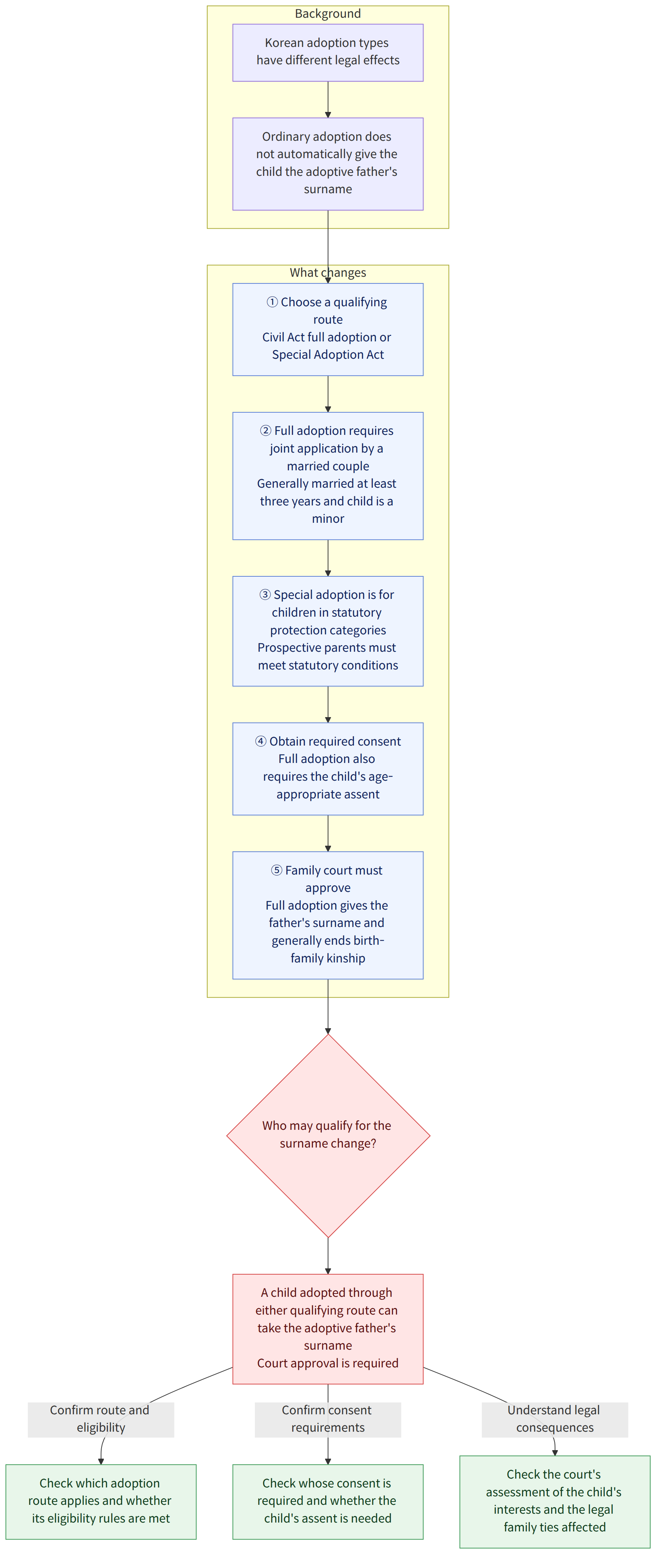
Yes, but not through every form of adoption. Under the legal framework addressed here, that result is available through a full adoption under the Civil Act, known as full adoption or chin-yangja adoption, or through an adoption under the Special Adoption Act. Each route has its own eligibility and consent requirements, and the family court must approve the adoption.
3. What Korean Law Says
The kind of adoption matters
Korean law does not treat every adoption as having the same consequences. In an ordinary adoption, the child generally does not automatically acquire the adoptive father’s surname simply because the adoption takes place. The routes that can give a child with a different surname the adoptive father’s surname are more consequential forms of adoption: a Civil Act full adoption or an adoption under the Special Adoption Act.
The central distinction: A shared surname is not an automatic consequence of every adoption. The adoption must fall within a legal category that gives the child the status and family-name consequences recognized by Korean law.
Full adoption under the Civil Act
A married couple seeking to adopt a child as a full adoptive child must generally meet the following requirements:
- They must apply jointly and have been married for at least three years. A separate exception applies when a spouse seeks to adopt the other spouse’s biological child.
- The child must be a minor.
- The child’s biological parents must consent, unless consent cannot be obtained for a legally recognized reason, such as a parent’s loss of parental authority or an unknown whereabouts.
- The child’s own assent is required in age-appropriate form. For a child aged thirteen or older, the child must consent to the adoption, with the legal representative’s approval. For a child under thirteen, the legal representative accepts the adoption on the child’s behalf.
- The family court must authorize the adoption. Meeting the formal requirements does not mean approval is automatic.
Once the court approves a full adoption, the child is treated as having been born during the adoptive parents’ marriage. The child takes the adoptive father’s surname and family origin (bon), and, as a general rule, the child’s legal kinship ties to the birth family end when the adoption becomes final. The law preserves a limited exception where one spouse adopts the other spouse’s biological child: the child’s kinship relationship with that spouse and that spouse’s relatives does not end.
A full adoption changes legal relationships, not just a name. It can sever the child’s former legal family ties, so the court must consider the child’s interests and the consequences of the change.
Adoption under the Special Adoption Act
The Special Adoption Act provides another route to the same surname outcome, but it is designed for children in need of protection—not for every child who might be adopted. The child must fit the statutory categories, which include certain children who have been separated from a caregiver, referred to a protected facility or adoption agency, or whose parents are unable to care for them in the circumstances recognized by law.
Prospective adoptive parents must also satisfy statutory conditions. These include having sufficient resources to care for the child, being able to provide appropriate upbringing and education, and having no disqualifying history involving specified forms of abuse, violence, sexual offences, drug offences, or substance addiction. Additional requirements may apply, including requirements for prospective adoptive parents who are not Korean citizens.
The adoption requires family-court approval and the relevant consent. Depending on the child’s circumstances, consent may be required from the biological parents or a guardian. A child aged thirteen or older must also consent. An adoption completed under this Act gives the child the same legal status as a Civil Act full adoption, including the corresponding family-name consequences.
The Special Adoption Act is not a shortcut for choosing a surname. The child must qualify as a child in need of protection, and the prospective parents must meet the Act’s requirements.
4. How Korean Courts Approach This
Korean family courts do not approach adoption as a transaction in which adults may select the legal status they prefer. Their central concern is the child’s welfare. A court examines whether the proposed adoption is legally available, whether the required consents have been obtained, and whether the placement and its lasting consequences serve the child’s interests.
That scrutiny matters especially in a full adoption because the change is substantial: the child is treated as the adoptive parents’ child born within their marriage, and the child’s prior legal kinship relationships generally end. A long marriage or a sincere wish to give the child a shared surname may help explain the family’s hopes, but neither fact alone guarantees approval.
The court also has to apply the requirements of the particular route. For example, a couple who have been married for ten years meet the marriage-duration threshold for a joint Civil Act full-adoption application, but they still need to adopt a minor, satisfy the consent rules, and obtain the court’s authorization. The Special Adoption Act, by contrast, is available only where the child meets its protection-related criteria.
5. Applying the Law to the Case
Hannah and Ethan have been married for ten years and want to adopt Noah jointly. Noah is eleven, so he is a minor and meets the age requirement for a Civil Act full adoption. Their marriage also exceeds the required three-year period.
The next question is consent. Noah is under thirteen, so the statutory rule calls for his legal representative to accept the adoption on his behalf. The biological parents’ consent is also generally required, unless an exception applies. The couple cannot bypass these requirements simply because they have already formed a close relationship with Noah or because they hope he will share Ethan’s surname.
The Special Adoption Act might also be relevant if Noah is legally a child in need of protection and the circumstances of his care fit that Act. But the fact that a child is being adopted does not, by itself, establish eligibility under that law. Hannah and Ethan should therefore confirm Noah’s legal circumstances with the responsible adoption professionals and authorities rather than assuming that the Special Adoption Act applies.
If the family court approves a Civil Act full adoption, the result is clear: Noah will be treated as Hannah and Ethan’s child born during their marriage and will take Ethan’s surname and family origin. This would also bring the broader legal consequences of full adoption, including the general termination of Noah’s legal kinship ties with his birth family. The court’s decision is therefore about much more than whether the household can share a name.
If you are dealing with a similar issue, attorney Ji-sun Ahn of Ijun Law Firm can review the child’s family registration, any adoption decision, and the grounds for applying to change the child’s surname with you. These details can help clarify which options apply to your situation.
6. Conclusion: What Happened, and What Should You Do?
In this fictional case, Hannah and Ethan’s ten-year marriage qualifies them to apply jointly for a Civil Act full adoption, and Noah’s age fits the statutory requirement for adoption of a minor. They proceed only after confirming the required consents and presenting their adoption plan to the family court. The court approves the full adoption. Noah becomes their legal child and takes Ethan’s surname, Park. The shared name reflects a legal change in family status—not merely a personal preference—and the adoption carries the broader consequences described above.
For readers considering a similar path:
- Identify the adoption route first. Ask whether the case is an ordinary adoption, a Civil Act full adoption, or an adoption under the Special Adoption Act; the child’s surname may depend on that distinction.
- Check eligibility and consent before making plans. Confirm the child’s age, the parents’ or guardian’s consent, and—where applicable—the child’s own consent and the Special Adoption Act’s protection-related criteria.
- Get advice on the full legal consequences and court process. A family-law professional or the relevant adoption authority can help explain what relationships will change and what evidence the family court may need.

















