
1. A Human Story
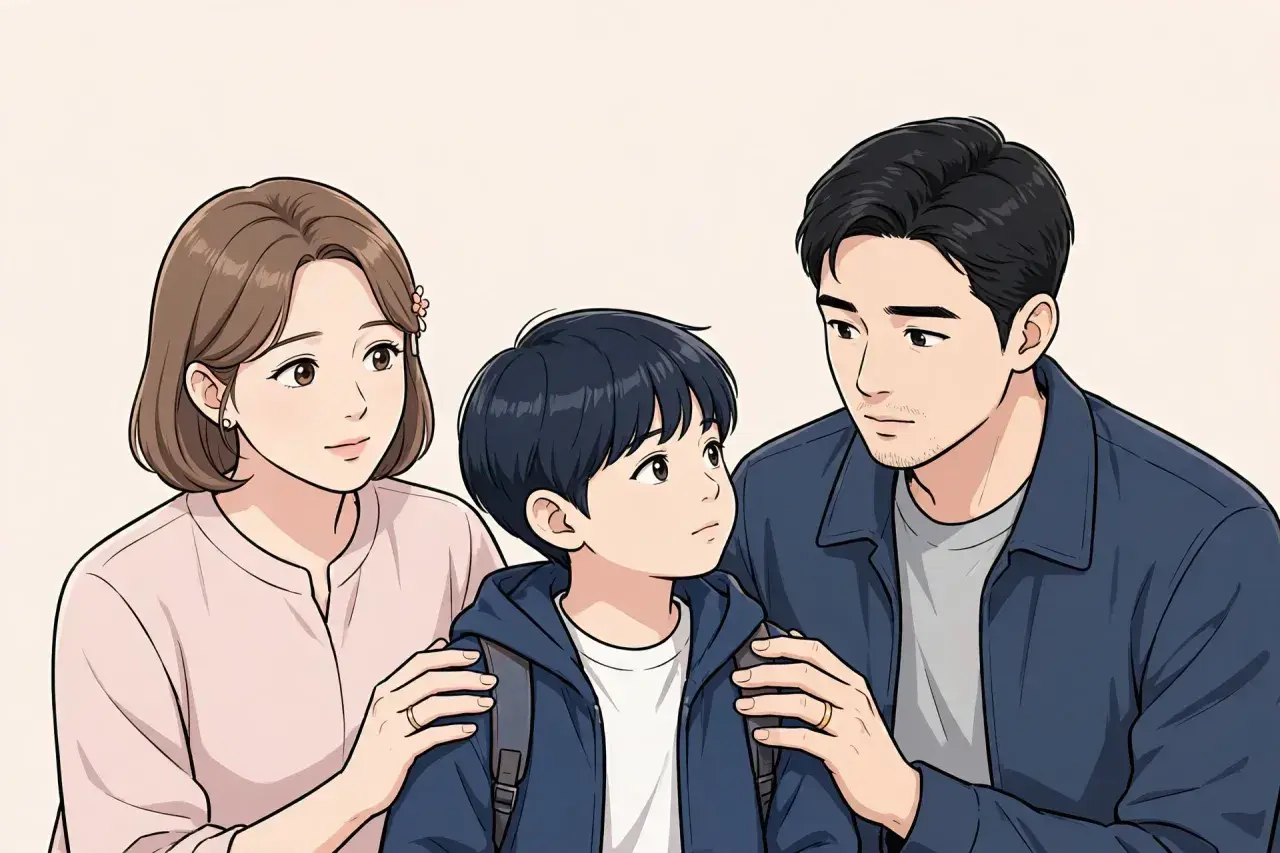
When Claire Morgan married Daniel Reed, she hoped the ceremony would mark a new beginning for all three members of their family. Her son, Ethan, had been born during Claire’s earlier relationship with a man who never acknowledged him as his child in law. Claire had registered Ethan’s birth as a child born outside marriage and had raised him herself.
Daniel was already part of Ethan’s daily life: packing his school lunch, helping with homework, and sitting beside him at medical appointments. He wanted to adopt Ethan so that their family bond would be recognized legally, not just understood at home. Claire supported the plan—but wondered whether the law would let her consent as Ethan’s mother if she and Daniel adopted him together.
2. The Legal Question
Can a woman who is adopting her own child jointly with her new husband also give the consent required for that child’s adoption? Or must the husband adopt alone, and does a court have to approve the adoption because the child is a minor?
3. What Korean Law Says
Korean adoption law distinguishes between the roles a person may hold in a family. A woman can be a child’s birth mother and, in the legal adoption process, also a prospective adoptive parent. In the situation described here, those roles do not automatically prevent her from giving the consent required for her child’s adoption.
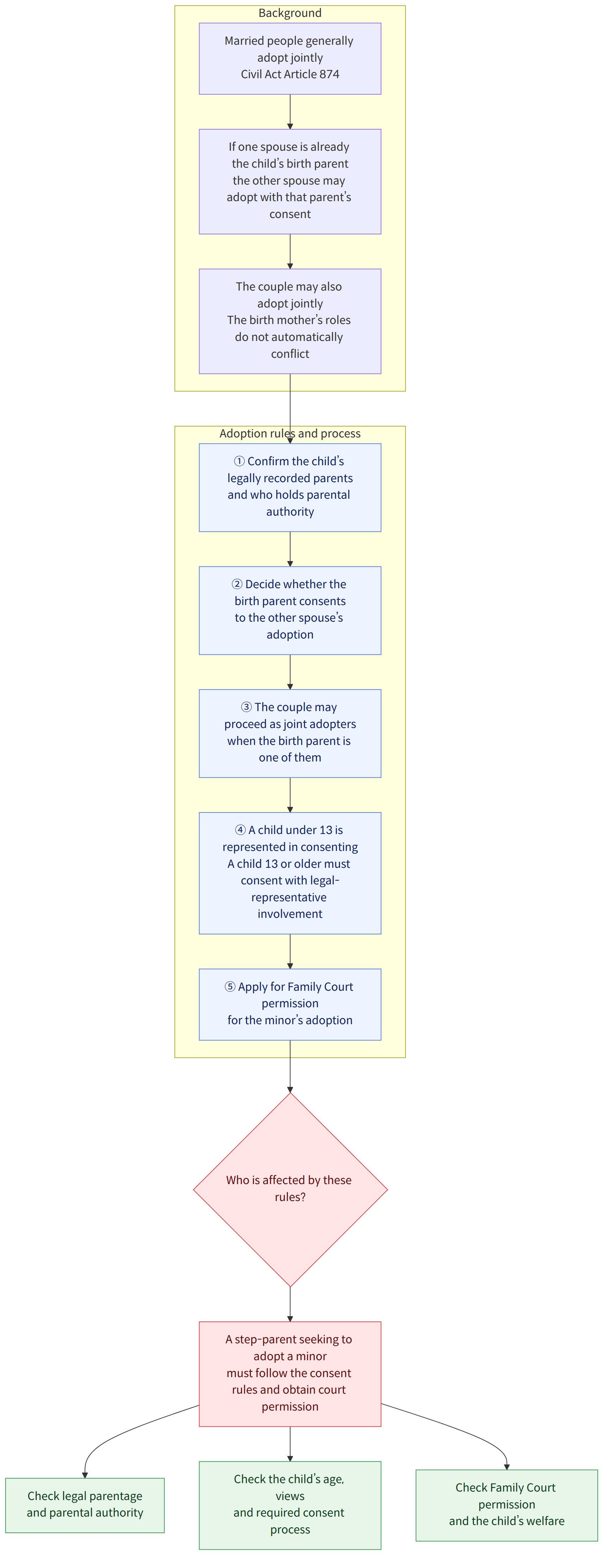
Under Civil Act Article 874, a married person generally adopts jointly with their spouse. But where one spouse is already the child’s birth parent, the other spouse may adopt the child alone with the birth parent’s consent. The couple may also adopt jointly.
That principle addresses a practical concern: a spouse should not be able to adopt a child who has no existing parent-child relationship with either spouse while bypassing the other spouse. But when one spouse is already the child’s legal parent, the family relationship is different. The birth parent’s consent can protect the child’s interests while the other spouse adopts.
Several further rules matter:
- A minor’s adoption requires Family Court permission. Korean law requires a person seeking to adopt a minor to obtain the court’s approval. The fact that the adopter is the child’s step-parent does not, by itself, remove this requirement.
- The child’s age affects how the child participates. Under the rules described in the Civil Act, a child under 13 is represented in consenting to the adoption; a child aged 13 or older must consent, with the required legal-representative involvement.
- The relevant parent’s legal status matters. If another person has legally established parentage or holds parental authority, that person’s consent may also be required. A past relationship with the birth mother alone does not necessarily make someone a legal parent, but legal recognition can change the analysis.
- The mother’s two roles are treated separately. A birth mother’s consent to her child’s adoption is not automatically an act of conflicting interests merely because she is also one of the proposed joint adopters. On that basis, appointing a special representative is not required solely for this reason.
The central distinction is between a biological relationship and the legal steps needed to establish or change family status. Before filing, the family should confirm who is legally recorded as the child’s parent and who holds parental authority.
4. How Korean Courts Approach This
Korean courts and family authorities focus on the purpose of the joint-adoption rule and the child’s legal and personal interests. The rule is meant to prevent instability—for example, one spouse creating an adoptive relationship without the other spouse’s agreement where neither spouse was already the child’s parent.
That concern is different when the child is already legally related to one spouse by birth. In that setting, the birth parent may consent to the other spouse’s adoption, and the couple may also proceed as joint adopters. The birth mother’s participation in one capacity does not automatically erase her ability to act in another capacity for purposes of the consent process.
For a minor, however, the court’s role is a separate safeguard. The family must apply for permission, and the court can consider whether the adoption serves the child’s welfare. The process is not simply a private agreement between the adults. The child’s age, views, existing legal relationships, and the circumstances of the proposed family arrangement can all be relevant.
5. Applying the Law to the Case
Claire and Daniel’s situation can be analyzed in a series of steps.
- Confirm Ethan’s legal parentage. Claire is recorded as Ethan’s mother. If his biological father has never legally acknowledged or otherwise established parentage, the facts differ from a case in which a second legal parent has parental rights. Claire should verify the birth and family records before proceeding.
- Choose the adoption structure. Daniel may seek to adopt Ethan alone, with Claire’s consent as Ethan’s birth mother. Alternatively, Claire and Daniel may apply to adopt Ethan jointly. The fact that Claire is already Ethan’s mother does not, by itself, make joint adoption impossible when Ethan was born outside marriage.
- Obtain the child’s required consent or assent. The steps depend on Ethan’s age. If he is under 13, the appropriate legal representative acts in the consent process. If he is 13 or older, his own consent is required along with the legally required representative involvement. The family should not treat this as a paperwork formality: Ethan’s understanding and wishes matter.
- Check for any other legal parent whose consent is required. If the former partner has legally established paternity or retains relevant parental authority, his consent may also be necessary. A historical rule concerning a mother who remarried after divorce illustrates the point: where the former husband remained a legal parent with parental authority, his consent could not simply be ignored. Claire’s facts must be checked rather than assumed to be identical.
- Apply to the Family Court. Because Ethan is a minor, Daniel—or the couple, if they choose joint adoption—must obtain Family Court permission. The step-parent relationship does not create an automatic exemption.
- Understand the special-representative issue. Claire is both Ethan’s birth mother and, if the couple choose joint adoption, one of the proposed adopters. Those are distinct legal positions. Her consent as Ethan’s mother is not treated as a conflict requiring a special representative merely because she is also an adopter.
If you are dealing with a similar issue, attorney Ji-sun Ahn of Ijun Law Firm can review the birth and family registration records, any adoption order or consent, and the child’s current living arrangements with you. These details can help clarify which options apply to your situation.
6. Conclusion: What Happened, and What Should You Do?
Claire and Daniel can pursue the adoption. They may ask the Family Court to approve Daniel’s adoption of Ethan, with Claire consenting as his birth mother, or they may seek joint adoption. Claire’s dual role does not, on its own, make her consent invalid or require a special representative. But the adoption cannot be completed for a minor without the required Family Court permission, and the family must establish whether anyone else is legally recognized as Ethan’s parent.
For families considering a similar step-parent adoption:
- Check the family records first. Confirm who is legally recorded as a parent and who holds parental authority; do not rely only on the history of the adults’ relationship.
- Prepare for the child’s involvement. Identify the consent requirements based on the child’s age and discuss the adoption with the child in an age-appropriate way.
- Plan for the court process. Gather the relevant family and identity documents and seek advice on the Family Court application, especially if another parent’s status or consent is uncertain.

















