

1. A Human Story
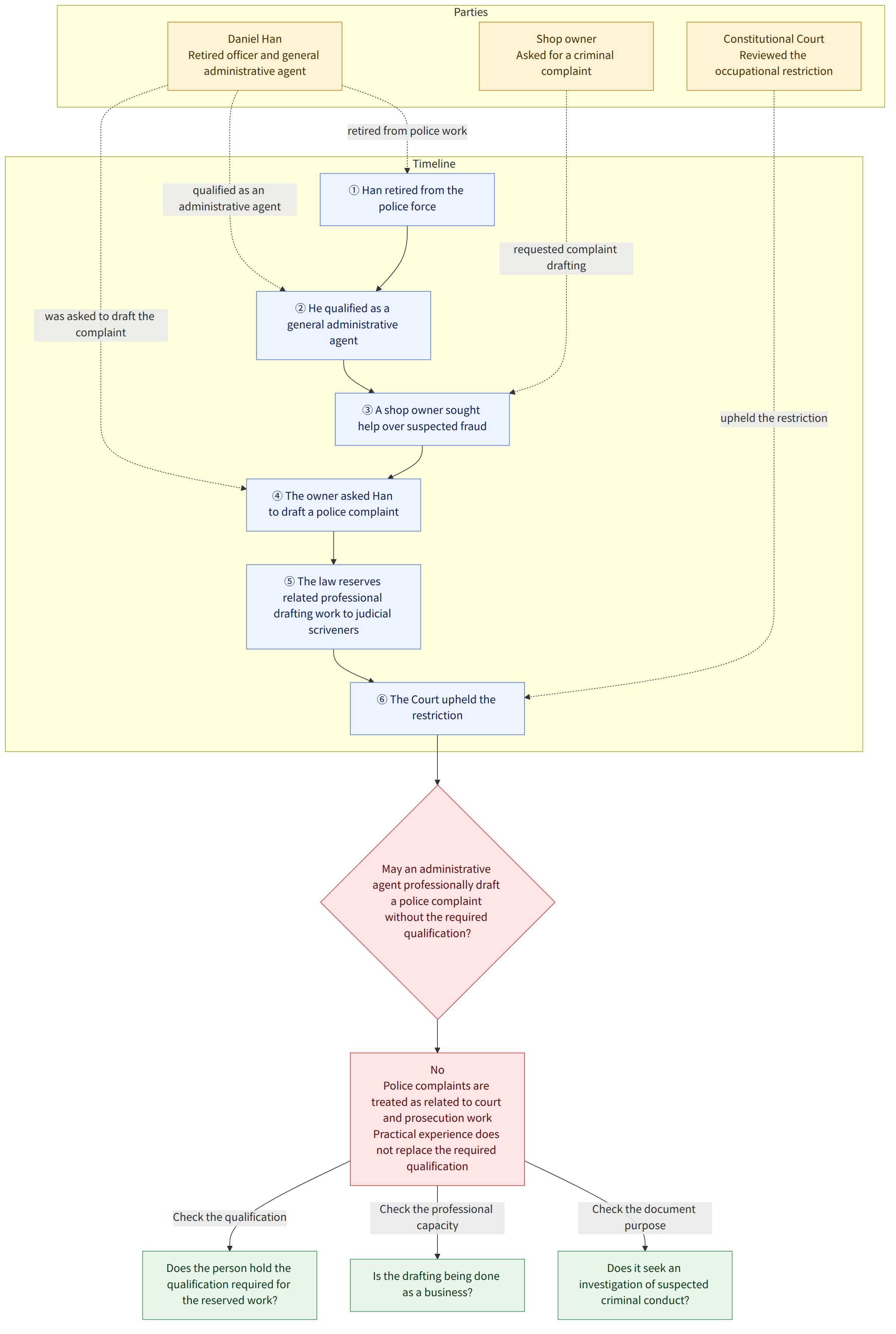
Daniel Han spent most of his career as a police officer. After retiring, he qualified as a general administrative agent and opened a small office, hoping to put his experience with public institutions to practical use. He helped clients prepare forms and documents for submission to government agencies.
One afternoon, a shop owner came to Daniel with a troubling account of suspected fraud. The owner wanted to file a complaint with the police and asked Daniel to write it. Daniel knew how police investigations worked and believed he could explain the events clearly. But the question was not only whether he could write a persuasive document. It was whether the law allowed him to make a business of drafting it.
2. The Legal Question
Can a retired police officer who works as a general administrative agent professionally draft a criminal complaint or accusation for submission to the police? And does reserving that work to judicial scriveners unlawfully restrict the administrative agent’s freedom to choose an occupation or treat the two professions unequally?
3. What Korean Law Says
Korean law distinguishes between documents an administrative agent may prepare and certain legal documents that are reserved to a judicial scrivener, known in Korean as a beopmusa.
The Judicial Scriveners Act defines the work that a judicial scrivener may perform for another person. It includes preparing documents submitted to courts and prosecutors’ offices, as well as preparing documents related to their work. A separate provision prohibits anyone who is not a judicial scrivener from carrying out those designated tasks as a business.
The statutory restriction is not limited to papers physically handed to a court or prosecutor. It also covers documents considered related to the work of courts and prosecutors.
A breach can carry criminal penalties. Under the Act, a non-judicial scrivener who conducts the reserved work as a business may face up to three years’ imprisonment or a fine of up to five million won. A person who commits the offence habitually may face up to five years’ imprisonment.
For a criminal complaint or accusation, the key points are:
- The document’s function matters. A criminal complaint asks public authorities to investigate suspected criminal conduct and is treated as connected to the work of the courts and prosecution system.
- The restriction concerns professional work. The law prohibits a non-judicial scrivener from taking on the reserved drafting work as a business; it does not turn every private act of writing about an alleged crime into a criminal offence.
- Past experience does not replace the required qualification. A person’s former occupation may provide relevant knowledge, but it does not itself authorize that person to perform work the statute reserves to another licensed profession.
4. How Korean Courts Approach This
The Constitutional Court has considered whether reserving the professional drafting of criminal complaints and accusations to judicial scriveners violates the occupational freedom or equality rights of general administrative agents. It upheld the restriction.
The Court’s reasoning focused on the different qualifications attached to the two professions. It considered that the statutory requirements for becoming a judicial scrivener provide a basis for treating that person as having the legal knowledge needed for court- and prosecution-related document work. The requirements for becoming a general administrative agent, by contrast, do not guarantee the same level of legal training.
In the Court’s view, limiting this work to judicial scriveners is a reasonable means of protecting the public’s legal interests and supporting the sound development of the justice system. The restriction therefore does not, by itself, violate an administrative agent’s occupational freedom or right to equality.
The ruling also means that a person cannot avoid the restriction simply by pointing to substantial practical experience. The legal question is whether the person holds the qualification the statute requires for the professional service at issue.
5. Applying the Law to Daniel's Case
Daniel’s situation follows the same legal path.
- Identify the requested document. The shop owner asked Daniel to draft a criminal complaint for submission to the police. Although the document would be delivered to a police station rather than directly to a court or prosecutor’s office, its purpose is to initiate a criminal investigation and it is treated as related to the work of the courts and prosecution system.
- Identify the capacity in which Daniel would act. Daniel was not merely describing his own experience or helping a friend informally. The client sought a professional service from Daniel’s administrative-agent office. If Daniel accepted such assignments as part of his business, he would be undertaking work reserved by statute to judicial scriveners.
- Consider Daniel’s former police career. His service may help him understand police procedures, but it does not give him the judicial-scrivener qualification. The constitutional reasoning rests on the licensing requirements established by law, not on a case-by-case estimate of how knowledgeable an individual agent may be.
- Consider the constitutional challenge. Daniel could argue that the restriction limits his ability to earn a living and is unfair to experienced former officers. But the Constitutional Court has already accepted the restriction as a reasonable way to protect clients and the justice system. His police background alone would not change that result.
The practical dividing line is therefore not Daniel’s ability to write well, nor the fact that the complaint is addressed to the police. It is that he would be professionally drafting a criminal complaint, a category of document treated as related to the work of the courts and prosecution system.
If a requested assignment or official notice leaves it unclear whether the service crosses that line, a review of the proposed service description and the relevant documents may help clarify the issue. You can ask [[lawyer]] to review those materials and explain what general legal options may be available.
6. Conclusion: What Happened, and What Should You Do?
Daniel declined the paid assignment to draft the shop owner’s criminal complaint. He could not rely on his former police service or his administrative-agent licence to take on work reserved to judicial scriveners, and the constitutional challenge he had considered would not remove that statutory boundary. The owner needed to seek help from a professional legally authorized to prepare the complaint.
For readers in a similar position:
- Check what the document is for, not only which office will receive it. A complaint sent to police may still be treated as related to the work of the courts and prosecution system.
- Review the scope of the paid service before accepting it. If the assignment involves drafting a criminal complaint or another reserved document, do not assume that experience in public service or another licence makes it permissible.
- Keep records of the request and your response. If the boundaries are unclear, get legal advice on the specific document and proposed work before proceeding.
If you have been asked to draft a criminal complaint, or have received a notice questioning work you performed, the wording of the engagement and the document itself may matter. You can ask attorney Ji-sun Ahn of Ijun Law Firm to review those materials and discuss the general legal options.
















