
1. A Human Story
Daniel Park had planned to vote on his way home from work. He had followed the campaign for weeks, arguing with friends about housing and wages, and even set an alarm so he would not miss the polling station. But Daniel was serving a three-year prison sentence. When election day came, he learned that he could not cast a ballot.
The restriction felt personal. Daniel accepted that he had been convicted and was being punished, but he wondered whether losing his freedom was not enough. Did a prison sentence also mean losing his place, however temporarily, in the country’s democratic life?
2. The Legal Question
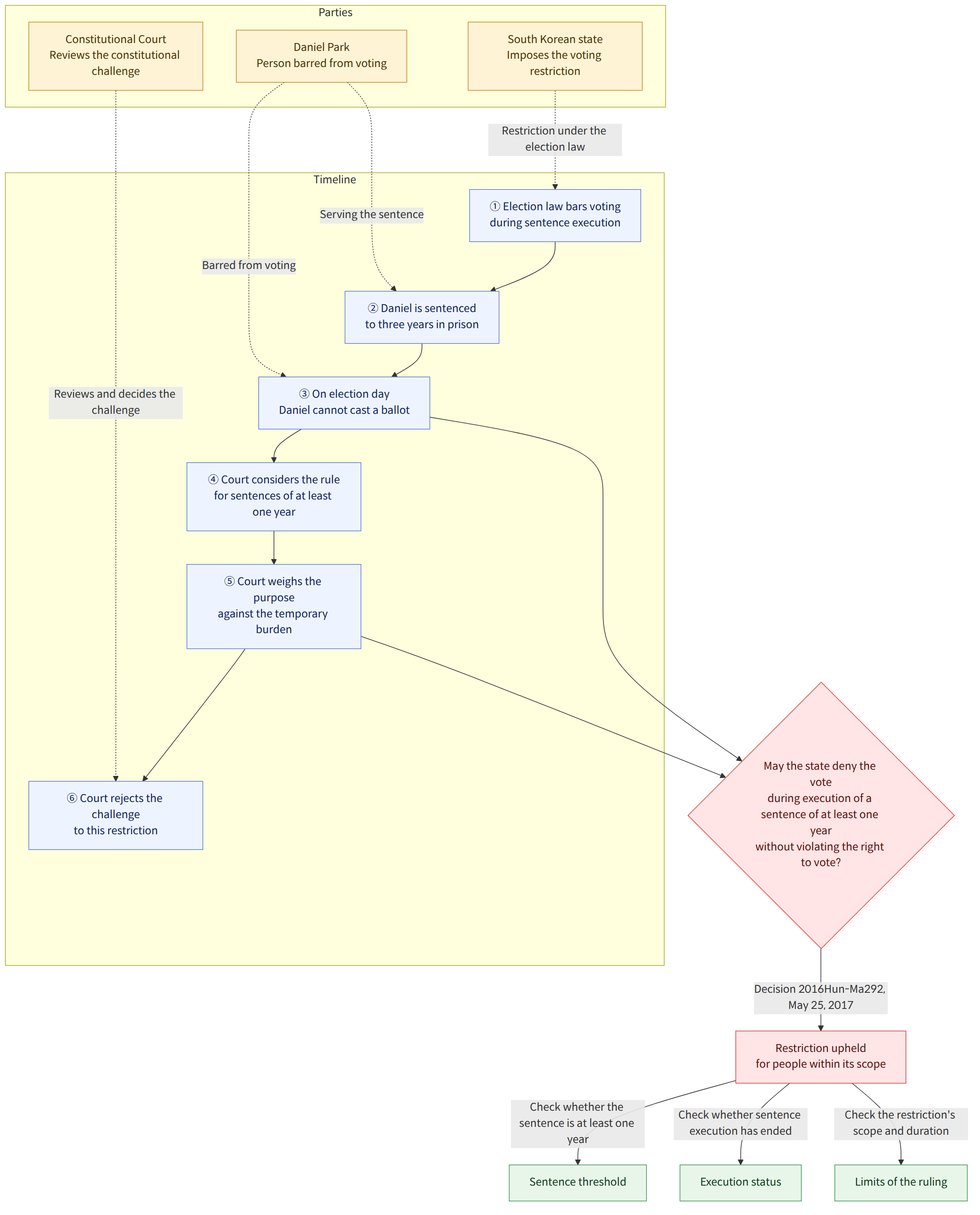
The central question is whether South Korea may deny the vote to someone sentenced to at least one year in prison for as long as that sentence is being executed, or whether doing so violates that person’s constitutional right to vote.
3. What Korean Law Says
The rule at issue was Article 18(1)(2) of the Public Official Election Act. As considered by the Constitutional Court, it withheld voting rights from people sentenced to imprisonment for one year or more while execution of their sentence remained unfinished.
The restriction applied because of both the length of the sentence and its status: the person had to have received a sentence of at least one year, and execution of that sentence had not yet ended.
The constitutional issue is not simply whether voting is important. It plainly is. The question is whether the state has a sufficiently strong reason to limit that right, and whether the restriction goes further than necessary.
The Court considered several points:
- The threshold: The rule applied to sentences of at least one year, rather than to every person convicted of an offence.
- The purpose: The restriction was intended to impose a social and criminal consequence for serious wrongdoing and to reinforce respect for the law.
- The duration: The voting restriction lasted while the prison sentence was being executed, rather than for a separate, fixed period extending beyond it.
- The balance: The Court weighed the individual’s temporary loss of the vote against the public interest in punishment and encouraging compliance with the law.
4. How Korean Courts Approach This
In a constitutional challenge, Korean courts assess whether a restriction serves a legitimate public purpose and whether the burden it imposes is proportionate. A law can pursue an important goal and still be unconstitutional if it sweeps too broadly or imposes a penalty out of proportion to that goal.
The Constitutional Court concluded that restricting the vote for people sentenced to at least one year in prison, during execution of their sentences, did not excessively infringe the right to vote. It reasoned that the length of the restriction corresponded to the period of punishment and that the public interest was not outweighed by the individual burden.
In its decision of May 25, 2017, in case 2016Hun-Ma292, the Court therefore rejected the argument that the provision violated the voting rights of a person in this position. The ruling concerned the particular statutory restriction before the Court; it should not be read as saying that every voting restriction, whatever its scope or duration, would be constitutional.
5. Applying the Law to the Case
Daniel’s situation falls within the rule the Court upheld, assuming the relevant facts are as described.
- His sentence meets the threshold. Daniel was sentenced to three years in prison, more than the one-year minimum considered by the provision.
- The sentence is still being executed. He is currently serving it, so execution has not ended. The restriction is tied to that status.
- The Court recognized a public purpose. It accepted that the state may treat the loss of voting rights during the execution of a sufficiently serious prison sentence as part of the social and criminal consequences of the offence, and as a means of reinforcing respect for the law.
- The restriction ends with sentence execution. Under the reasoning in the decision, Daniel does not lose his vote indefinitely under this rule. The restriction lasts while the sentence is being executed, a period the Court regarded as proportionate to the punishment.
- The constitutional challenge is therefore unlikely to succeed on these facts. The Court has already concluded that the provision does not violate the voting rights of people within its scope.
The result is difficult for Daniel: his interest in voting is real, but the Court’s balancing of that interest against the public purpose of the restriction came down in the state’s favour.
If you are dealing with a similar issue, attorney Ji-sun Ahn of Ijun Law Firm can review the provision applied in your case, the ruling or notice you received, and the dates relevant to challenging it with you. These details can help clarify which options apply to your situation.
6. Conclusion: What Happened, and What Should You Do?
Daniel could not vote while he was serving his three-year sentence under the restriction considered by the Constitutional Court. The Court held that this limit did not unconstitutionally infringe his right to vote because it applied to sentences of at least one year, lasted during execution of the sentence, and served purposes the Court considered sufficiently important.
For readers facing a similar situation:
- Check the exact sentence and legal status. The rule discussed here depended on a sentence of at least one year and on execution still being underway.
- Confirm the law that applies to your circumstances. Election rules can change, and details such as the sentence, its execution, or any later legal order may matter.
- Get qualified advice if eligibility is unclear. A lawyer or the relevant election authority can help establish whether the restriction applies and what steps, if any, are available.

















