

A Human Story
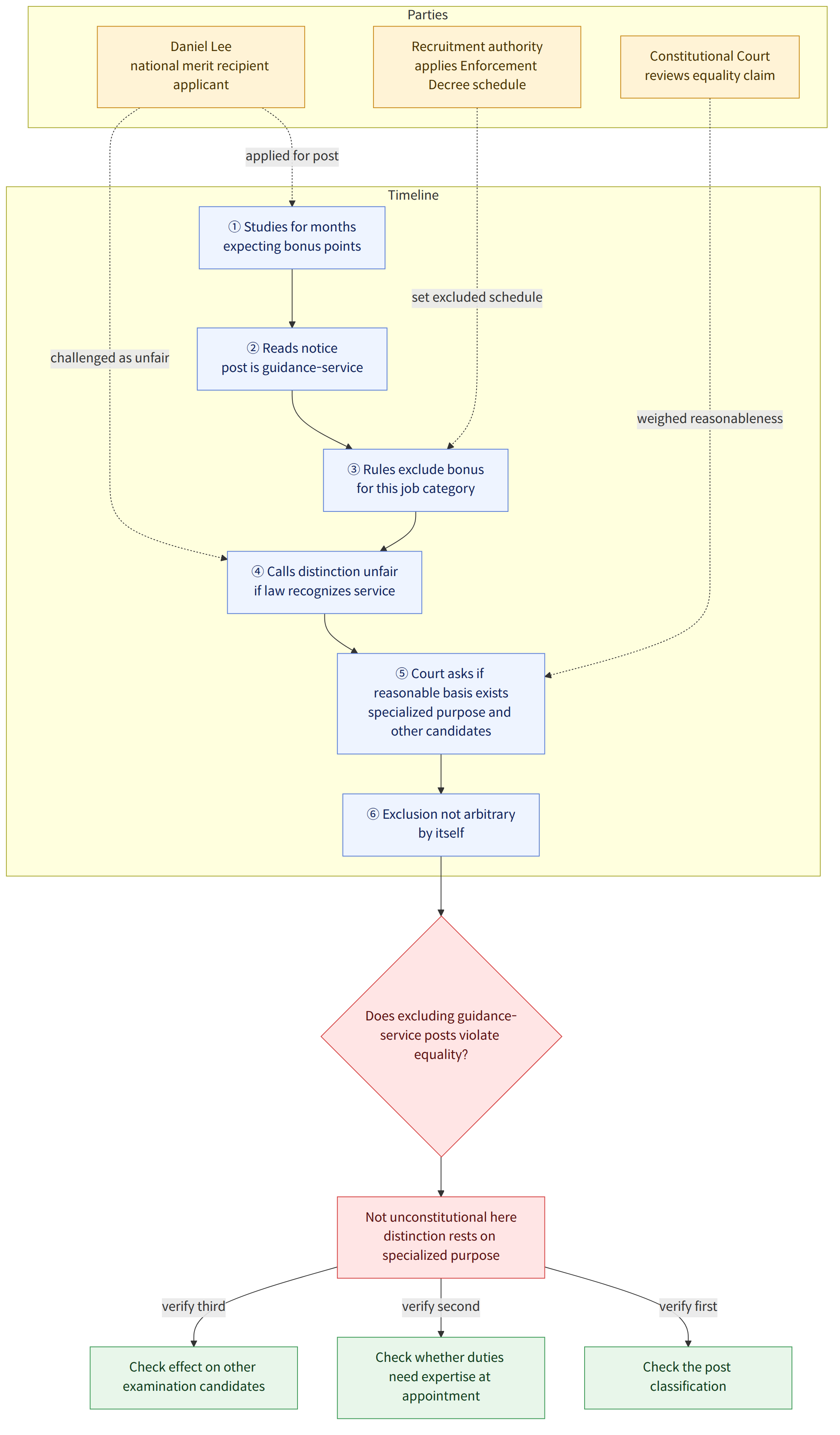
Daniel Lee had built his plans around a single opportunity: a guidance-service civil servant position in a regional agricultural office. A recipient of national merit benefits, he believed Korean law would give him additional points in the recruitment examination. He studied for months, expecting that preference to be part of the contest.
Then he read the recruitment notice more carefully. The position was classified as a guidance-service post, and the rules did not award the employment-support bonus to applicants for that category of public-service job. Daniel felt the distinction was unfair. If the law recognizes his service, he wondered, why should the benefit disappear for the particular civil-service position he hoped to hold?
The Legal Question
Does excluding guidance-service civil servants from the public-service recruitment bonus for eligible national merit recipients violate the constitutional guarantee of equality?
What Korean Law Says
Korea’s Act on the Honorable Treatment and Support of Persons of Distinguished Service to the State provides employment support that can include additional points in recruitment examinations conducted by designated employment-support institutions. The implementing Enforcement Decree specifies which civil-service classes and grades qualify for the bonus. Under its relevant schedule, guidance-service civil servants are excluded from the covered public-service recruitment positions.
The constitutional issue is not simply whether extending the bonus would be a more generous way to honor national merit recipients. It is whether the government’s decision to draw this particular line is irrational or otherwise outside the discretion allowed to the legislature and the executive in designing the benefit.
Equal treatment does not require identical treatment in every circumstance. A distinction may be constitutionally permissible when it rests on relevant differences and has a reasonable relationship to the purpose of the rule.
In assessing the distinction, the relevant considerations include:
- The purpose and nature of the guidance-service position.
- Whether the job calls for specialized expertise or experience at the time of appointment.
- Whether the role can readily be filled by, or substituted for, other civil-service positions.
- The purpose of employment-support bonuses and their effect on other examination candidates.
How Korean Courts Approach This
Korean courts generally examine whether a classification has a reasonable basis, rather than asking whether another policy might be fairer or more generous. In this context, the Constitutional Court has treated guidance-service recruitment as meaningfully different from recruitment into general civil-service roles.
Guidance-service positions may be created to meet particular local or national needs and can require professional knowledge or relevant experience from the outset. That differs from general civil-service jobs where employees may develop much of their administrative or technical ability after appointment. The Court has also considered whether the role’s duties are interchangeable with those of other civil servants.
The Court’s approach is that excluding guidance-service posts from the bonus is not, by itself, an arbitrary or irrational form of discrimination when the distinction reflects the posts’ specialized purpose and the design of the employment-support system.
The Court has also weighed the interests of other applicants. As the number of people eligible for employment bonuses has grown and competition for public-service jobs has become more intense, expanding bonus coverage can reduce the opportunities available to candidates who do not receive those points. That concern does not automatically defeat a claim, but it can form part of the legislature’s reasonable policy judgment.
Applying the Law to Daniel’s Case
- Daniel’s benefit is governed by both the statute and its implementing rules. The statute establishes employment support, while the Enforcement Decree’s schedule identifies the relevant covered positions. Being eligible for national merit benefits does not necessarily mean receiving bonus points in every public recruitment examination.
- The post’s classification matters. Daniel applied for a guidance-service position, not a general civil-service role. If the position is correctly classified under the excluded category, the fact that he otherwise qualifies for employment support does not remove that exclusion.
- The distinction has a stated occupational basis. Guidance-service roles are understood to require specialized professional capability that the appointing body needs to use immediately. The government may therefore treat recruitment for those posts differently from recruitment for general roles in which job-specific ability can be developed after appointment.
- The exclusion also reflects competing interests. Extending extra points to more examination categories could improve support for eligible applicants, but it could also narrow the practical opportunity for other candidates to obtain public employment. The Court has regarded that balance as a matter in which the government has room to make policy choices.
- The constitutional challenge is therefore unlikely to succeed on equal-protection grounds alone. The Court’s reasoning treats the exclusion as a policy distinction connected to the work involved, not as a plainly arbitrary denial of national merit recipients’ rights. Daniel’s disappointment is real, but the difference in treatment does not, on these facts, establish a constitutional violation.
For a case like Daniel’s, the recruitment notice and the formal classification of the post are central. A reader could ask [[lawyer]] to review those documents and the applicable rules to check whether the position was correctly classified and whether the bonus rules were applied to the particular recruitment process.
The recruitment notice and the post’s formal classification are decisive documents in Daniel’s situation. You could ask attorney Ji-sun Ahn of Ijun Law Firm to review them alongside the applicable rules to assess whether the position was correctly classified and whether the bonus provisions were applied as written.
Conclusion: What Happened, and What Should You Do?
Daniel’s equal-protection challenge would not prevail merely because guidance-service applicants are excluded from the recruitment bonus available in other covered public-service examinations. Korean constitutional reasoning accepts the distinction as grounded in the specialized nature of those jobs, the need for expertise at appointment, and the competing interests of other candidates. The rule may be debated as policy, but that alone does not make it unconstitutional.
For readers facing a similar situation:
- Check the exact job classification in the recruitment notice; a job’s title or employer alone may not tell you which rules apply.
- Compare the notice with the governing decree and schedule to confirm whether the post is excluded and whether the bonus was calculated correctly.
- Keep the relevant documents and seek a timely review of the decision if you believe the post was misclassified or the rules were applied incorrectly.

















