

1 — A Human Story
Daniel Park had spent years building a neighborhood restaurant in Seoul. His customers came for familiar food, long conversations, and the freedom to smoke after a meal. When he learned that his restaurant had to become entirely smoke-free, he worried that regulars would stop coming and that a government rule was reaching too far into the way he ran his business.
Daniel wondered whether the requirement violated his freedom to pursue an occupation. He was not asking to close his restaurant or ignore every health rule; he wanted to know whether the law could require every general restaurant to make its premises non-smoking, even when that choice might affect his business.
2 — The Legal Question
Does requiring every general restaurant to designate its entire premises as a non-smoking area unconstitutionally infringe the owner’s freedom to conduct a business?
3 — What Korean Law Says
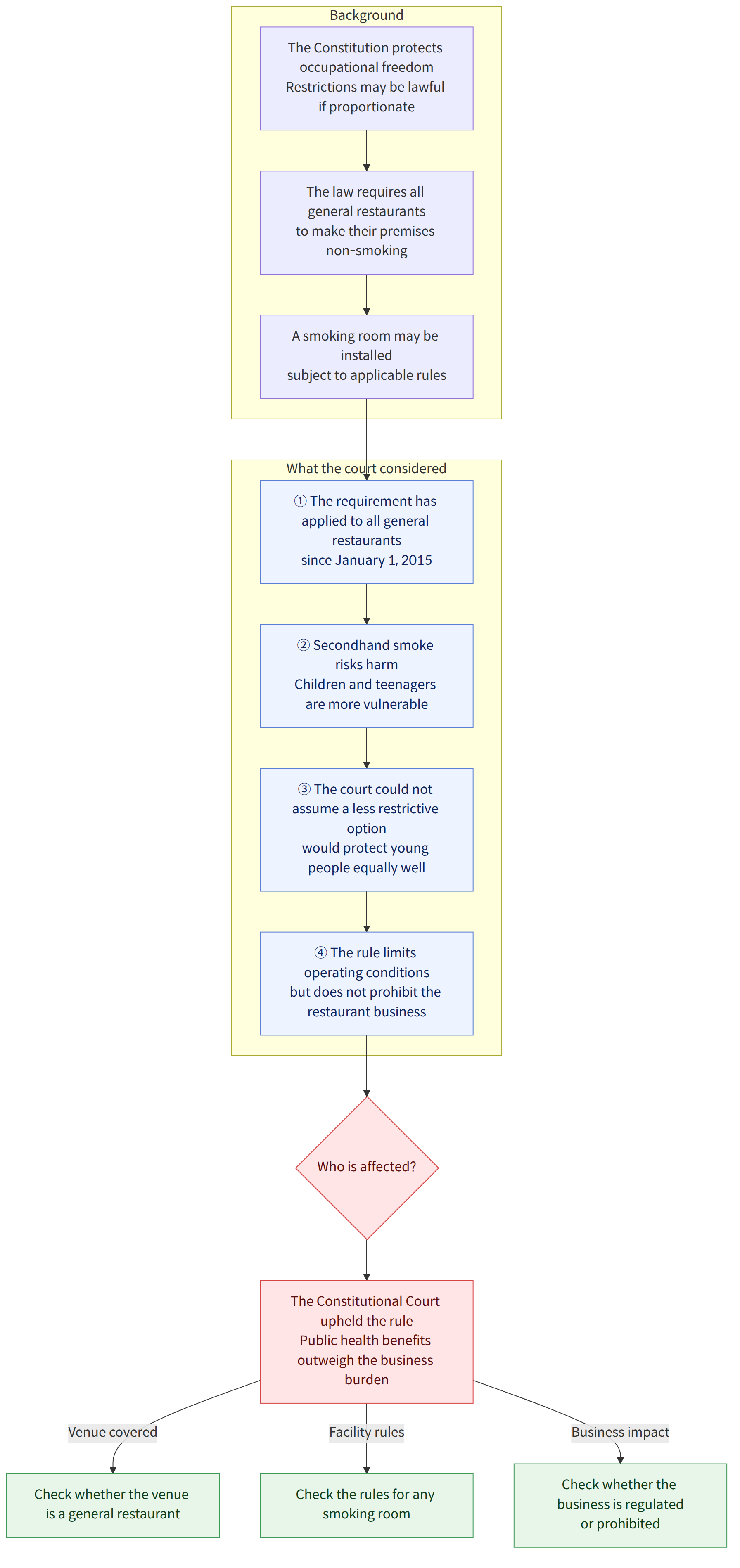
The relevant provisions of the National Health Promotion Act and its implementing rules require general restaurants to designate their entire premises as non-smoking. The requirement has applied to all general restaurants since January 1, 2015. A restaurant may install a smoking room, subject to the rules governing such facilities.
The law restricts the manner in which a general restaurant operates; it does not prohibit the restaurant business itself.
The constitutional framework also matters. The Constitution protects the freedom to choose and pursue an occupation, but that freedom may be limited by law when the restriction serves a legitimate public purpose and is proportionate. It also places particular importance on the state’s duty to protect public health.
Article 36(3) of the Constitution emphasizes the state’s duty to protect the health of the people.
In assessing a restriction on business activity, the key questions include:
- Legitimate purpose: Is the rule aimed at protecting an important public interest?
- Suitability: Can the restriction help achieve that purpose?
- Necessity: Is there an equally effective, less restrictive alternative?
- Balance: Does the public benefit justify the burden placed on the business owner?
4 — How Korean Courts Approach This
The Constitutional Court has upheld the rule requiring general restaurants to make their premises non-smoking. Its reasoning recognizes that secondhand smoke poses health risks and that children and teenagers are more vulnerable to those risks than adults.
The court has also considered the character of general restaurants. Under the relevant laws, they are a category of venue where alcohol may be served but young people are not, as a general rule, barred from entering. In the court’s view, it could not simply be assumed that a less restrictive measure would protect children and teenagers just as effectively as making restaurant premises smoke-free.
The court then weighed the competing interests. Owners remain free to operate restaurants, although their choice of operating conditions is limited. Against that burden, the rule seeks to prevent harm from secondhand smoke and protect people’s health and physical safety. The court concluded that the public interest was greater than the disadvantage imposed on restaurant operators.
The court’s central distinction is between banning a business and regulating how it operates. A meaningful restriction on business practices is not automatically an unconstitutional denial of occupational freedom.
5 — Applying the Law to Daniel’s Restaurant
Daniel’s concern is understandable: a smoke-free policy can change the atmosphere he has cultivated and may affect customer habits. But the constitutional question is not simply whether the rule makes running his business harder. It is whether the restriction crosses the line from regulating his business to unlawfully preventing him from pursuing it.
- The rule serves a substantial public purpose. Requiring smoke-free premises is intended to reduce exposure to secondhand smoke and protect health, including the health of younger patrons who may be particularly vulnerable.
- The court found no clearly equivalent alternative. Daniel might argue that separating smokers from other customers should be enough. But the Constitutional Court concluded that it could not be assumed that an alternative would protect children and teenagers equally well. The law’s permission to install a smoking room does not change the basic requirement that the restaurant premises be designated as non-smoking.
- The business is restricted, not prohibited. Daniel can continue operating his restaurant. The rule limits the conditions under which he may serve customers, rather than preventing him from running the business altogether.
- The balance favors public health. The court viewed the harm the rule seeks to prevent as more important than the operating disadvantage faced by restaurant owners. On that reasoning, Daniel’s claim that the requirement is unconstitutional would be unlikely to succeed.
For an owner facing an inspection, notice, or disagreement about whether a particular area is covered, the specific paperwork and the restaurant’s layout may still matter. A reader could ask [[lawyer]] to review those documents and the facts of the premises, without assuming that an individual compliance dispute changes the constitutional rule.
If you have received an inspection notice or are unsure how the smoke-free requirement applies to a particular part of your restaurant, attorney Ji-sun Ahn of Ijun Law Firm could review the notice, floor plan, and related records with you. The constitutional rule is settled at a general level, but the documents may help clarify the issue raised in your individual situation.
6 — Conclusion: What Happened, and What Should You Do?
Daniel’s restaurant remained open, but its dining premises had to comply with the non-smoking requirement. His objection raised a genuine concern about occupational freedom, yet the constitutional balance recognized that the rule regulates the way a restaurant operates rather than banning the business. Because protecting people—particularly children and teenagers—from secondhand smoke was considered a weightier public interest, the requirement was not held unconstitutional.
For restaurant owners in a similar position:
- Check the rules that apply to your premises, including the requirements for any smoking room; do not assume that a smoking room removes the duty to designate the restaurant as non-smoking.
- Keep inspection records, notices, and relevant floor plans if you need to clarify how the requirement applies to your particular premises.
- Respond to a specific compliance notice with its details in hand, since the general constitutional ruling does not answer every question about an individual restaurant’s layout or enforcement circumstances.

















