

1. A Human Story
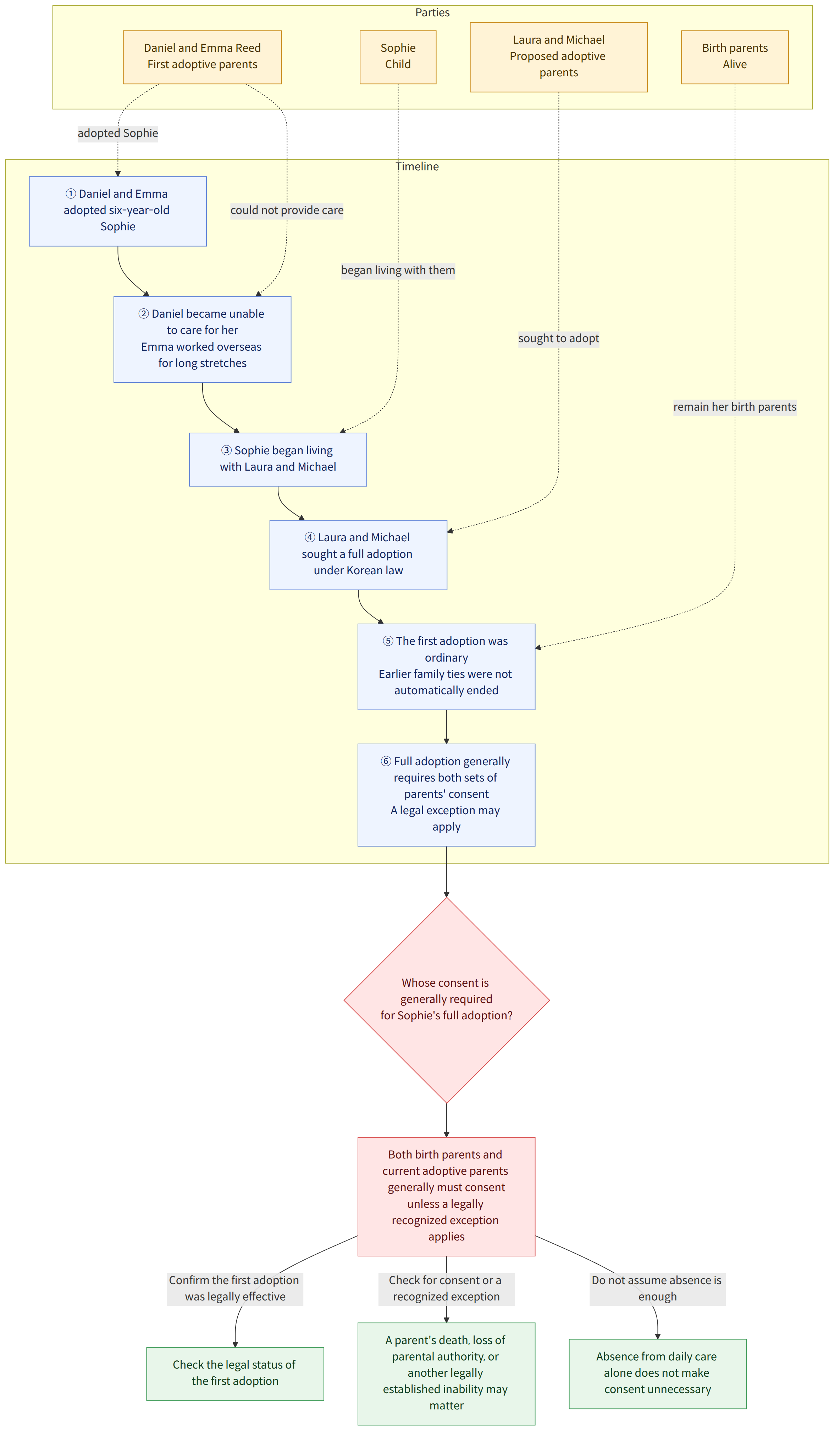
When Daniel and Emma Reed adopted six-year-old Sophie, they imagined the three of them growing into a family together. But after a serious illness left Daniel unable to care for her and Emma’s work took her overseas for long stretches, Sophie began living with Emma’s sister, Laura, and Laura’s husband, Michael. They wanted to make Sophie’s place in their home permanent by adopting her as their own child through a full adoption under Korean law.
The plan seemed straightforward until the family reached the question of consent. Sophie’s birth parents were no longer raising her, but they were alive. Daniel and Emma, meanwhile, were already her legal adoptive parents. Laura and Michael wondered whether only Sophie’s birth parents needed to agree—or whether the couple who had adopted her first also had to give consent.
2. The Legal Question
When a child is first adopted by one couple and is later to be fully adopted by another, whose consent is required under Korean law: the birth parents, the current adoptive parents, or both?
3. What Korean Law Says
Korean law distinguishes ordinary adoption from full adoption. An ordinary adoption creates a legal parent-child relationship between the child and the adoptive parents. At the same time, the child’s pre-adoption family relationships generally continue. A later full adoption therefore concerns a child who already has legal parents as well as birth parents whose family relationship has not simply disappeared.
The Civil Act sets out a consent requirement for full adoption:
A person’s birth parents must consent to that person’s full adoption. The law provides an exception where a parent has lost parental authority, has died, or is unable to consent for another legally recognized reason.
The Act also gives an adopted child the status of the adoptive parents’ child and establishes kinship with their relatives. But, in an ordinary adoption, the child’s existing family relationships are not automatically extinguished. Read together, these rules mean that the relevant consents generally include both sets of parents:
- The birth parents, because they remain the child’s birth parents and their consent is ordinarily required for full adoption.
- The current adoptive parents, because the first adoption made them the child’s legal parents.
- An exception may apply if a parent’s consent is legally unnecessary because of a circumstance such as death, loss of parental authority, or another established inability to consent.
The exception is not a general shortcut. A parent’s absence from daily care, disagreement with the proposed adoption, or the family’s belief that the adoption would be best for the child does not, by itself, establish that consent is legally impossible or unnecessary.
4. How Korean Courts Approach This
Korean courts look at the legal substance of the family relationship, not just the label used on a document. If the first adoption was real and legally effective, the first adoptive parents cannot be treated as strangers merely because the child is later to join another household. The law recognizes them as parents.
Courts also take account of the fact that ordinary adoption does not, by itself, erase the child’s earlier kinship ties. The consent rules for a later full adoption must therefore be read in light of both relationships: the child’s connection to the birth parents and the legal parent-child relationship created by the first adoption.
A court may also look beyond a document’s form when deciding whether an adoption relationship exists. For example, a birth registration made in the form of a parent’s registration can, in appropriate circumstances, be treated as evidence of an adoption if the people involved genuinely intended to create an adoptive relationship and the legal requirements were met. That principle reinforces a broader point: family status turns on the real legal relationship, not simply on what a document happens to be called.
5. Applying the Law to the Case
For Sophie, the analysis begins with the first adoption. Daniel and Emma did not merely care for her informally; they adopted her. Their relationship with her therefore carries legal consequences. They are her adoptive parents, not just former caregivers.
Next, the law asks whether Sophie’s relationship with her birth parents continues. Because the first adoption was an ordinary adoption, the answer is generally yes: her earlier kinship ties were not automatically severed by that adoption. The birth parents’ consent remains relevant to a proposed full adoption unless a statutory exception applies.
The proposed adoption by Laura and Michael is a separate legal step. It would give Sophie a new and more complete family status, but the fact that Laura and Michael have cared for her does not itself replace the consent required from those who already hold legal parental status or from her birth parents.
On the facts described, neither illness nor living apart automatically excuses Daniel and Emma from consenting. Nor does the fact that Sophie’s birth parents are not raising her automatically remove the need for their consent. If any of the four parents cannot or will not participate, the family would need to establish the relevant legal facts and ask the appropriate court to assess whether a statutory exception applies. A mere refusal to consent is not the same thing as being unable to consent.
If you are dealing with a similar issue, attorney Ji-sun Ahn of Ijun Law Firm can review the birth and family registration records, any adoption order or consent, and the child’s current living arrangements with you. These details can help clarify which options apply to your situation.
6. Conclusion: What Happened, and What Should You Do?
Laura and Michael could not proceed on the assumption that only Sophie’s birth parents mattered. As a general rule, the proposed full adoption required consent from both her birth parents and her current adoptive parents, Daniel and Emma. If a parent’s consent could not be obtained because of death, loss of parental authority, or another legally recognized inability, that issue would have to be supported with evidence and assessed under the statutory exception.
For families facing a similar situation:
- Map the child’s legal relationships first. Confirm whether the existing arrangement is an ordinary adoption, a full adoption, or an informal caregiving arrangement.
- Gather records and address consent early. Collect adoption documents and identify each parent whose consent may be required; document any claimed inability to consent.
- Get advice before taking procedural shortcuts. Consult a Korean family-law professional about the court process and do not rely on an informal agreement or a different form of registration to bypass consent rules.

















