

A Human Story
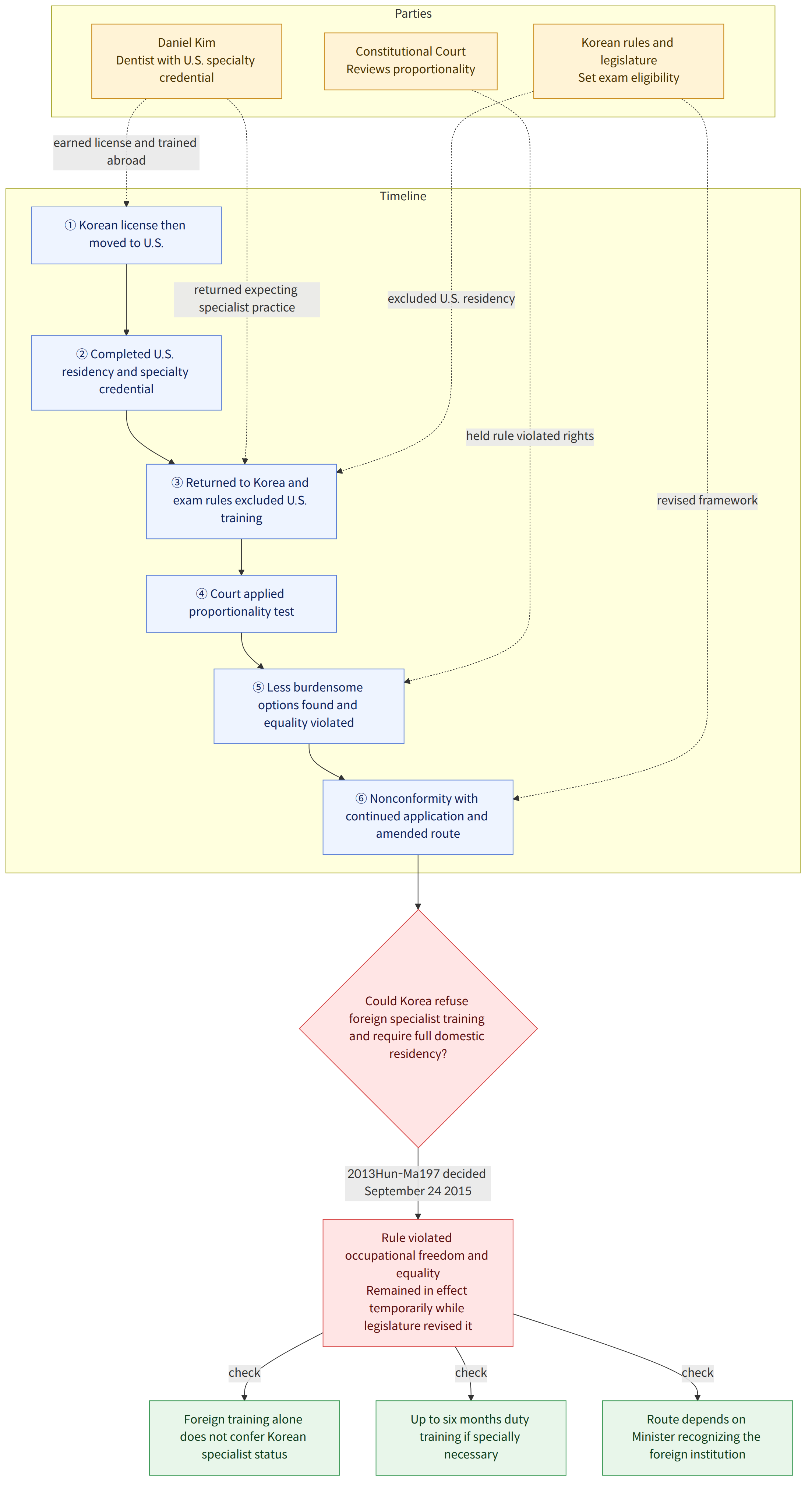
Daniel Kim had built his career across two countries. After earning his Korean dental license, he moved to the United States, completed a dental residency, and obtained a U.S. specialty credential. He returned to Korea expecting that his years of training would open the door to specialist practice.
Instead, Daniel learned that the rules for taking Korea’s dental specialist examination recognized specified Korean training routes but did not include his U.S. residency. To qualify, he would have to complete specialist training again in Korea. The question was not whether Korea could set standards for specialists. It was whether making Daniel start over, without assessing what he had already learned, imposed too heavy a burden.
The Legal Question
Could Korea refuse to recognize foreign dental specialist training as a route to its specialist examination—and require a dentist who had already completed such training abroad to repeat a domestic residency—without violating the dentist’s freedom to pursue an occupation and right to equality?
What Korean Law Says
The rule challenged in this dispute listed who could take Korea’s dental specialist qualification examination. In essence, eligibility was limited to dentists who had completed a training course under the Korean system or whose training had otherwise been recognized under the relevant domestic rules. It did not provide a route for someone solely because that person had completed specialist training at a foreign medical institution.
The Constitutional Court considered whether that exclusion satisfied the constitutional principle of proportionality: a legitimate public goal must be pursued by means that do not restrict a person’s rights more than reasonably necessary.
The Court accepted that Korea could seek to ensure foreign-trained dentists had the knowledge and experience needed for practice in Korea. But it found that requiring them to repeat an entire domestic specialist training course was more restrictive than necessary when alternatives could assess their qualifications.
The Court identified less burdensome options, including:
- Reviewing whether a foreign training program is equivalent to the required Korean training.
- Requiring a preliminary examination before the specialist qualification examination.
- Taking account of the training’s duration, content, and method when deciding what additional preparation is needed.
The Court also addressed equality. It noted that doctors and dentists both need specialist expertise to treat patients, and that earlier regulations had treated the recognition requirements for medical and dental specialists alike. It found no persuasive reason, in the circumstances, to treat foreign-trained dental specialists differently.
In its decision of September 24, 2015, in 2013Hun-Ma197, the Court held that the rule violated occupational freedom and equality. It did not simply strike the rule down immediately. Instead, it issued a constitutional nonconformity decision with continued application, allowing the existing framework to remain in effect temporarily while the legislature revised it.
The amended framework described in connection with the ruling provided a route for certain foreign-trained applicants. Where the Minister of Health and Welfare recognizes the foreign institution or training course, and determines that the applicant’s training is equivalent to or exceeds the required domestic training, the applicant may, if considered specially necessary, be required to complete up to six months of duty training before sitting the examination. Passing the examination remains necessary; foreign training alone does not automatically confer Korean specialist status.
How Korean Courts Approach This
In disputes over professional licensing, Korean courts and the Constitutional Court recognize that the government has an important role in protecting patients and maintaining professional standards. A qualification system may legitimately require training, examinations, or other safeguards.
But professional regulation must still be proportionate. The central questions are whether the rule serves a proper purpose, whether it meaningfully advances that purpose, and whether a less restrictive approach could do so without imposing an excessive burden. The Court’s reasoning here turned on the difference between checking whether foreign training is adequate and refusing to consider it at all.
A public-safety objective does not, by itself, justify making every foreign-trained applicant repeat an entire domestic program. The rule must also balance the public interest against the real burden placed on the individual.
The equality analysis added another check: if two groups require comparable expertise to perform their work, a different qualification rule needs a sound justification. A distinction that lacks a sufficient basis may raise a separate constitutional problem even when the broader regulatory goal is legitimate.
Applying the Law to Daniel’s Case
- Korea had a legitimate objective. Daniel’s U.S. training did not automatically prove that he had the experience and knowledge needed to practise as a specialist within Korea’s healthcare system. The government was entitled to protect patients and set domestic standards.
- The original route did not assess Daniel’s actual preparation. Under the challenged rule, his foreign residency and U.S. specialist credential did not provide an eligible path to the examination. Requiring a full Korean residency treated his prior training as irrelevant rather than asking whether it was equivalent.
- That blanket approach went further than necessary. The Court reasoned that Korea could pursue its goal through an equivalency review, a preliminary examination, or a limited period of additional training. Those options could address gaps in Daniel’s preparation without automatically making him repeat years of specialist education.
- The burden was substantial. Repeating an entire domestic residency would demand considerable time and effort from someone who had already completed specialist training abroad. The Court concluded that this burden was not adequately balanced against the public interest when less restrictive assessment methods were available.
- The distinction also raised an equality concern. The Court found no special basis for imposing a different recognition approach on dental specialists than on medical specialists, given the comparable need for expertise and the history of similar treatment under earlier rules.
The decision did not establish that Daniel was already entitled to call himself a Korean dental specialist. Rather, it meant that the rules could not constitutionally shut the door on his foreign training without a fair assessment. Under the amended route described above, his eligibility would depend on whether the responsible ministry recognized his training as equivalent and whether any additional duty training was required.
If your application turns on whether a foreign residency is equivalent to Korean training, attorney Ji-sun Ahn of Ijun Law Firm can review the training certificate, curriculum, clinical records, and any written response from the relevant authority to help clarify what the documents establish and what question remains unresolved.
Conclusion: What Happened, and What Should You Do?
Daniel’s challenge succeeded on the constitutional issue: the Court found that the exclusion of foreign-trained dental specialists violated occupational freedom and equality. But the ruling was not a personal award of a Korean specialist credential. The revised approach created a way for qualifying applicants to have foreign training assessed, with limited additional training possible, while preserving the requirement to pass Korea’s specialist examination.
For anyone in a similar position, the practical lesson is to distinguish recognition of training from recognition of a professional title. A foreign credential may support an application, but the domestic assessment and examination requirements still matter. Rules can also change, so applicants should verify the requirements that apply to their specialty and application date.
- Gather official records showing the foreign program’s duration, curriculum, clinical work, and completion status, as well as the specialist credential itself.
- Ask the relevant Korean authority which recognition route and examination requirements apply to your training; do not assume that a foreign title automatically qualifies you.
- Keep written decisions and requests for additional documentation, so you can identify what the authority recognized and what remains in dispute.

















