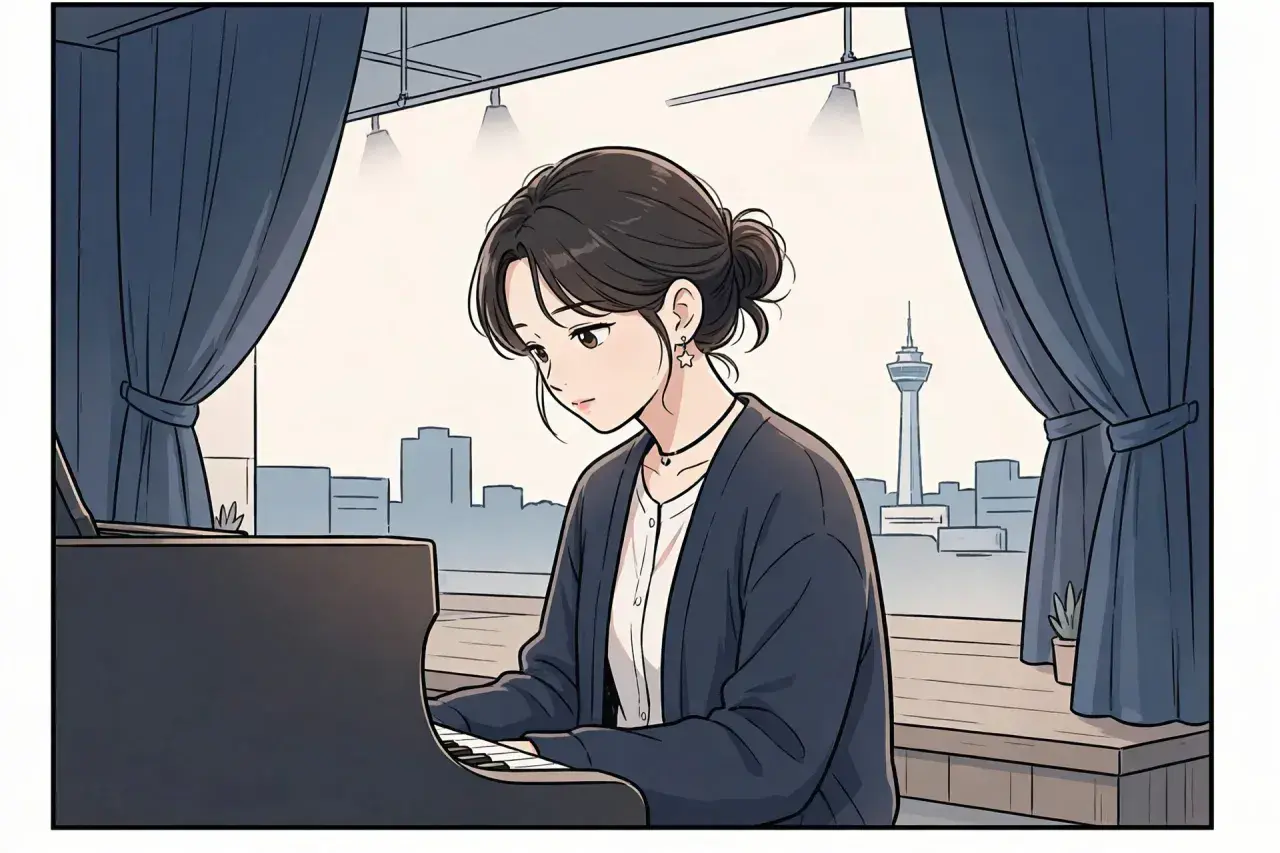
Pianist Geum-sun Oh, who has continued Korean-Japanese music exchange and local performances while based in Daegu, has organized the Ikoi Choir (이코이), the Spielraum music exchange group (슈필라움), and the Youth Star Ensemble (유스스타 앙상블). She said that lesson fees and other income cover her studio rent and activity costs, but do not allow her to save money. Even so, she describes her work as performing, planning, and cultural exchange, and says she wants to call herself a pianist who connects people and cultures through music.
Background and context
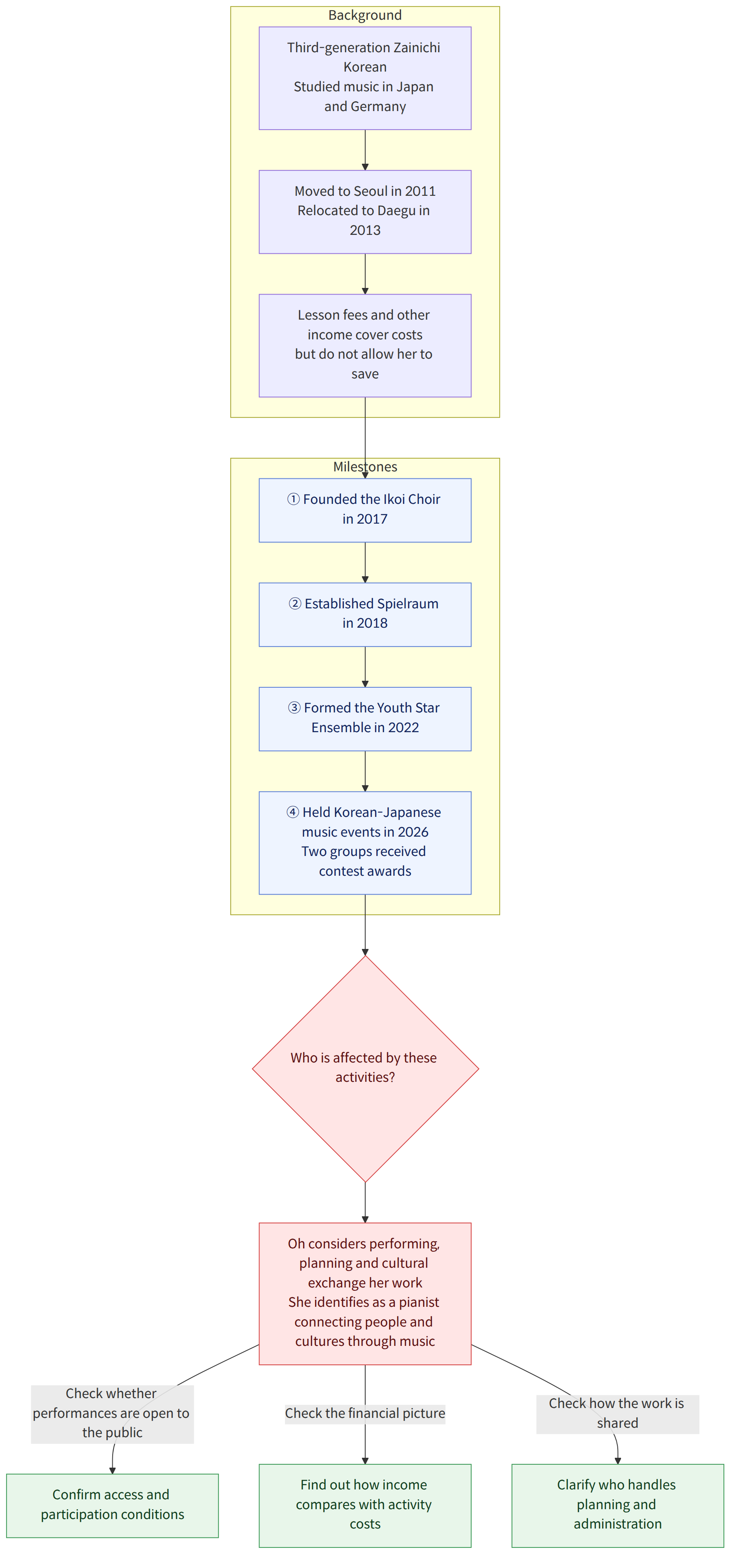
Geum-sun Oh is a third-generation Zainichi Korean who was born and raised in Japan. After graduating from Senzoku Gakuen College of Music (센조쿠가쿠엔 음대), she studied at the Hanns Eisler School of Music Berlin (베를린한스아이슬러 음대) and lived in Germany for nearly 10 years. She married a Korean student studying abroad and moved to Seoul in 2011. After her husband took a position at a public research institution in Daegu in 2013, she relocated there.
After settling in Daegu, Oh began activities that brought Japanese women together to sing. Building on that work, in 2017 she formed the Ikoi Choir, a choir of Japanese women living in Korea that is active mainly in Daegu and North Gyeongsang Province. She went on to establish the Korean-Japanese music exchange group Spielraum in 2018 and the youth performance group Youth Star Ensemble in 2022.
The three groups’ activities have extended beyond performance stages. In February 2026, Spielraum held a Korean-Japanese piano exchange concert in Osaka, Japan. In June, it presented a “100th Anniversary of ‘Spring in My Hometown’” song concert in Daegu, introducing songs from Korea and Japan. In October of the same year, it held a Korean-Japanese song concert in Osaka.
At the first National Multicultural Harmony Contest (제1회 전국다문화어울림 경연대회), held in Daegu in September 2026, the Ikoi Choir received an Encouragement Award, and the Youth Star Ensemble received a Special Award. The groups, which began in Daegu, have each continued local performances, Korean-Japanese exchange, and youth music activities.
What this news means
One notable aspect of this case is that the breadth of someone’s activities does not necessarily match the amount of income they earn. Oh serves as music director or representative for the three groups. At Spielraum and the Youth Star Ensemble, she takes on much of the work, from writing proposals and recruiting performers to booking venues, managing rehearsals and performances, and preparing accounts and reports. The groups reportedly have no separate staff.
She raises money for her studio rent and activity costs through lesson fees and other income, but said her earnings are not enough to save. This shows that doing work one loves does not make that work trivial or cause it to lose its character as work. The time and responsibility required to keep preparing and running performances exist regardless of the amount of income they generate.
Oh identified performing, planning, and cultural exchange as central to her work, and said she wants to describe herself as “a pianist who connects people and cultures through music.”
Her preference for describing herself as a pianist rather than a planner can also be understood in this context. Even though she spends much of her time planning and running performances, piano and performance remain at the center of her activities. Rather than defining a profession solely by a single job title, she makes her identity reflect why she does the work and what she places at its center.
These activities may also be meaningful to audiences and participants. Performances that present Korean and Japanese songs on the same stage create opportunities to encounter one another’s music, while youth performance groups and choirs can provide ways for people to make music together in their community. For example, Daegu audience members who attend one of these performances may hear Japanese songs as well as familiar Korean ones. However, the reporting does not establish how open the performances actually are to the public or what conditions apply to participation.
Confirmed facts and what is not yet known
Confirmed facts
- Oh is a third-generation Zainichi Korean who was born and raised in Japan, and studied at Senzoku Gakuen College of Music and the Hanns Eisler School of Music Berlin.
- She established Ikoi in 2017, Spielraum in 2018, and the Youth Star Ensemble in 2022.
- In 2026, Spielraum held Korean-Japanese music performances in Daegu and Osaka, Japan.
- At the first National Multicultural Harmony Contest in September 2026, the Ikoi Choir and the Youth Star Ensemble received an Encouragement Award and a Special Award, respectively.
- Oh said that lesson fees and other income cover her studio rent and activity costs, but do not provide enough for her to save.
What is not yet known
- The number of members and annual operating budgets of the Ikoi Choir, Spielraum, and the Youth Star Ensemble are not provided in the published information.
- It has not been confirmed what financial support or income sources the three groups use to continue their performances and rehearsals.
- The reporting does not establish what performances are planned in the future or what conditions apply to attending or participating as a member of the public.
What readers should check
- Readers who want to attend a performance should check the event announcements from each group for dates and attendance conditions.
- Young people who want to take part in music activities, and those interested in joining the choir, should check separately whether each group is recruiting and how its rehearsals are conducted.
- To assess whether these activities are sustainable, readers should look not only at awards but also at the number of members, operating budgets, and the resources that support performances and rehearsals.