
1. A Human Story
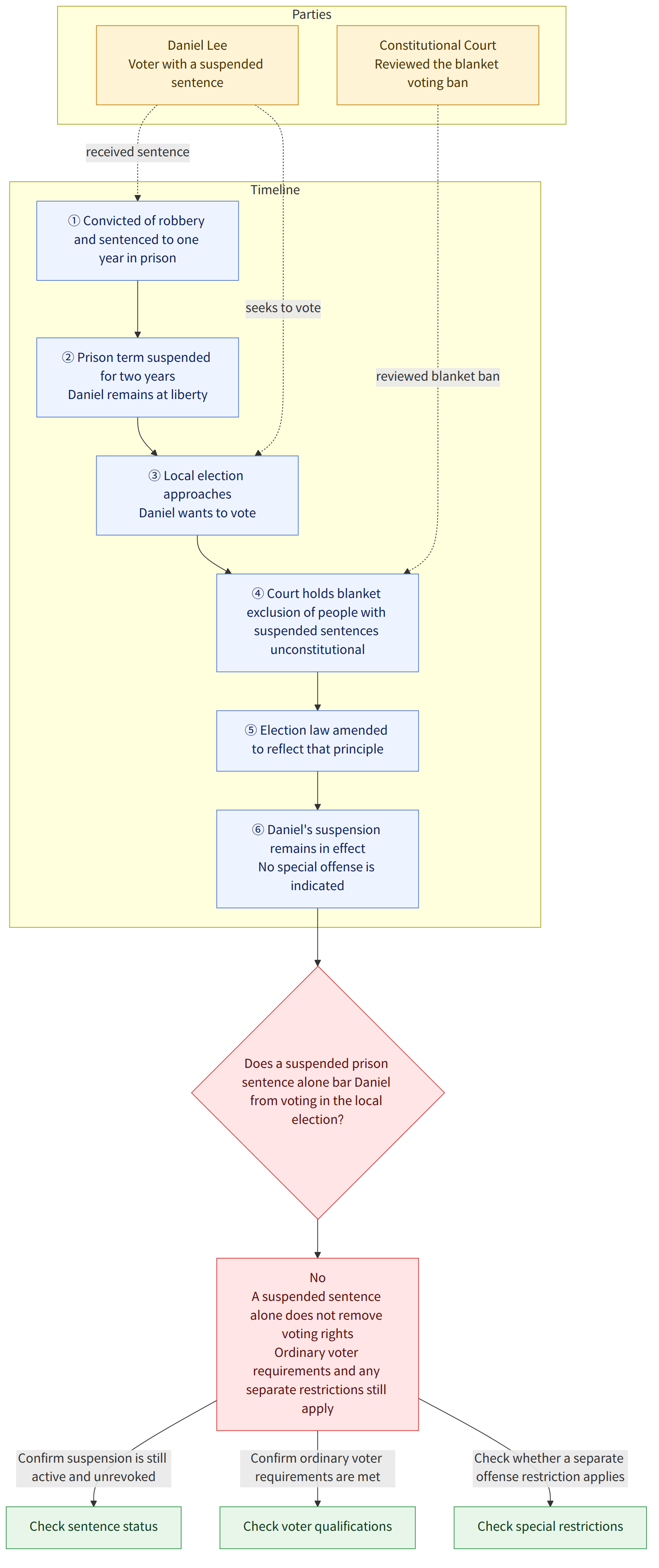
Daniel Lee had expected his first local election after sentencing to pass without much thought. He had been convicted of robbery and received a sentence of one year in prison, suspended for two years. The judgment was serious, but he was not sent to prison. He returned home, kept his job, and spent the months of his suspended sentence trying to rebuild a steady life.
When election day approached, Daniel wanted to vote for a candidate whose political views matched his own. A friend told him that a person with an unexpired suspended sentence could not cast a ballot. Daniel wondered whether his conviction had also taken away his place in the electorate.
2. The Legal Question
Does a person in Korea lose the right to vote in a local election merely because they have been sentenced to imprisonment, even when the sentence is suspended and they are not incarcerated?
3. What Korean Law Says
The Korean Constitution recognizes the right to vote and allows election laws to set reasonable qualifications and restrictions. But a restriction on voting must have a sufficient justification; it cannot automatically follow from a criminal conviction without regard to the person’s circumstances.
The key distinction is between a person who is actually serving a prison sentence and one whose prison sentence has been suspended. A suspended sentence is a court-imposed sentence whose execution is held back during a specified period, subject to legal conditions. It does not, by itself, mean that the person is confined in a correctional facility.
The Constitutional Court held that a blanket rule denying voting rights to people with suspended sentences was unconstitutional. While the suspension remains in effect and has not been revoked or otherwise brought to an end, those individuals are not imprisoned and generally live in the community like other members of the public.
The election law was amended to reflect that principle. In general:
- A person with a suspended sentence may vote while the sentence remains suspended, provided they meet the ordinary requirements for voting.
- A suspended sentence does not automatically remove a person from the electorate simply because the underlying conviction resulted in a prison term.
- Separate, stricter restrictions may apply to certain offenses, including election-related crimes and some corruption offenses such as bribery. The details depend on the relevant law and the person’s sentence and circumstances.
- If a suspended sentence is revoked or otherwise ceases to protect the person from serving the prison term, the person’s eligibility may need to be reassessed under the rules then applicable.
4. How Korean Courts Approach This
Korean courts, and particularly the Constitutional Court when considering constitutional challenges, examine whether a restriction on a fundamental right is justified and proportionate. The fact that someone has been convicted is relevant, but it does not automatically answer whether that person should be excluded from voting.
For people with suspended sentences, the central consideration is that they remain at liberty unless the suspension is revoked. They are not separated from society by imprisonment and can ordinarily take part in everyday civic life. A blanket ban would therefore impose a substantial penalty on their political participation without a sufficiently strong reason applying to every person in that group.
The general principle is that voting restrictions must be grounded in law and reasonably connected to a legitimate purpose. A suspended sentence alone is not enough to justify excluding someone from the ballot.
That does not mean every person with any criminal history is always eligible. The law may impose specific restrictions for certain offenses or circumstances. Those rules must be considered separately rather than assumed to apply to every suspended sentence.
5. Applying the Law to Daniel’s Case
Daniel’s situation can be assessed step by step:
- His sentence is suspended. He was sentenced to one year in prison, but its execution was suspended for two years. He is not currently serving that term in prison.
- His sentence has not been revoked. On the facts given, nothing has happened to cancel the suspension or require him to begin serving the prison term.
- The offense is robbery, not one of the identified special categories. The facts do not indicate an election offense or a corruption offense, such as bribery, that might be subject to a separate and stricter rule.
- The former blanket exclusion does not govern his case. Korean law now reflects the Constitutional Court’s conclusion that people with suspended sentences should not automatically lose their voting rights.
- Ordinary voter requirements still matter. Daniel must also satisfy the usual requirements for voting in the local election and must not be subject to some other independent legal disqualification.
On these facts, Daniel’s robbery conviction and unexpired suspended sentence do not prevent him from voting. He may cast a ballot for the candidate of his choice, just as any other eligible voter may.
If you are dealing with a similar issue, attorney Ji-sun Ahn of Ijun Law Firm can review the provision applied in your case, the ruling or notice you received, and the dates relevant to challenging it with you. These details can help clarify which options apply to your situation.
6. Conclusion: What Happened, and What Should You Do?
Daniel checked his eligibility with the election authorities and voted in the local election. His suspended sentence remained in force, had not been revoked, and was not based on an offense that triggered a separate voting restriction. The conviction was serious, but it did not, by itself, erase his right to participate in the election.
If you are in a similar position:
- Check the exact status of your sentence. A suspended sentence is different from a prison term currently being served, and a later revocation may change the analysis.
- Confirm whether a special offense-based rule applies. Election-related and certain corruption offenses may be treated differently from ordinary criminal convictions.
- Ask the election authority before election day if anything is unclear. Provide the details of the sentence and any later court orders, rather than relying on general advice or assumptions.

















