
1. A Human Story
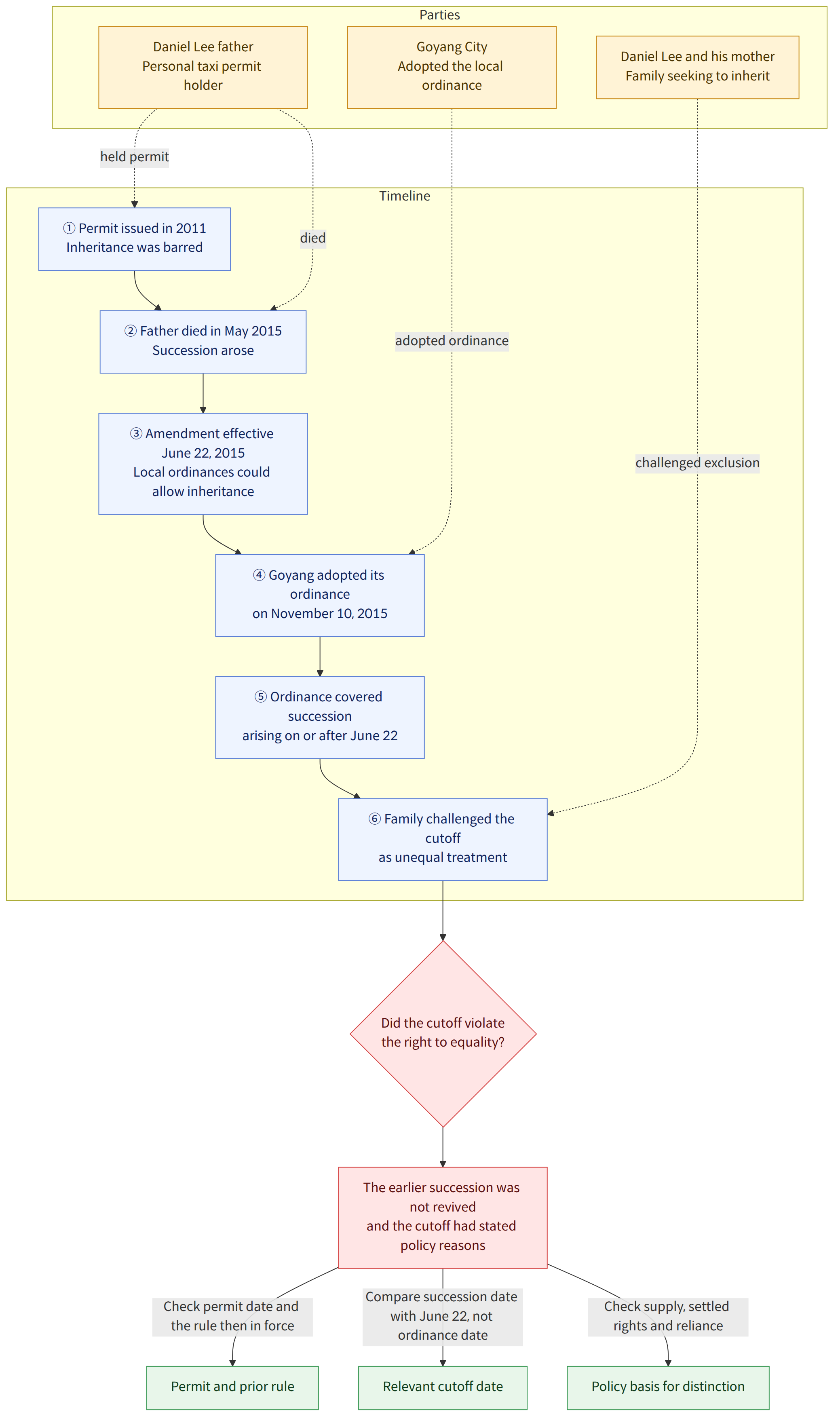
For years, Daniel Lee’s father had spent his days behind the wheel of a personal taxi in Goyang. The car was more than a livelihood: it was the steady routine that had helped support his family. His operating permit had been issued in 2011, at a time when the rules did not allow permits like his to be inherited.
When his father died in May 2015, Daniel and his mother faced both grief and an urgent practical question: could one of them continue the taxi business? A few months later, Goyang adopted an ordinance allowing inheritance of certain personal taxi businesses. But the ordinance set a date—June 22, 2015—and the family’s loss had come before it. They argued that excluding them while allowing other families to inherit was unfair.
2. The Legal Question
Did Goyang violate the constitutional right to equality by allowing inheritance of personal taxi businesses licensed after November 28, 2009, only when the inheritance first arose on or after June 22, 2015? In particular, could a family whose operator had died before that cutoff demand the same treatment as families whose inheritance arose afterward?
3. What Korean Law Says
The rules changed in stages. The Passenger Transport Service Act had prohibited inheritance of personal taxi businesses licensed after November 28, 2009. An amendment effective June 22, 2015, allowed inheritance only where the relevant local government provided for it by ordinance. Goyang later adopted such an ordinance, but limited its application to cases in which inheritance first arose on or after June 22, 2015.
That distinction matters. The date the ordinance was enacted—November 10, 2015—was not the cutoff in dispute. The ordinance applied to inheritance arising from June 22 onward, but did not reach back to revive a permit after the operator had already died and the business right had ended under the earlier rule.
The ordinance permitted inheritance within a defined period, rather than reopening every succession that had occurred before the statutory change.
In reviewing an equality challenge, the key question is whether the different treatment has a reasonable basis. A date-based distinction is not automatically unconstitutional. The government may draw lines to serve legitimate policy purposes, provided the distinction is rationally connected to those purposes and does not arbitrarily disadvantage one group.
The relevant considerations included:
- Taxi supply: The city could consider the total number of taxis and the balance between supply and demand in its jurisdiction.
- Legal stability: Reopening a business right that had already ended could unsettle legal relationships treated as settled.
- Reliance: When the permit was issued, inheritance was prohibited under the rules then in force. The family therefore could not reasonably rely on a future right to inherit it.
4. How Korean Courts Approach This
Korean constitutional review of equality asks whether people in comparable situations have been treated differently and, if so, whether there is a reasonable justification for the distinction. The assessment takes account of the subject matter and the room the government needs to make policy choices.
For a cutoff date tied to a change in transport regulation, courts may consider whether the date helps manage public resources and whether extending the new rule backward would unsettle settled rights. They also examine whether those excluded had a legitimate expectation that the law would later grant them a benefit. Here, the permit holders had acquired their licenses while inheritance was barred, a fact that weighed against finding that their families had a protected expectation of succession.
A later expansion of a benefit does not, by itself, require the government to restore rights that had already ended under the previous law. The distinction must still have a reasonable policy basis.
5. Applying the Law to Daniel’s Family
The result turns on the sequence of events, not simply on the date Goyang passed its ordinance.
- The permit fell within the restricted category. Daniel’s father received his personal taxi permit in 2011, after November 28, 2009. Under the law then in force, the business was not inheritable.
- The succession arose before the new statutory framework took effect. His father died in May 2015, before the June 22 amendment. The ordinance’s later permission did not apply to an inheritance that had already arisen before that date.
- The cutoff had a policy explanation. Goyang could take account of taxi numbers and local supply and demand when deciding how broadly to allow inheritance. The limit also avoided reopening business rights that had already ended, preserving the stability of settled legal relationships.
- The family had no established expectation of inheritance. At the time the permit was issued, the law prohibited its inheritance. The later change created a limited opportunity for qualifying families; it did not establish that every earlier succession had to be reopened.
Daniel’s family could point to the hardship of being just outside the cutoff. But the constitutional question was not whether the line produced a difficult result for them. It was whether the city had a reasonable basis for drawing it. The policy concerns and the earlier prohibition supplied that basis.
If the dates or the local authority’s decision are unclear, attorney Ji-sun Ahn of Ijun Law Firm could review the permit record, death documentation, and relevant ordinance or notice to help assess how the cutoff applies to those specific facts.
6. Conclusion: What Happened, and What Should You Do?
Daniel’s family could not inherit his father’s personal taxi business under the ordinance. The Constitutional Court concluded that limiting inheritance to cases first arising on or after June 22, 2015, did not violate the right to equality. The cutoff served a rational purpose, avoided unsettling rights that had already ended, and did not defeat an expectation the family could reasonably have held under the earlier law.
For anyone facing a similar issue:
- Confirm the dates: Establish when the permit was issued and when the operator died; the date inheritance first arose may be decisive.
- Check the governing rules: Review the applicable version of the national statute and the relevant local ordinance, including any transitional provisions.
- Keep the records: Preserve the permit, death record, inheritance-related notices, and communications with the local authority so the timeline can be assessed accurately.

















