

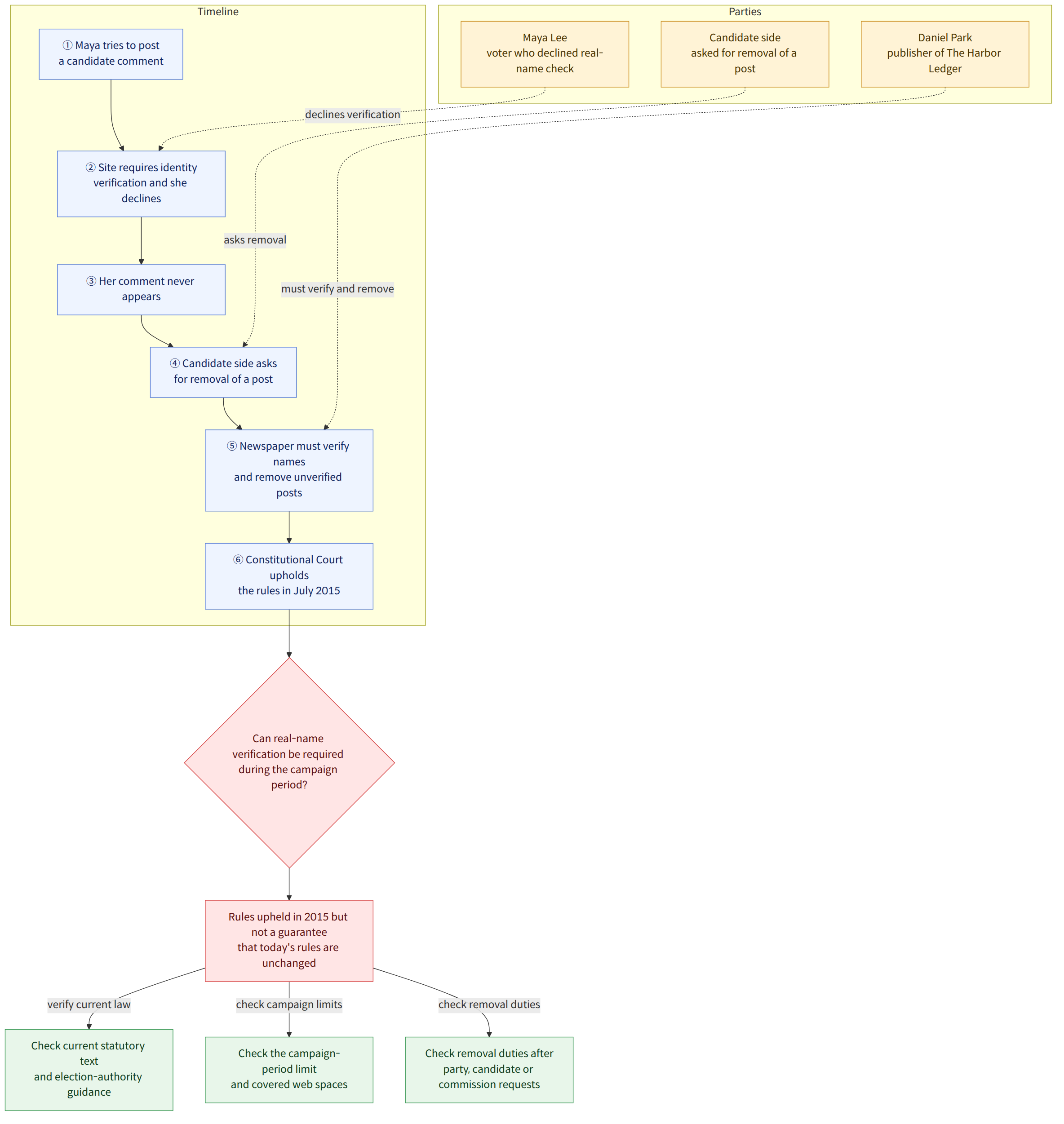
1. A Human Story
During a close parliamentary election, Maya Lee opened the website of The Harbor Ledger, an online newspaper run by Daniel Park. She wanted to post a short message supporting one candidate and criticizing another. The site asked her to verify her identity first. Maya declined: she was willing to express her political view, but not to attach her real identity to it. Her comment never appeared.
Daniel’s problem was different but connected. The election rules required an online newspaper that hosted candidate-related comments during the campaign period to take technical steps to verify a poster’s real name. Posts lacking the required verification mark had to be removed. When a candidate’s side also asked the newspaper to remove a post, Daniel faced a further statutory duty to act. Maya and Daniel believed the rules burdened both anonymous political speech and the newspaper’s freedom to publish.
2. The Legal Question
Could Korea require online newspapers, during the official campaign period, to verify the real identities of users posting support for or opposition to political parties or candidates—and require unverified posts to be removed—without violating constitutional rights to anonymous expression, personal-information control, and press freedom?
3. What Korean Law Says
The provisions examined by the Constitutional Court required an online newspaper that allowed candidate- or party-related material on its discussion boards or chat rooms during the campaign period to use a technical process to verify the poster’s real name. A specified identity-verification process under another statute could satisfy that requirement.
The rule applied to candidate- or party-related support or opposition posted on an online newspaper’s boards or chat rooms during the campaign period. It did not require every internet user to identify themselves whenever they went online.
The law also imposed removal duties:
- An online newspaper had to promptly remove covered support-or-opposition material that appeared without the required real-name verification mark.
- If a political party, candidate, or election commission asked for removal of material covered by that provision, the newspaper had to act promptly.
- The verification requirement was limited by both time—the campaign period—and subject matter—support for or opposition to a party or candidate on the relevant website spaces.
The constitutional issues included three related interests: a user’s freedom to speak politically without being identified publicly, the user’s ability to control personal information, and the online newspaper’s freedom of expression. The Court assessed the restrictions under the principle that a limit on rights must serve a legitimate public purpose and must not burden those rights more than necessary to achieve it.
In its July 2015 decision, the Constitutional Court concluded that the terms “online newspaper” and “support or opposition” were sufficiently understandable in context, and that the challenged provisions did not violate the Constitution.
That decision considered the statutory scheme then before the Court. It should not be read as confirmation that the same wording or requirements necessarily govern every election today; current statutory text and election-authority guidance should be checked before acting.
4. How Korean Courts Approach This
In reviewing a restriction on political expression, the Constitutional Court weighs the public interest relied on by lawmakers against the practical burden on speakers and publishers. In the 2015 ruling, the Court accepted fair elections as a legitimate aim. It reasoned that false or malicious claims spread through a prominent online news outlet could travel quickly and widely, potentially distorting information during an election.
The Court also focused on how narrowly the requirement was drawn. It applied only during the campaign period, only to specified political material, and only in particular online spaces. A user could choose whether to complete identity verification and post, and the public-facing mark showed that verification had occurred rather than displaying the poster’s personal details. The Court considered the process to impose little time or cost on users.
The Court’s reasoning was not that anonymous speech has no constitutional value. Rather, it concluded that this particular, time-limited verification rule—considered against the election-related purpose and the safeguards described—did not cross the constitutional line.
On the statutory language, the Court found that an online newspaper could determine whether it fell within the defined category, and that an ordinary reader could generally recognize whether a post expressed support for or opposition to a party or candidate. It therefore rejected the argument that these terms were too vague to guide those affected.
5. Applying the Law to Maya’s Post
First, the setting matters. Maya posted during the official campaign period, on the discussion board of an online newspaper. Those facts placed her post within the kind of setting covered by the provisions considered in 2015.
Second, the subject of the post matters. Her message expressly supported one candidate and criticized another. It was therefore the kind of candidate-related support or opposition that the statute addressed, rather than an unrelated comment on public affairs.
Third, the verification mark explains the removal. Maya chose not to complete the identity check, so the site could not display the required mark. Under the statutory scheme reviewed by the Court, the newspaper had to remove a covered post lacking that mark. The Court did not treat the user’s ability to decline verification as a right to publish the same covered material anonymously on that particular board during the campaign period.
Fourth, Daniel’s constitutional objection faced the same limits. The duty did constrain the newspaper’s editorial freedom by requiring it to implement verification and remove certain posts. But the Court considered the restricted time period, the narrow category of political content, the limited display of identity information, and the election-fairness rationale. On those facts, it held that the interference was not disproportionate.
Finally, a removal request did not mean every criticism could automatically be erased. The statutory duty described in the ruling concerned material within the specified provisions. Whether a particular request or post falls within that scope depends on its content, the forum, the timing, and the applicable current law. The 2015 ruling does not settle every dispute about a particular takedown.
6. Conclusion: What Happened, and What Should You Do?
Under the statutory framework reviewed in 2015, Maya’s constitutional challenge would not succeed merely because she wanted to post candidate-related speech anonymously on the newspaper’s campaign-period discussion board. The Constitutional Court upheld the challenged verification and removal provisions against the rights claims raised. Daniel, too, would have had to comply with the statutory duties as the Court understood them, provided the site and post were within the law’s scope.
That is a conclusion about the framework the Court examined—not a substitute for checking the law in force for a present-day election. If a similar dispute arises now, the exact statutory text, election dates, website category, content of the post, and basis for any removal request may matter.
- Check the current rule first. Confirm the applicable version of the election law and current election-authority guidance before posting or moderating election-related comments.
- Keep the record. Save the post, any identity-verification prompt, the removal notice, and any request from a candidate, party, or election commission.
- Identify the precise dispute. Note when and where the post appeared, what it said, and why removal was requested; those details can determine whether a legal duty applied.
If you are dealing with a similar removal, a consultation with attorney Ji-sun Ahn of Ijun Law Firm could help review the post, the platform’s notice, and any request from a candidate, party, or election commission against the applicable statutory text. The timing and location of the post may also be important to understanding whether the rule applies.

















