
1. A Human Story
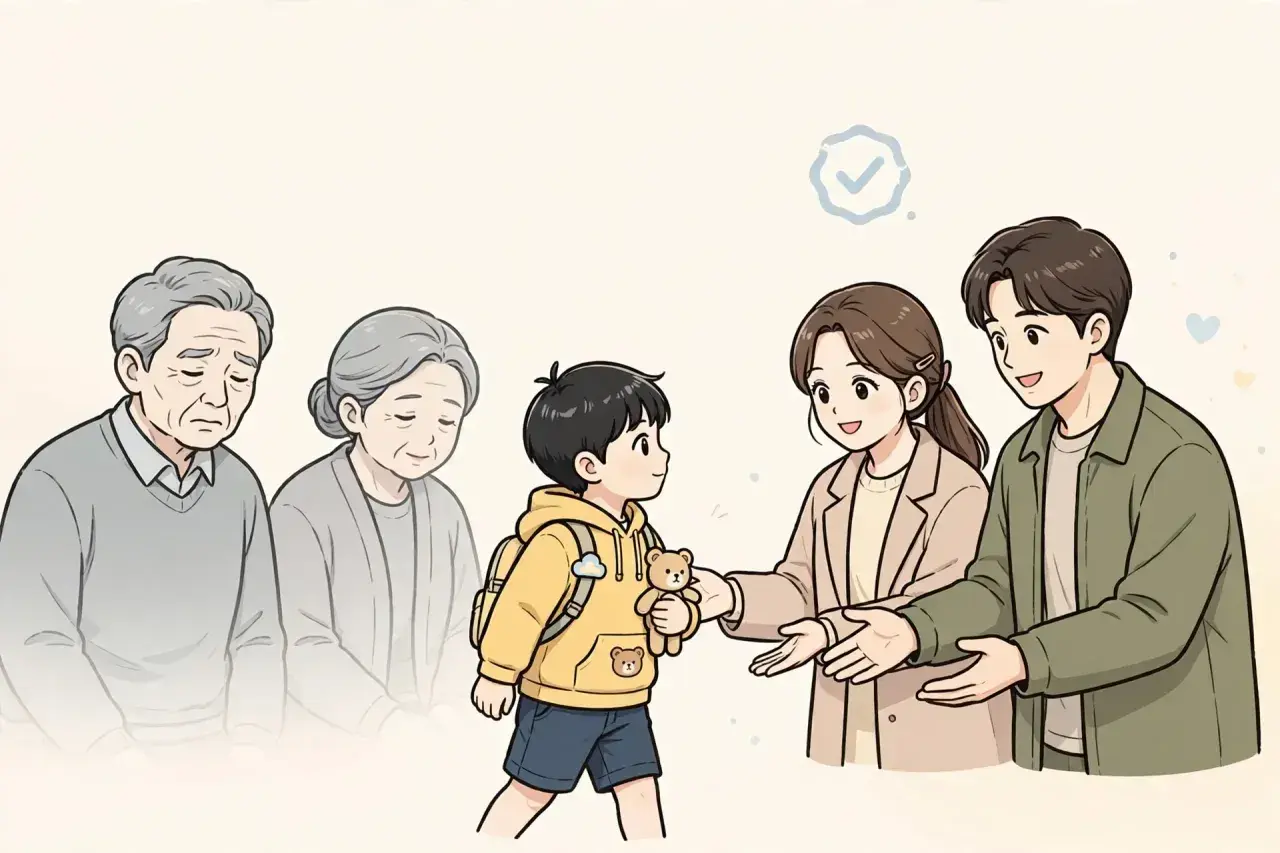
When Hannah and Daniel Park first met Noah, he was nine years old and already knew their home well. He was the son of a family friend who could no longer care for him. Over several months, weekend visits grew into school mornings, dinner at the Parks’ table, and a room that felt unmistakably his.
The couple had been married for four years and wanted to adopt Noah together. But as they began asking questions, they discovered that “adoption” was not a single legal route in Korea. An ordinary adoption would make them his legal parents while leaving important legal ties to his birth family in place. A full adoption, known in Korean law as chin-yangja adoption, could give him the legal status of their child born during their marriage—but would also end most of those ties.
Hannah and Daniel were not choosing between a loving home and an unloving one. They were deciding what kind of legal family structure would best protect Noah, and what that structure would mean for his identity and relationships over time.
2. The Legal Question
What is the difference between ordinary adoption and full adoption under Korean law, and what must a married couple establish before a court can approve a full adoption?
3. What Korean Law Says
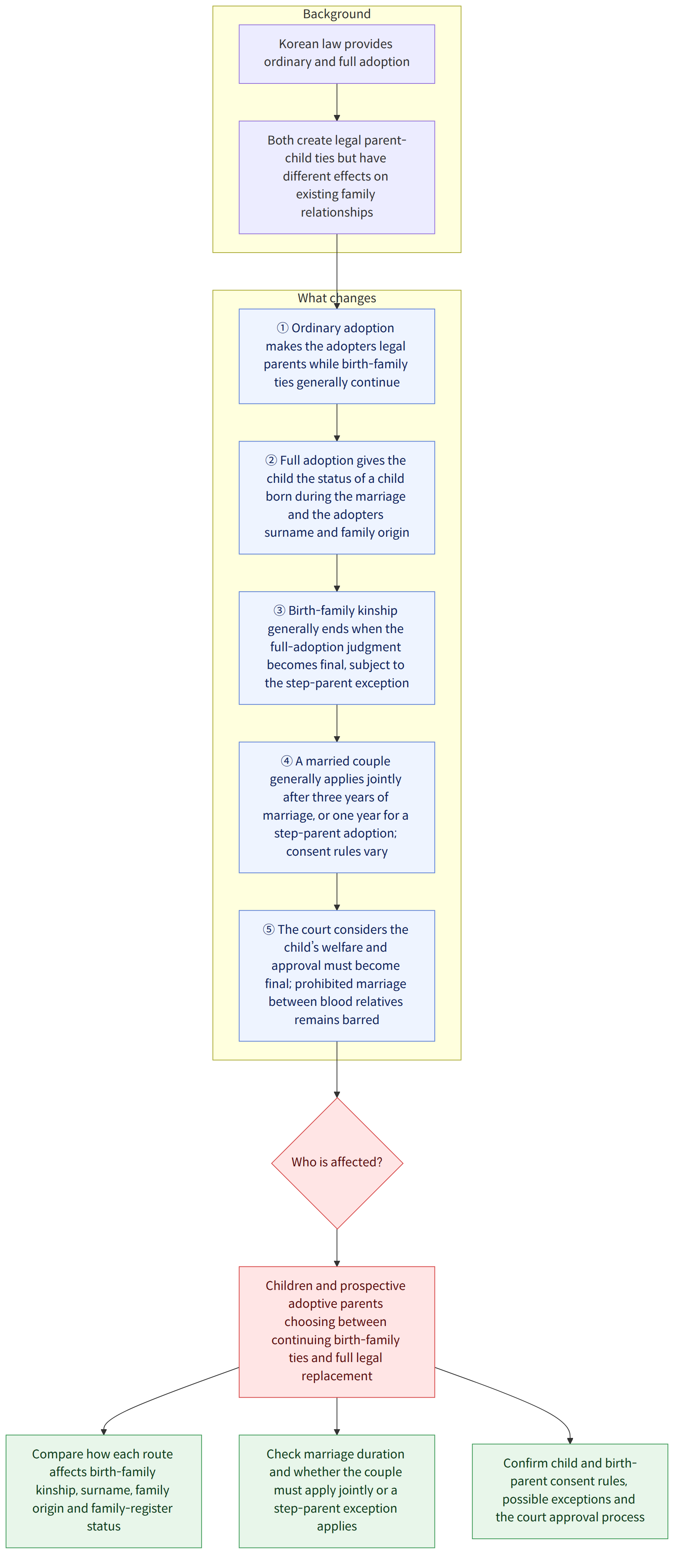
Korean law provides two distinct adoption frameworks. Both can create a legal relationship between a child and adoptive parents, but their effects on the child’s existing family relationships are not the same.
Ordinary adoption
In an ordinary adoption, the adoptive parents become the child’s legal parents, but the child’s legal relationship with the birth family generally continues. The adoption does not, by itself, make the child legally equivalent to a child born to the adoptive parents during their marriage. Nor does it automatically give the child the adoptive parents’ surname and family origin. A surname change may involve separate legal steps, and the family-register treatment is not the same as under full adoption.
Full adoption
Full adoption is designed to give the child the legal status of a child born during the adoptive parents’ marriage. The child takes the adoptive parents’ surname and family origin, and the family register records the child as their child. The legal relationship with the birth parents and their relatives generally ends when the court’s approval becomes final—not merely when an application is filed.
Civil Act, Article 908-3(2), in substance: When a full-adoption judgment becomes final, the child’s kinship relationship with the birth parents and their relatives ends, subject to the statutory exception for a spouse’s child adopted by the other spouse.
That exception matters in a step-parent adoption. If one spouse adopts the other spouse’s biological child, the child’s relationship with that spouse—and that spouse’s relatives—does not end merely because of the full adoption.
The legal separation from the birth family also has an important limit. Even after the relevant kinship relationships end for legal purposes, Korean law continues to prohibit marriage between people who were blood relatives within the prohibited degree before adoption.
Civil Act, Article 809(1), in substance: Marriage is prohibited between blood relatives within the specified degree, including where adoption has changed the legal kinship relationship.
The main requirements for full adoption
A court does not approve full adoption simply because the adults prefer it. The Civil Act sets conditions, and the court must consider whether the adoption serves the child’s welfare. Among the principal requirements are:
- Joint adoption by a married couple: As a general rule, the couple must have been married for at least three years and apply together.
- A shorter period for a step-parent adoption: If one spouse is adopting the other spouse’s biological child, the minimum marriage period is generally one year.
- The child’s consent and the birth parents’ consent: The law sets age-based rules for the child’s consent and recognizes exceptions to the birth parents’ consent requirement in specified circumstances.
- Judicial approval: The adoption takes effect as a full adoption only when the court approves it and the judgment becomes final.
The exact consent requirements depend on the child’s age and the circumstances, including whether a statutory exception applies. Families should confirm those details before relying on the birth parents’ agreement—or assuming that it is unnecessary.
4. How Korean Courts Approach This
Korean courts treat full adoption as a major and lasting change to a child’s legal family relationships. It is not merely a way to make a family register look simpler or to give adults the legal arrangement they prefer. The court’s central concern is the child’s welfare and whether the proposed adoption is appropriate in the child’s circumstances.
The practical principle: A full adoption should be assessed from the child’s perspective. The court must consider the legal consequences, the child’s situation, and whether the required consents and statutory conditions have been met.
That means the court may look beyond the couple’s good intentions. It can examine the stability of the home, the child’s wishes and understanding in light of the law’s consent rules, the history of the child’s care, and the position of the birth parents. Approval is a judicial decision, not an automatic result of a family agreement.
Courts also give legal effect to the distinction between the two types of adoption. In an ordinary adoption, the birth-family relationship generally remains. In a full adoption, the relevant legal ties end when the judgment becomes final, apart from the statutory exceptions. But a change in legal status does not erase a child’s personal history, and families should not assume that a family-register entry means every record of the past has disappeared.
5. Applying the Law to the Case
For Hannah and Daniel, the first question is whether they meet the basic requirements for a joint full adoption. They have been married for four years, so they satisfy the general three-year marriage period described by the Civil Act. Because neither is Noah’s spouse’s biological parent, the one-year step-parent exception is not the relevant route; they would apply together under the general rule.
Second, they must address consent. Noah is nine, so the rules governing a child younger than thirteen are relevant: the required consent is ordinarily given through the child’s legal representative. The law’s requirements concerning the birth parents must also be examined. In this fictional case, Noah’s birth parents are able and willing to give the required consent. In another family, the answer could differ if a parent cannot be located or a statutory exception applies.
Third, the couple must decide whether the consequences of full adoption are right for Noah. If the court approves the petition and the judgment becomes final, Noah will be treated in law as the Parks’ child born during their marriage. He will take their surname and family origin, and his family-register status will reflect that parent-child relationship. At the same time, his legal kinship relationship with his birth parents and their relatives will generally end.
That is a more profound change than simply adding adoptive parents. The Parks therefore need to think carefully about how they will explain Noah’s background to him and how they will support any continuing personal relationship with his birth family, if appropriate. The legal end of kinship does not dictate what Noah remembers, feels, or may wish to know.
Finally, a court must decide whether the arrangement serves Noah’s welfare and whether all legal requirements have been satisfied. The Parks’ stable marriage and Noah’s growing connection to their home are relevant, but neither fact guarantees approval. On the facts of this fictional case—where the required consents are available and the court finds that the adoption is in Noah’s interests—the court approves the petition. The full adoption takes effect when the judgment becomes final.
If you are dealing with a similar issue, attorney Ji-sun Ahn of Ijun Law Firm can review the birth and family registration records, any adoption order or consent, and the child’s current living arrangements with you. These details can help clarify which options apply to your situation.
6. Conclusion: What Happened, and What Should You Do?
The court grants Hannah and Daniel’s petition, and, once the judgment becomes final, Noah becomes their child in the full legal sense. His legal ties to his birth parents’ family generally end, although his personal history does not. The Parks understand that full adoption offers a more complete legal parent-child relationship, but also carries consequences that ordinary adoption does not.
For families considering adoption in Korea:
- Compare the legal effects before choosing. Ask specifically whether birth-family kinship will continue, what surname and family-origin rules will apply, and how the family register will reflect the adoption.
- Check consent and eligibility early. Marriage duration, joint application, the child’s age, birth-parent consent, and any statutory exception can affect the process.
- Plan for the child’s long-term wellbeing. Court approval is only one part of adoption; consider how you will discuss the child’s origins and preserve appropriate support and relationships.

















