

1. A Human Story
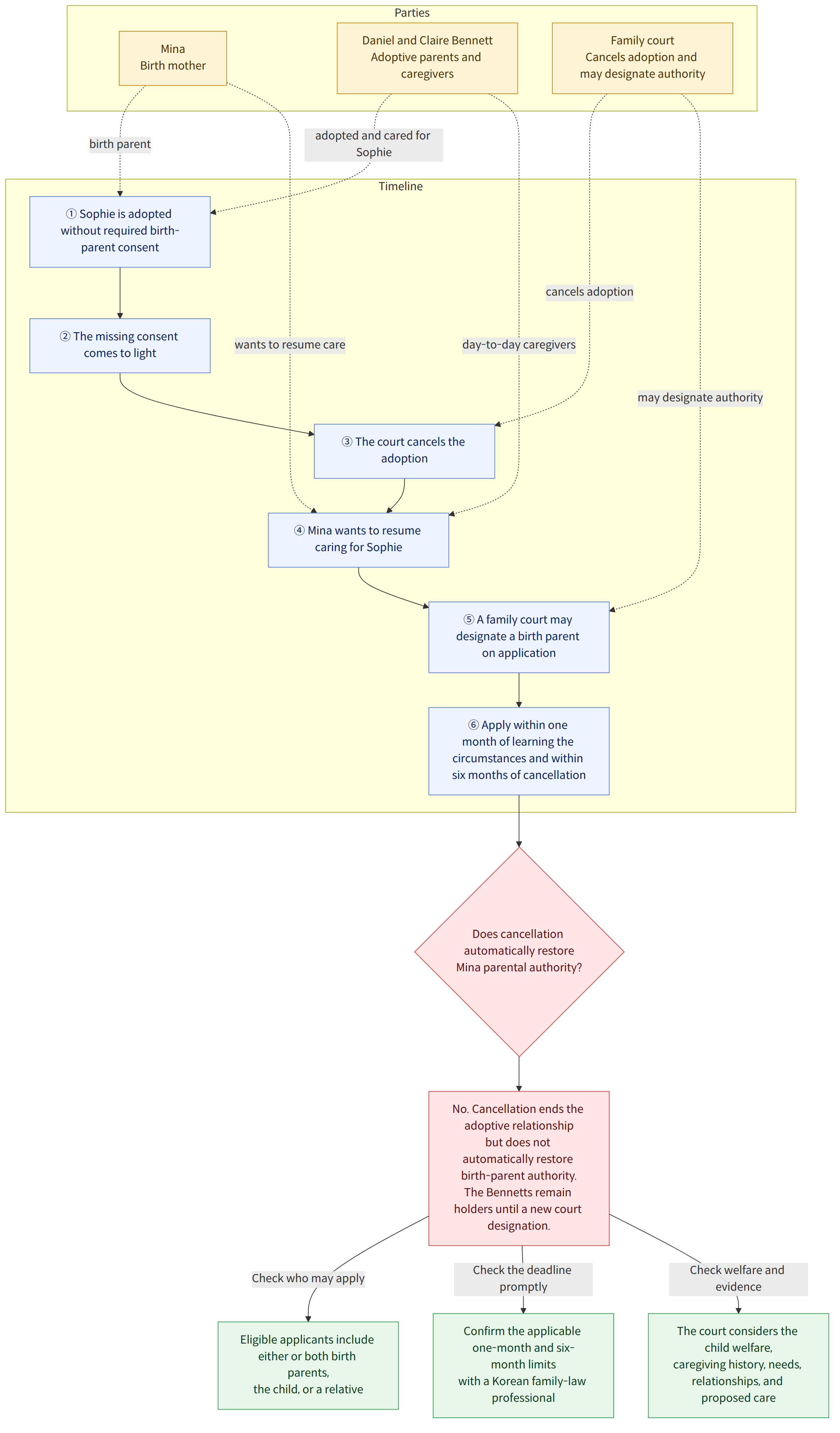
When Daniel and Claire Bennett adopted eight-year-old Sophie, they imagined the family’s difficult chapter was behind them. Sophie had settled into their home, begun at a new school, and started calling them Mom and Dad. But the adoption had gone ahead without the required consent of her birth parents. After that defect came to light, a court canceled the adoption.
Sophie’s birth mother, Mina, wanted to resume caring for her. The Bennetts, meanwhile, had been Sophie’s day-to-day caregivers and believed that the cancellation meant Mina immediately regained legal authority over the child. Mina was unsure whether she could make decisions about Sophie’s schooling and medical care. Each adult wanted to protect Sophie; none knew who was legally entitled to act for her.
2. The Legal Question
When a Korean court cancels an adoption of a minor because the birth parents’ required consent was missing, does parental authority automatically return to the birth parents, or does it remain with the adoptive parents until a court makes a new order?
3. What Korean Law Says
Korean law separates two questions that can seem like one: whether the adoptive relationship has ended, and who has parental authority over the child afterward.
Under the Civil Act, adoptive parents have parental authority over a minor child they adopt. The law also provides that cancellation of an adoption does not take effect retroactively. Although the legal kinship created by adoption ends when the adoption is canceled, that does not, by itself, make the birth parents’ parental authority spring back into force.
In substance, Civil Act Articles 824 and 909: Adoption cancellation is not retroactive, and adoptive parents exercise parental authority over a minor adoptee. The cancellation therefore does not automatically undo the legal consequences that arose while the adoption was in effect.
The Civil Act provides a route for the family court to designate a birth parent as the child’s parental-authority holder after cancellation:
In substance, Civil Act Article 909-2(2): After an adoption is canceled, the family court may designate one or both birth parents as the person or persons with parental authority, on application by an eligible applicant.
The eligible applicants include:
- Either or both birth parents;
- The minor child; or
- A relative of the minor.
There are strict time limits. An application must be made within one month after the applicant learns of the relevant circumstances, and within six months of the adoption’s cancellation. The statute also addresses the situation in which both adoptive parents have died: the six-month period may run from their deaths. Anyone considering an application should confirm the applicable deadline promptly with a Korean family-law professional.
The Civil Act also provides that the family relationship created by adoption ends upon cancellation or dissolution of the adoption. But the end of that relationship and the designation of a new holder of parental authority are separate legal steps.
4. How Korean Courts Approach This
The key principle is that a canceled adoption does not automatically restore the birth parents’ parental authority. That approach differs from the view taken in some earlier practice, under which authority was treated as reviving automatically. The concern was that an automatic return could undermine the child’s welfare—for example, if it abruptly changed who could make essential decisions without a court considering the child’s circumstances.
A family court’s designation is therefore not simply a formality. The court considers the child’s welfare and the particular family situation, including who has been caring for the child, the child’s needs and relationships, and the proposed parent’s ability to provide care. The outcome depends on the evidence; cancellation alone does not guarantee that a birth parent will be designated.
The practical rule: Until the family court makes a new designation, parental authority does not automatically transfer to the birth parents merely because the adoption has been canceled.
5. Applying the Law to the Case
First, the court canceled Sophie’s adoption because the required consent of her birth parents had not been obtained. That defect supplied a basis for cancellation under the Civil Act’s rules on consent to adoption.
Second, cancellation ended the adoptive relationship, but it did not operate retroactively. The legal consequences of the adoption were not erased as though the adoption had never existed. In particular, Mina’s parental authority did not automatically revive at the moment of cancellation.
Third, the Bennetts remained the holders of parental authority unless and until the family court made a new designation. This does not mean the adoption remained in force; it means that the legal question of who could exercise parental authority required a further court decision.
Finally, Mina applied to the family court within the statutory time limits. The court heard from the family and considered Sophie’s circumstances. In this fictional case, the evidence showed that Mina had a stable home and had maintained a relationship with Sophie, and that Sophie wanted to live with her. The court designated Mina as the holder of parental authority. From that point, Mina—not the Bennetts—could exercise that authority under the court’s order.
A different record could lead to a different decision. The court could designate one or both birth parents, and the child’s welfare—not the adults’ assumptions about what cancellation automatically means—would guide the decision.
If you are dealing with a similar issue, attorney Ji-sun Ahn of Ijun Law Firm can review the birth and family registration records, any adoption order or consent, and the child’s current living arrangements with you. These details can help clarify which options apply to your situation.
6. Conclusion: What Happened, and What Should You Do?
Mina ultimately became Sophie’s legally designated parental-authority holder, but not automatically when the adoption was canceled. The Bennetts retained parental authority until the family court made its order. The cancellation ended the adoption; the court’s later decision determined who would hold authority afterward.
If you face a similar situation:
- Do not assume authority has transferred automatically. Check the cancellation order and obtain legal advice about who may make decisions for the child while an application is pending.
- Act quickly. The one-month and six-month limits can be decisive; confirm when each deadline begins and file promptly.
- Put the child’s needs at the center. Gather practical evidence about caregiving, stability, the child’s relationships, and the proposed living arrangements for the family court.

















