
Section 1 — A Human Story
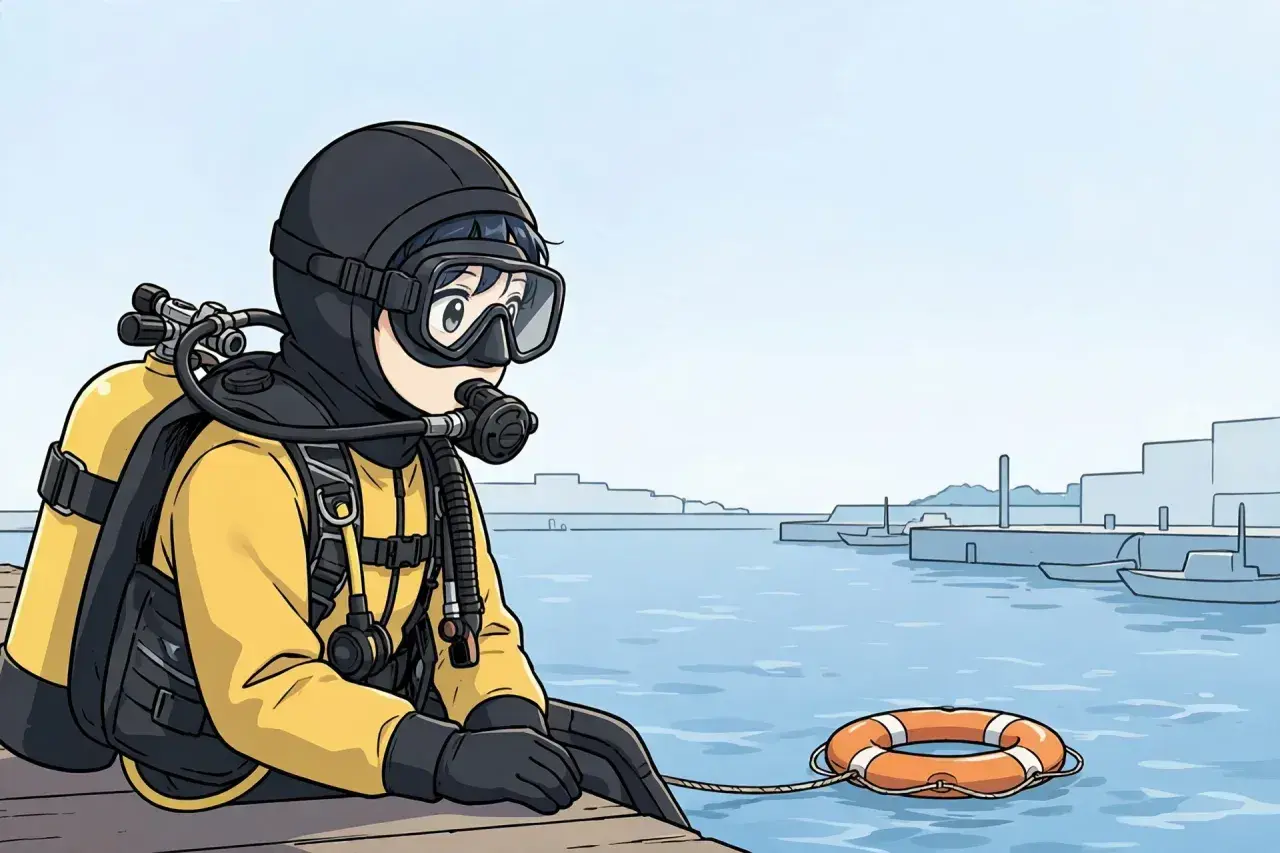
On a clear Saturday morning, Claire Morgan stood beside the harbor with a clipboard in one hand and a stack of dive masks in the other. She ran a small underwater-experience business on Korea’s coast, taking visitors to nearby reefs. Most weekends brought a different mix of customers, and the final headcount sometimes changed shortly before departure.
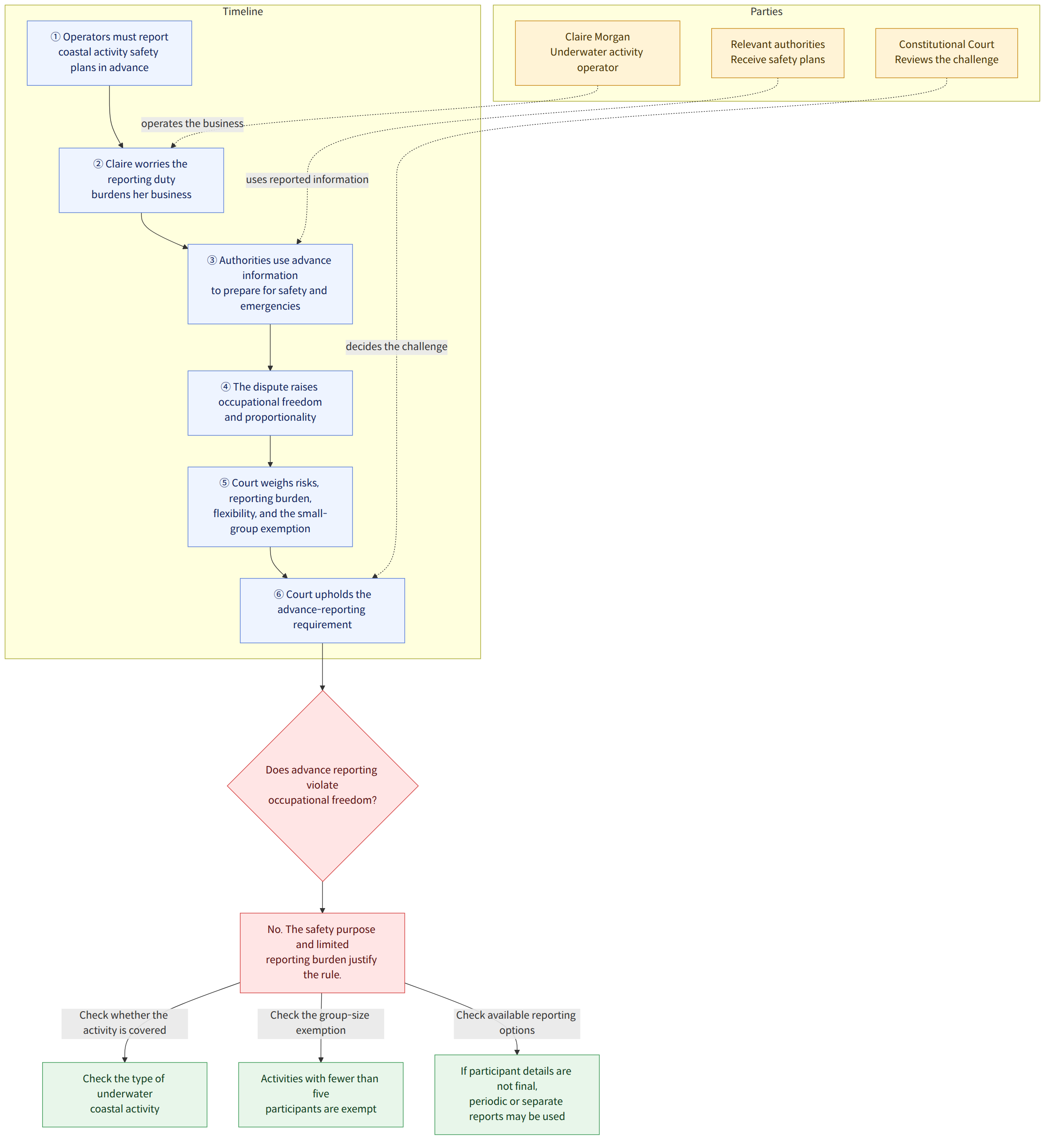
Then Claire learned that operators like her had to prepare and file a coastal activity safety plan in advance. She worried that the paperwork would be an unnecessary obstacle for a small business—and wondered whether the government could make her report her plans before she took paying customers into the water. Her concern was not that safety mattered, but that a blanket reporting rule might go too far.
Section 2 — The Legal Question
Does requiring an operator of an underwater coastal experience to prepare and report a safety plan in advance violate the constitutional freedom to conduct a profession?
Section 3 — What Korean Law Says
The Korean Constitution protects occupational freedom: the ability to choose and pursue a profession. That freedom is important, but it is not absolute. The government may regulate professional activity to protect public interests, provided the restriction is proportionate.
The legal dispute concerned a reporting duty for operators of underwater coastal activities. Its purpose was to give relevant authorities information before an activity began, so they could manage safety in advance and respond more quickly and accurately if an accident occurred.
The Constitutional Court concluded that advance reporting pursues the legitimate aim of protecting participants’ lives and physical safety, and that collecting information about planned activities beforehand is a suitable way to advance that aim.
The court’s reasoning focused on several practical points:
- The activity can carry serious risks. An underwater incident may become a major accident, making advance safety management important.
- Authorities need information in advance. Knowing the main details of an activity can help officials prepare for safety oversight and an emergency response.
- The duty is to report, not to obtain permission. The rule requires operators to provide information; it does not, in itself, make the activity subject to a government permit.
- Some flexibility is built in. Operators who cannot yet finalize participant details may use a periodic activity report or report each activity separately. The rule also exempts underwater activities with fewer than five participants.
These safeguards mattered to the court when it considered whether the restriction went further than necessary.
Section 4 — How Korean Courts Approach This
When a constitutional challenge argues that a business regulation infringes occupational freedom, Korean courts generally assess whether the measure has a legitimate purpose, whether it can help achieve that purpose, whether a less restrictive approach would work just as well, and whether the public benefit is fairly balanced against the burden on the business.
In this dispute, the Constitutional Court upheld the advance-reporting requirement. It reasoned that authorities cannot effectively prepare for underwater safety risks if they have no reliable information about planned activities. Because the rule imposed a reporting obligation rather than requiring operators to obtain approval, the court considered the burden limited in comparison with the public interest in protecting life and bodily safety. The court also took account of the flexible reporting options and the exemption for groups of fewer than five participants.
The court’s central balance was between an operator’s paperwork burden and the public interest in protecting participants from serious harm. It found the safety interest weightier in this setting.
Section 5 — Applying the Law to Claire’s Operation
Claire’s business offers underwater activities to paying participants. Those activities fall within the kind of operation the reporting rule was designed to cover, and her usual groups are large enough that the fewer-than-five exemption would not apply.
The analysis then proceeds step by step:
- There is a legitimate public purpose. Underwater activities can involve risks that are difficult to manage once an emergency is underway. Advance information can help the authorities prepare and act more effectively.
- Reporting is connected to that purpose. Claire’s plan can give authorities advance notice of the activity’s main details. That information is relevant to safety oversight and emergency response.
- The court did not regard the obligation as excessive. Claire may find the filing inconvenient, especially when her customer list changes. But the reporting duty is not a requirement to secure permission before operating. The rules also provide options for reporting when participant details are not yet settled.
- The balance favors safety. The burden on Claire is a requirement to provide information, while the public benefit is the protection of participants’ lives and physical safety. The court found that balance constitutionally acceptable.
The result would differ on the specific question of whether a particular session is exempt if it involves fewer than five participants. Claire would need to confirm the applicable participant count and reporting procedure for each relevant activity; she should not assume that a changing booking list automatically removes her reporting obligation.
Section 6 — Conclusion: What Happened, and What Should You Do?
Claire’s constitutional objection would not succeed: Korean law, as assessed by the Constitutional Court, does not treat this advance safety-plan reporting duty as an unconstitutional infringement of an underwater activity operator’s freedom to conduct a profession. The rule was upheld because it supports advance safety management, imposes a reporting rather than a licensing requirement, and includes limited accommodations for smaller or not-yet-finalized activities.
For operators in a similar position:
- Check the current reporting rules and forms with the relevant authority before scheduling an activity; the details that apply can depend on the activity and participant count.
- Keep a record of your planned dates, locations, participant numbers, and submitted reports, particularly when bookings change.
- If you are unsure whether a session qualifies for an exemption or which reporting format fits your schedule, get the facts and paperwork reviewed before relying on an exception.
If your bookings change or you are unsure which reporting route applies, attorney Ji-sun Ahn of Ijun Law Firm could review your activity schedule, participant records, and any safety-plan form or notice you received to help you understand how those documents relate to the reporting requirement.

















