

1. A Human Story
Eastbridge Cyber University had spent years building a degree program for students who studied online while working, raising families, or living far from a campus. Then its administrators noticed a statutory rule that appeared to treat Eastbridge graduates differently from people who had studied the same subject and graduated from a conventional university.
The university’s president, Daniel Park, believed the distinction was unfair. The institution prepared a constitutional complaint, hoping the Constitutional Court would review the rule. Maya Lee, a recent graduate who believed the distinction affected her own prospects, watched closely. Before the court could consider whether the law treated graduates unjustly, however, it had to answer a more basic question: who, legally, was bringing the case?
2. The Legal Question
Can a cyber university itself file a constitutional complaint against a law that appears to disadvantage its graduates, or must the complaint be brought by someone with the legal capacity to act as a claimant—such as an affected student?
3. What Korean Law Says
A constitutional complaint is not simply a request for the court to review a law that someone considers unfair. The claimant must be legally capable of bringing the case and must generally show that the exercise or failure to exercise public power has affected that claimant’s own constitutional rights.
Under the Constitutional Court’s established approach, a university that is merely an educational facility established under the Private School Act and the Higher Education Act does not, by that fact alone, have the legal capacity to hold rights or to act as a party in civil litigation. Such a university therefore cannot itself be a claimant in a constitutional complaint.
The key points are:
- The university’s legal status matters. A school operating as an educational facility is not necessarily a separate legal person. Its name, campus, or president does not automatically give it an independent legal identity.
- Claimant capacity is a threshold issue. The court may dismiss a complaint if the named claimant cannot legally bring it, without considering whether the challenged law is constitutional.
- The person directly affected may be able to file. The Constitutional Court has recognized that a student enrolled at a university can have claimant capacity. That does not automatically establish that the student’s complaint is admissible or that the student’s rights were violated; those questions must also be examined.
- The claimant must be identified correctly. The university, its operating foundation, and an individual student are not interchangeable. Each must establish its own legal capacity and connection to the alleged rights violation.
4. How Korean Courts Approach This
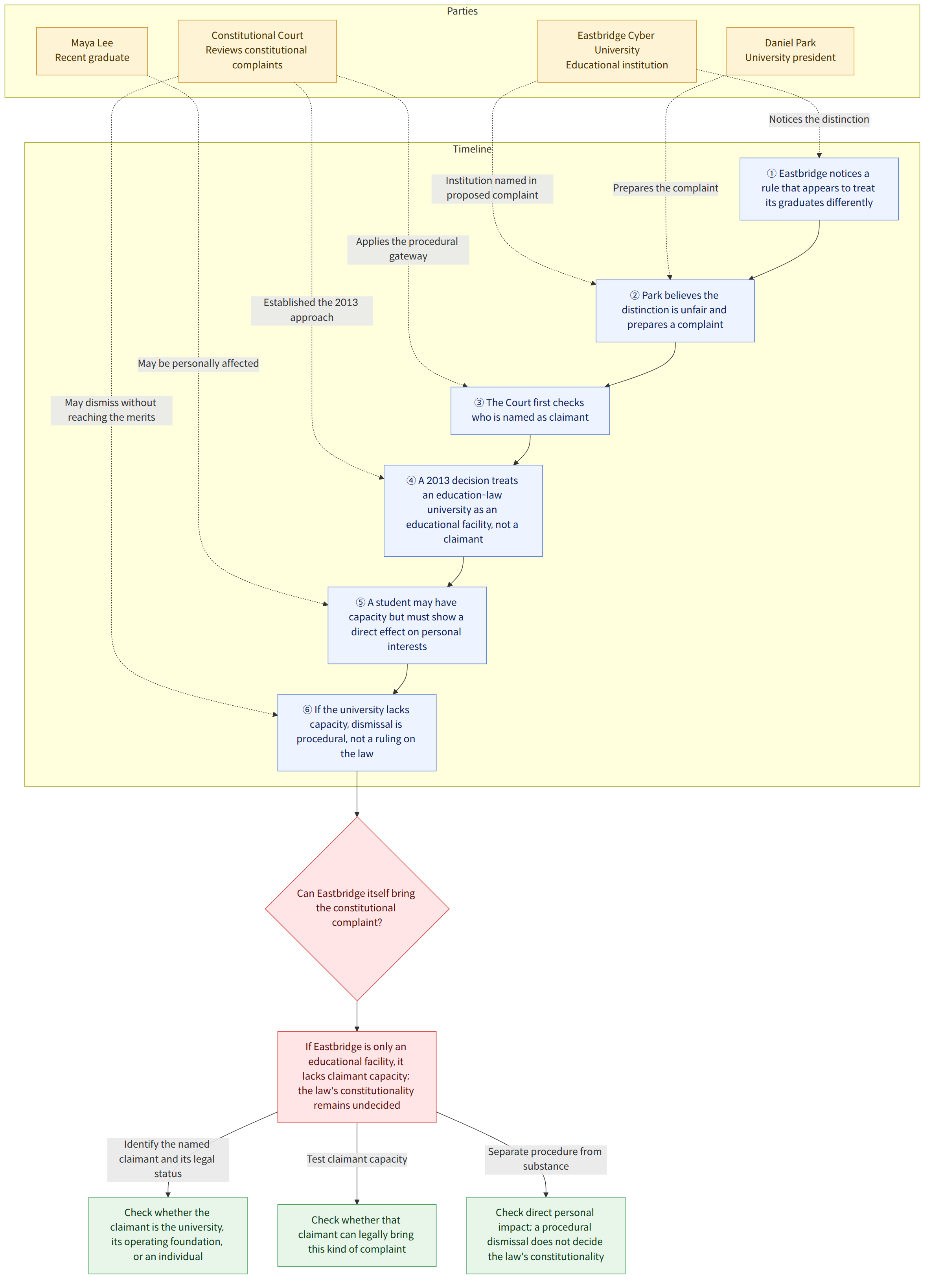
The Constitutional Court treats claimant capacity as a procedural gateway. It asks first whether the named claimant is a person or legal entity that can bring a case of this kind. Only if that requirement is met can the court proceed to other questions, including whether the challenged rule affects the claimant directly and whether it infringes a protected constitutional right.
The Court has consistently distinguished a university as an educational facility from a legally separate entity. In a decision issued on August 29, 2013, it applied that distinction to a university established under education laws and concluded that the institution itself lacked the capacity to bring a constitutional complaint. The result was dismissal on procedural grounds, not a ruling on the underlying constitutional merits.
A court can decline to hear the substance of a dispute when the claimant is not legally capable of bringing it. That procedural dismissal does not decide whether the challenged law is fair or constitutional.
The Court’s recognition that a student may have claimant capacity reflects the different legal position of an individual. But the student must still show that the rule has a sufficiently direct effect on the student’s own legal or constitutional interests. A general concern about unequal treatment, without an individual connection to the rule, may not be enough.
5. Applying the Law to the Case
First, the court would examine the identity of the claimant named in Eastbridge’s petition. If the claimant is the university itself, the question is whether Eastbridge is a separate legal person or merely an educational facility established and operated under the education laws.
Second, if Eastbridge has only the status of an educational facility described above, the university cannot rely on its institutional interest in its graduates’ treatment to create claimant capacity. The fact that its president authorized the filing, or that graduates may be affected, would not turn the school into a separate legal person.
Third, the court would likely dismiss a complaint filed in Eastbridge’s own name at this threshold stage. That would leave the alleged difference in treatment unresolved: the court would not have decided whether the statutory distinction was justified or unconstitutional.
Maya’s position would be different in one important respect. As an individual student or graduate, she may have claimant capacity. But she would still need to show that the provision applies to her, or otherwise directly affects her own rights, and satisfy the other requirements for a constitutional complaint. Her ability to bring a case would not guarantee a ruling in her favor.
If the university’s operating foundation is a separate legal entity, that would not automatically solve the problem. The foundation would have to establish that it is the proper claimant and that the challenged rule affects rights belonging to the foundation itself. It could not simply substitute for students whose individual interests are at stake.
A review of the university’s founding and registration documents, the exact statutory provision, and the way that provision applies to a particular student may help clarify who could properly bring a complaint. A reader could ask [[lawyer]] to review those documents and assess the claimant and the claimed direct effect, without assuming that a student’s eligibility to file guarantees success.
If a university is considering a complaint, the founding and registration documents, the exact statutory provision, and evidence showing how it applies to a particular student are central to identifying the proper claimant. A reader could ask attorney Ji-sun Ahn of Ijun Law Firm to review those materials and the proposed claimant’s connection to the rule.
6. Conclusion: What Happened, and What Should You Do?
Eastbridge’s institutional complaint would likely be dismissed if the university is only an educational facility and lacks separate legal capacity. The court would not reach the question of whether the law actually discriminates against its graduates. Maya, as an individual, could potentially bring her own complaint if the rule directly affects her rights and she meets the remaining procedural requirements—but that would require a separate assessment of her circumstances.
For readers facing a similar issue:
- Check who legally operates the school. Review its founding and registration documents rather than assuming the university name is itself a legal person.
- Identify an individually affected claimant. Determine whether the law applies directly to a particular student or graduate, and gather documents showing how it affects that person.
- Separate procedure from merits. Confirm claimant capacity and other filing requirements before investing in an argument that the law is unconstitutional.

















