

A Human Story
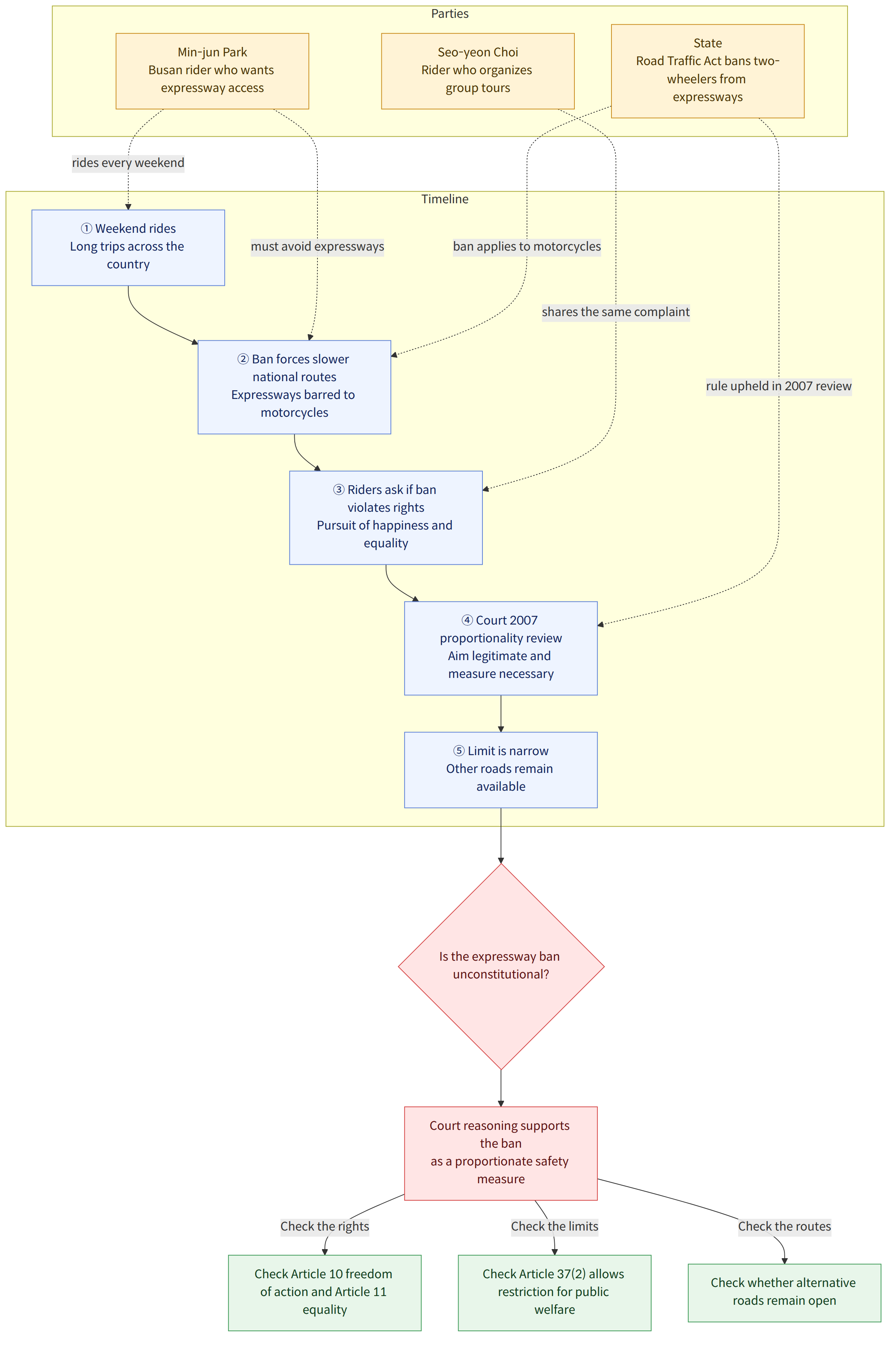
Min-jun Park, a 34-year-old graphic designer in Busan, spends nearly every weekend on his motorcycle. For him, a ride is not just transport. It is the feeling of wind through his jacket and the thrill of a long, open road stretching toward the horizon. Over the years he has crossed much of the country this way, from coastal towns in the south to mountain villages in the north.
Yet his journeys have a frustrating limit. Whenever he plans a trip, he must avoid the expressways and motorway-type roads where traffic moves fastest. Those roads would cut his travel time in half, but he is required to take slower national routes, stopping at traffic lights and winding through towns. His friend Seo-yeon Choi, a fellow rider who organizes group tours, shares the same complaint. Together they begin to wonder whether a rule that keeps them off the fast lanes is simply an outdated restriction on their freedom.
They ask a practical question: does the ban on motorcycles using expressways violate the constitutional right to pursue happiness and the right to equality? Their question is far from unusual, and it reaches the heart of how Korea balances individual liberty against public safety.
The Legal Question
The central issue is whether Article 63 of the Road Traffic Act, which prohibits two-wheeled vehicles other than emergency vehicles from using expressways and motorway-type roads, unlawfully restricts the constitutional right to pursue happiness and the right to equality.
What Korean Law Says
The Road Traffic Act sets out who may use which roads. The relevant provision reads:
Vehicles other than automobiles (two-wheeled vehicles are covered only when they are emergency vehicles), as well as pedestrians, must not travel on or cross expressways and similar roads.
Two constitutional principles frame the dispute:
- Right to pursue happiness: Article 10 of the Constitution protects a general freedom of action, including freedom to move and to choose how to travel.
- Right to equality: Article 11 guarantees equal treatment, meaning people in comparable situations should not be singled out without good reason.
However, these rights are not absolute. Under Article 37(2) of the Constitution, fundamental rights may be restricted by law when necessary for national security, public order, or public welfare, provided the restriction does not violate the essence of the right.
How Korean Courts Approach This
The Constitutional Court addressed this exact question in a 2007 decision concerning the earlier version of the same rule. The Court applied a proportionality analysis, examining whether the restriction pursued a legitimate aim, was an appropriate means, was necessary, and was balanced against the harm to the individual.
The Court's reasoning rested on several points:
- Structural risk: Two-wheeled vehicles leave riders exposed, so even a minor impact can throw the rider from the vehicle.
- Maneuverability: Motorcycles can change lanes and direction abruptly, which raises the chance of collisions at high speed.
- Severity of harm: Statistics cited by the Court showed that two-wheeler accidents had a fatality rate roughly 3.4 times higher than that of four-wheeled vehicles.
- Impact on others: Allowing motorcycles on fast roads could endanger ordinary cars travelling at high speed.
The Court concluded that the aim of protecting riders and maintaining smooth, safe traffic was legitimate, and that a blanket ban was an appropriate and necessary way to achieve it. It also stressed that the restriction was limited, since expressways exist only in sections where alternative roads are available. Riders were not prevented from travelling; they simply had to use other routes.
Applying the Law to the Case
Applying this reasoning to Min-jun and Seo-yeon, the analysis proceeds in steps.
Step 1: Is there a restriction? Yes. The ban clearly stops them from using expressways on their motorcycles, which limits their freedom of movement and their choice of travel route.
Step 2: Is the aim legitimate? Yes. Protecting riders from a high-risk form of transport and keeping high-speed roads safe for all users are recognized public purposes.
Step 3: Is the measure appropriate and necessary? The Court has treated a full prohibition as a reasonable means, because the statistical risk is substantial and the danger of a crash at high speed is severe. A less restrictive option, such as speed-limited access, was considered by the Court as something the legislature could reasonably decline to adopt given the stakes.
Step 4: Is the restriction proportionate? The Court found that the limit is narrow. Riders can still reach every destination by other roads, so the ban does not block their movement altogether. The personal inconvenience is real but is outweighed by public safety.
On these facts, Min-jun and Seo-yeon are unlikely to succeed in a challenge. Their frustration is understandable, but the law treats the expressway ban as a justified safety measure rather than an unconstitutional restriction on happiness or equality.
Conclusion: What Happened, and What Should You Do?
Min-jun and Seo-yeon learn that the Constitutional Court has already considered their concern and upheld the ban. The rule restricts their travel choices, but it is justified by the higher accident risk of motorcycles and the public interest in safe, efficient highways. Their rides will continue on national roads, which remain open to them.
For readers in a similar position, a few practical points follow:
- Plan routes around the restriction. Check which roads are designated expressways and motorway-type roads before a long trip, and build alternative routes into your schedule.
- Know that emergency vehicles are treated differently. The exception for two-wheeled emergency vehicles means the rule's scope depends on the vehicle's legal classification, so verify that status before relying on it.
- If you want to challenge a rule, focus on evidence. Courts weigh statistics and the real scope of the restriction, so any argument should address those factors directly rather than rely on personal preference alone.
















