
A Human Story
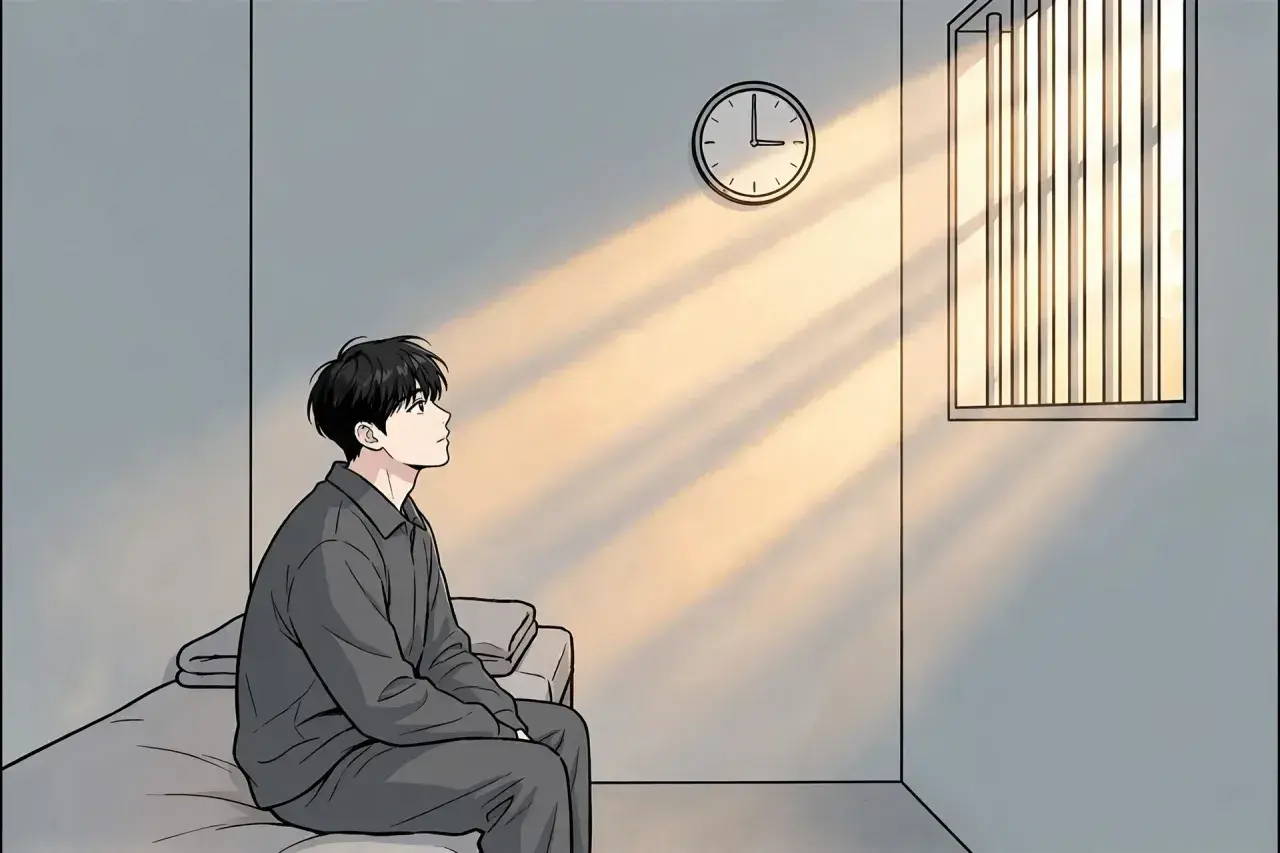
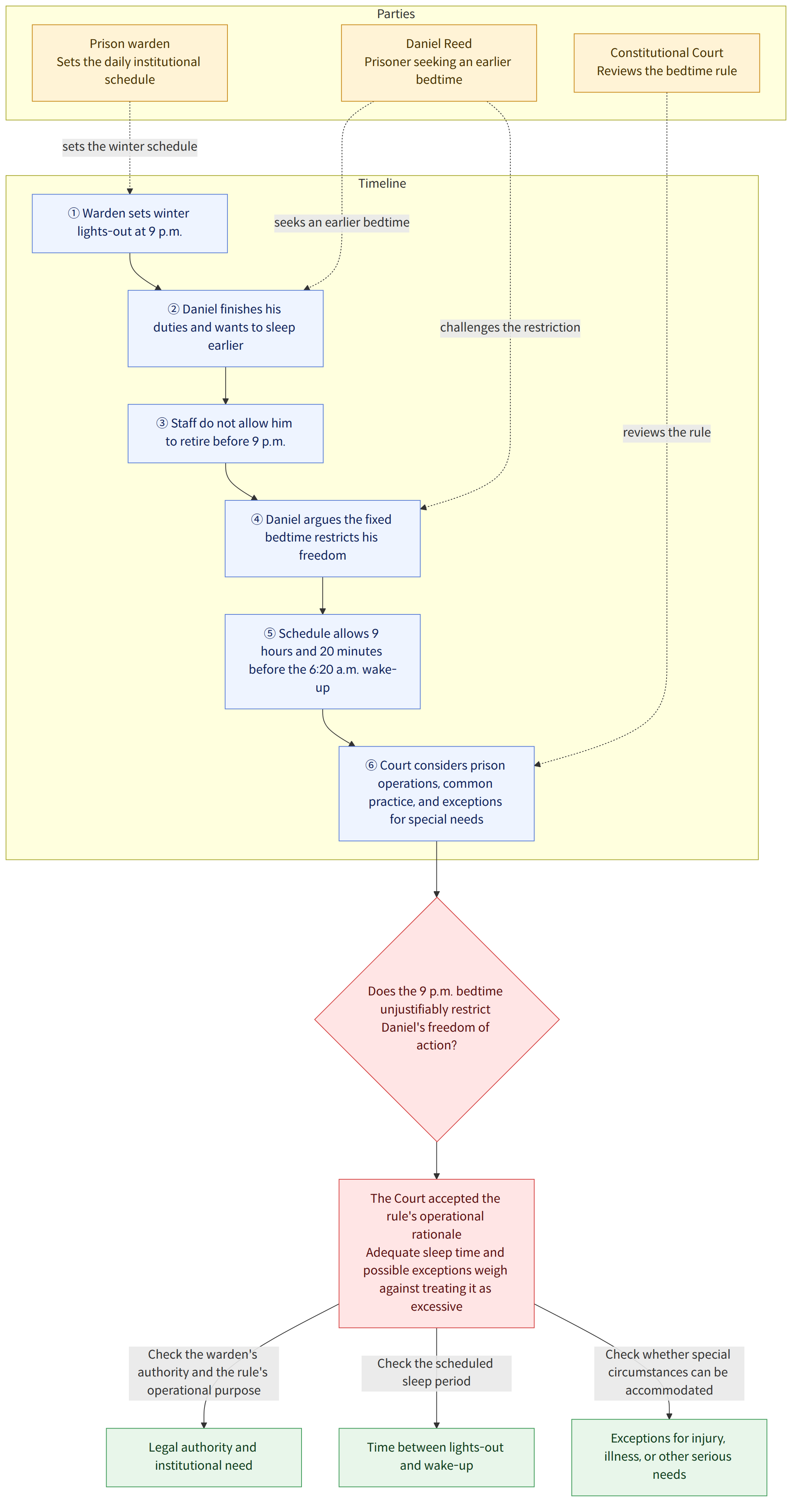
When winter settled over the prison, Daniel Reed found the evenings especially long. His work and other duties were finished well before the new lights-out time, and he wanted to go to sleep earlier. But the prison’s winter schedule set bedtime at 9 p.m., and staff would not let him retire for the night before then.
Daniel saw the rule as more than an inconvenience. He believed that deciding when to sleep was part of his personal freedom, and that a fixed bedtime—unconnected to his sentence—unfairly took that choice away. He began to consider whether the rule violated his constitutional rights.
The Legal Question
May a Korean prison warden require all prisoners to follow a fixed winter bedtime of 9 p.m., even when a prisoner has finished the day’s duties and wants to sleep earlier? Or does that rule unlawfully restrict the prisoner’s freedom of action?
What Korean Law Says
Korean law gives prison officials responsibility for setting and maintaining a daily institutional routine. Under Article 105(2) of the Administration and Treatment of Correctional Institution Inmates Act, prisoners must comply with the daily schedule set by the warden.
Prisoners are required to follow the daily schedule established by the warden under Article 105(2) of the Act.
That authority is not unlimited. A prison schedule affects people’s daily lives and may restrict their freedom of action. The constitutional question is whether the restriction is reasonably connected to the needs of running a shared institution and whether its burden is excessive in light of its purpose.
Several practical considerations matter:
- Shared living and order: A prison houses many people in close quarters. A common timetable can help staff maintain order and safety.
- Sleep opportunity: The amount of time between lights-out and morning wake-up is relevant to whether the schedule imposes an excessive burden.
- Consistency with ordinary practice: A schedule that follows a broadly used prison standard may support the view that it is an operational rule rather than an arbitrary penalty.
- Exceptions for special needs: The availability of exceptions can matter, particularly where an inmate is injured or ill and needs appropriate treatment.
A common bedtime may be permissible when it supports orderly and safe prison operations, provides an adequate period for sleep, and does not disregard circumstances that call for an exception.
How Korean Courts Approach This
Korean constitutional review recognizes that a prison is not an ordinary home. Because prisoners live together under institutional supervision, some common rules are necessary even when they limit individual choice. Courts therefore look at both the purpose of a rule and the way it operates in practice.
In addressing a winter bedtime set at 9 p.m., the Constitutional Court accepted that a uniform bedtime could be necessary for the prison’s orderly operation, safety, and maintenance of discipline. The schedule also set wake-up at 6:20 a.m., allowing 9 hours and 20 minutes for sleep. The Court regarded that as more than the sleep period generally considered appropriate for an adult. It also noted that a 9 p.m. bedtime was consistent with a common standard across prisons and that exceptions could be made under the relevant rules for special circumstances, including injury or illness requiring appropriate treatment.
The broader principle is one of practical balance: a prisoner’s freedom matters, but it must be weighed against the realities of collective life and security behind prison walls. A routine rule is not automatically unconstitutional merely because it prevents an individual from choosing a different schedule.
Applying the Law to Daniel’s Case
Daniel’s wish to sleep earlier is understandable. But the constitutional issue is not simply whether he would prefer a different bedtime. It is whether the prison’s rule unjustifiably restricts his freedom of action.
- The warden has statutory authority to set a daily schedule. Article 105(2) requires prisoners to follow that schedule. A bedtime can form part of it, even though it is not itself a criminal punishment.
- The rule serves institutional purposes. A single bedtime can make it easier to manage a shared living environment and maintain safety and order. Those are legitimate concerns in a prison.
- The schedule provides a substantial sleep period. With lights-out at 9 p.m. and wake-up at 6:20 a.m., the scheduled period is 9 hours and 20 minutes. That fact weighs against finding the rule excessively burdensome on its face.
- The rule is not necessarily absolute. The possibility of exceptions for special circumstances is important. If Daniel had an injury, illness, or another serious need that made the ordinary schedule unsuitable, the question would include whether the prison considered that need under the applicable rules.
On the facts as given, Daniel has identified a personal preference to sleep earlier, but not a special medical or other circumstance requiring different treatment. The general rule’s purpose, the length of the overnight sleep period, and the availability of exceptions all weigh against a finding that the 9 p.m. bedtime unlawfully infringes his freedom of action.
If a prisoner’s situation differs because of a diagnosed condition or treatment plan, the relevant records and any written request to the prison could be important in assessing whether an exception should have been considered. A reader in that position could ask [[lawyer]] to review those documents and the prison’s response in light of the individual circumstances.
If a medical condition or treatment schedule made the ordinary bedtime unsuitable, the medical records, written request for an exception, and the prison’s response would help show what was considered. You could ask attorney Ji-sun Ahn of Ijun Law Firm to review those documents and explain how the individual facts bear on the legal issue.
Conclusion: What Happened, and What Should You Do?
Daniel’s constitutional challenge would likely fail on these facts. Korean constitutional law permits a prison to set a common bedtime where the rule reasonably supports order and safety, affords an adequate sleep period, and allows exceptions for genuine special needs. The fact that the rule limits personal choice does not, by itself, make it unconstitutional.
For readers facing a similar issue:
- Identify the reason for seeking an exception. A preference for a different routine is not the same as a medical or other exceptional need.
- Keep relevant records. Preserve medical documentation, treatment instructions, written requests, and the prison’s responses if health or injury is involved.
- Ask how the rule applies to your circumstances. A challenge may turn less on the general bedtime and more on whether the prison considered a documented need under its rules.

















