

A Human Story
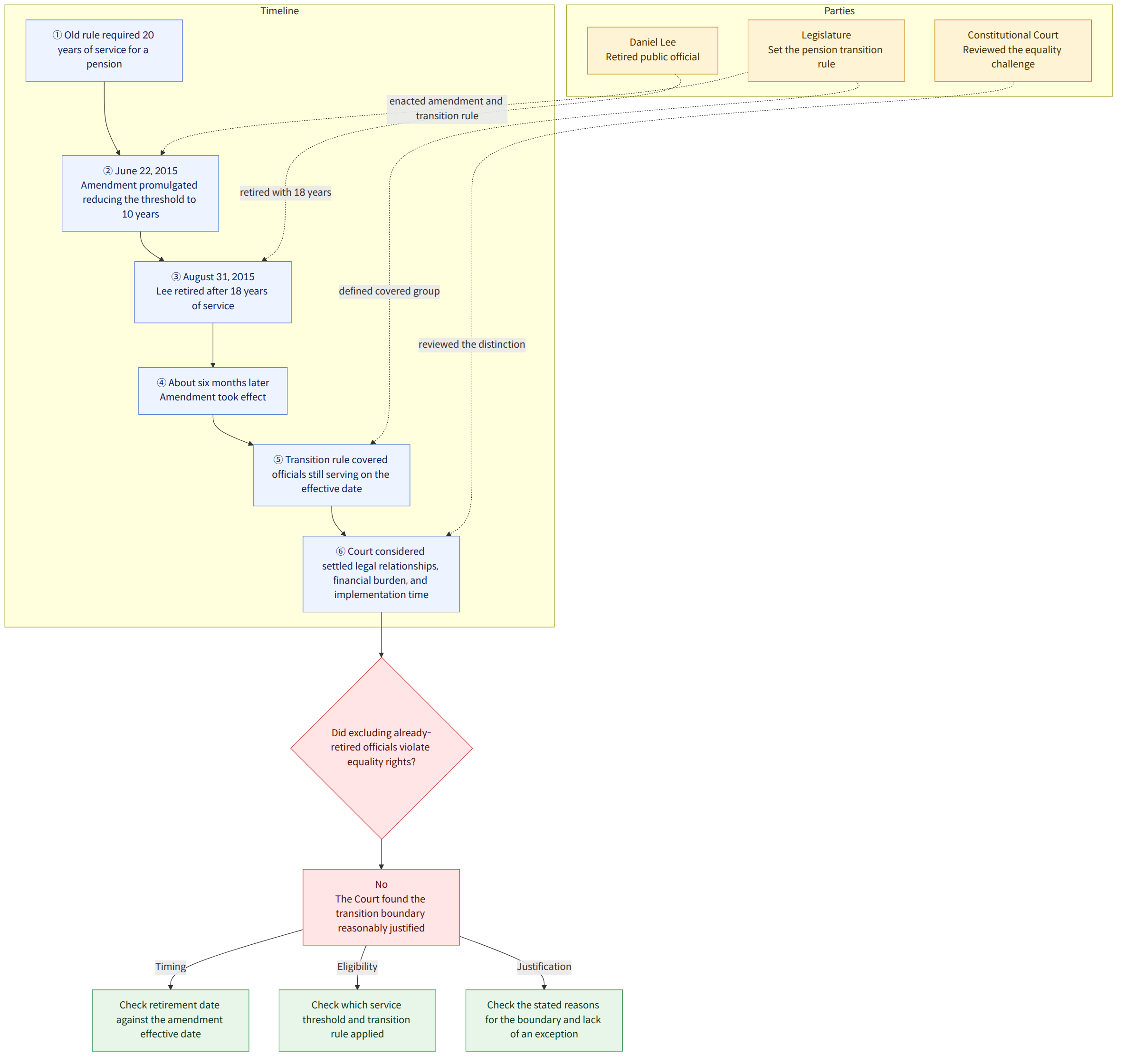
For Daniel Lee, retirement was supposed to mark the end of a long, steady chapter. He had served in government for 18 years, and on August 31, 2015, he left public service at the mandatory retirement age. He expected a pension, but the rules then in force required 20 years of service to qualify for a retirement pension.
A few weeks before he retired, Daniel heard that the law had changed. In June 2015, the qualifying service period had been reduced to 10 years. But the new rule would not take effect until later, and its transition provision covered officials still serving on the effective date. Daniel had already left. The reform seemed to recognize the value of long service—just not his.
The Legal Question
Did Korea’s failure to extend the new 10-year pension threshold to people who retired before the amendment took effect, including those who retired between its announcement and its effective date, violate their constitutional right to equality?
What Korean Law Says
The 2015 amendment reduced the service requirement for a public-official retirement pension from 20 years to 10 years. Its transition rule limited the new threshold to officials who were still in service when the amended law took effect. That meant people who had already retired were assessed under the earlier rule, even if their retirement occurred after the amendment was announced.
The constitutional question was not simply whether Daniel’s situation felt unfair. It was whether the legislature had drawn a distinction without a constitutionally adequate reason.
The Constitutional Court found that applying the new rule to people whose retirement-related legal circumstances had already been settled could undermine legal certainty and create a substantial additional financial burden. It held that setting a defined group of beneficiaries was reasonably justified.
The amendment was passed and promulgated on June 22, 2015, but took effect about six months later. In considering the gap, the Court accepted that time was needed to prepare for the law’s implementation. It also addressed the difficult in-between group: officials who retired after the amendment was promulgated but before it took effect.
The key points were:
- The former 20-year requirement governed people who had retired before the new law took effect.
- The 10-year requirement applied to officials still serving on the effective date, as specified by the transition rule.
- The law did not provide a general exception for people who retired during the interval between promulgation and commencement.
- The absence of such an exception was not, by itself, a violation of the constitutional right to equality.
How Korean Courts Approach This
When a law changes, the legislature often must decide how to treat people whose circumstances fall on either side of the effective date. Korean constitutional review recognizes that such dividing lines can have real consequences, but it does not require every reform to be extended retroactively to everyone who might have benefited from it.
The Court considered the reasons for the transition rule: protecting the stability of legal relationships already settled under the old law and avoiding a substantial financial burden that might follow from extending the new benefit to a wider group. It also accepted that a period between promulgation and commencement could be needed to prepare for implementation.
A transition rule is not unconstitutional merely because people close in time to the effective date receive different treatment. The question is whether the distinction has a sufficiently reasonable basis and is not markedly unreasonable.
That approach left room for the legislature to draw a prospective boundary. The Court did not say that every effective-date distinction is automatically valid; rather, it concluded that the particular boundary in this pension reform had understandable reasons behind it.
Applying the Law to the Case
Daniel’s case followed the rule’s dividing line in four steps:
- His service was below the old threshold. He had completed 18 years, not the 20 years then required for a retirement pension.
- The new threshold had not yet taken effect when he retired. The amendment had been promulgated, but its effective date was still in the future.
- The transition provision did not include him. Because Daniel was no longer serving when the new law took effect, he was outside the group covered by the 10-year rule.
- The Court found a sufficient justification for that distinction. It accepted the concerns about settled legal relationships, public finances, and the time needed to implement the change. It therefore held that the lack of a retroactive exception did not amount to a clearly unreasonable discrimination.
The Constitutional Court reached that conclusion on May 25, 2017, in 2015Hun-Ma933. Daniel’s 18 years of service did not bring him within the amended pension threshold, and the constitutional challenge did not change the result.
If a pension decision turns on a close timing issue, you could ask attorney Ji-sun Ahn of Ijun Law Firm to review the written decision, your service record, and the relevant retirement and effective dates to clarify how the transition rule applies to your documents.
Conclusion: What Happened, and What Should You Do?
Daniel was excluded from the reduced 10-year requirement because he had retired before the amendment took effect. The Constitutional Court held that this exclusion did not violate his equality rights: the legislature could limit the new benefit to officials still serving on the effective date, given the interests in legal certainty, implementation, and managing the public cost.
For anyone facing a similar pension issue:
- Check the exact retirement date, the law’s effective date, and the wording of any transition provision; the announcement date alone may not determine eligibility.
- Keep your service record and the written pension eligibility or denial decision, and compare them with the rule that applied on the date you retired.
- If the dates or transition provisions are unclear, seek an individual review of the relevant documents before deciding whether a challenge is available.

















