
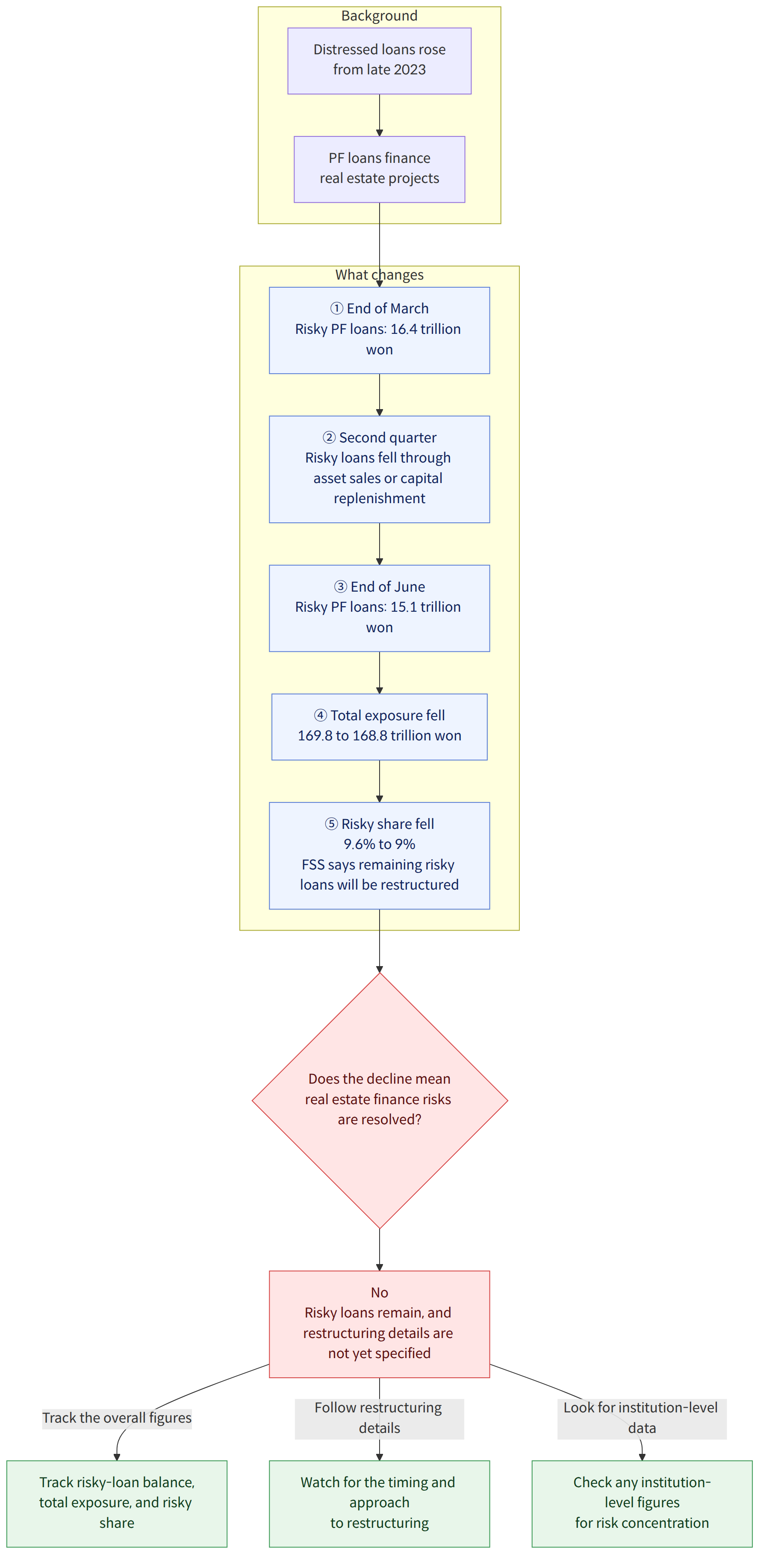
The Financial Supervisory Service said Tuesday that the balance of risky loans for real estate development projects fell in the second quarter through asset sales or capital replenishment. At the end of June, risky real estate project financing (PF, funding for a project) loans totaled 15.1 trillion won, down 1.3 trillion won from 16.4 trillion won at the end of March.
Over the same period, financial institutions’ total exposure to real estate development projects was 168.8 trillion won, and risky loans accounted for 9%. The source report said both figures were down from total exposure of 169.8 trillion won and a risky-loan share of 9.6% at the end of March. The Financial Supervisory Service said it would also restructure the remaining risky PF loans.
Background and context
PF loans are a form of financing linked to real estate development projects. The source report explained that the increase in distressed loans, which began in late 2023, had become an ongoing concern for financial markets, prompting concerns that it could undermine the stability of financial institutions and the financial market as a whole.
These figures show the extent of the change: not only did the balance of risky loans fall, but total exposure and the share of risky loans also declined. However, the information made public does not show how much of the decline resulted from asset sales and how much from capital replenishment. It is therefore important to consider both the lower figures and the follow-up action on the remaining risky loans.
What this news means
The decline in risky loans may be a positive sign for financial institutions, but the risks have not ended, given the Financial Supervisory Service’s statement that it will also restructure the remaining loans. Restructuring is a process of resolving or restoring troubled loans to sound status; the pace at which the remaining risks decline may depend on how and when it is carried out. However, no specific plan was included in this report.
For readers following real estate development and financial markets, it is important to distinguish between total exposure and the share of risky loans. Even if the balance of risky loans has declined, financial institutions still have overall exposure, and some risky loans remain. Against the backdrop of concerns that the increase in distressed loans could undermine the stability of financial institutions and markets, this decline can be read as one indicator of progress rather than proof that the risks have been fully resolved.
For example, if a loan for a development project continues to be classified as risky, it could also be covered by the restructuring mentioned by the Financial Supervisory Service. However, the information currently available does not show what measures the project will face or when.
Confirmed facts and what remains unknown
Confirmed facts
- At the end of June, the balance of risky real estate PF loans was 15.1 trillion won; at the end of March, it was 16.4 trillion won.
- Total exposure to real estate development projects was 168.8 trillion won at the end of June, down from 169.8 trillion won at the end of March.
- Risky loans accounted for 9% of total exposure at the end of June, down from 9.6% at the end of March.
- The Financial Supervisory Service said it would also restructure the remaining risky PF loans.
- The source report cited the increase in distressed loans that began in late 2023 and concerns about the stability of financial institutions and financial markets as context.
What remains unknown
- How much asset sales and capital replenishment each contributed to the decline in the balance of risky loans.
- When and how the remaining risky PF loans will be restructured.
- The size and distribution of risky PF loans at individual financial institutions.
What readers should watch
- In future announcements, readers can track not only the balance of risky loans but also changes in total exposure and the share of risky loans.
- Whether the timing and approach to restructuring are disclosed may provide a clearer picture of how the remaining risky loans will be handled.
- If figures for individual financial institutions are released, they should be examined separately from the overall total to help determine whether risk is concentrated at particular institutions.
References
- Other coverage consulted: en.yna.co.kr