

1. A Human Story
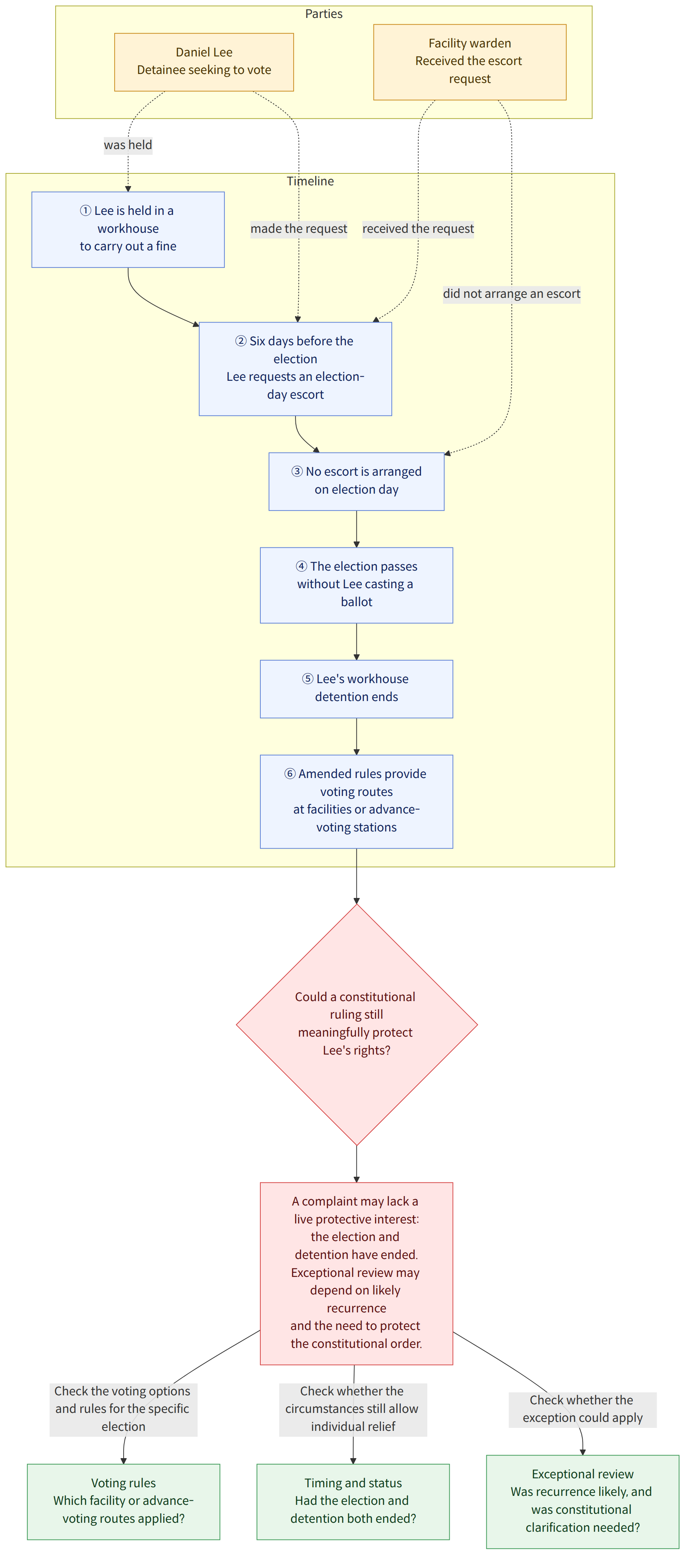
Six days before a presidential election, Daniel Lee sat in a detention facility with a request he hoped would make his vote possible. He was there not serving a prison sentence, but because he was being held in a workhouse to carry out a fine. He wrote to the facility’s warden, asking to be escorted on election day to the polling station serving the address where he had lived before detention.
The election came and went. No escort was arranged, and Daniel did not cast a ballot. Later, his workhouse detention ended. He believed the warden’s inaction had deprived him of a fundamental right and considered asking the Constitutional Court to declare that failure unconstitutional. But by then, two important events—the vote and his detention—were already in the past.
2. The Legal Question
Can a person obtain a constitutional ruling on a detention official’s failure to arrange transport to vote when the election has ended and the person is no longer detained? The central issue is not only whether the right to vote was affected, but whether a court ruling could still meaningfully protect that person’s rights.
3. What Korean Law Says
A constitutional complaint is a procedure for protecting fundamental rights. It is not simply a way to obtain a declaration that a public official acted unlawfully. In general, the person bringing the complaint must have a protectable interest—a practical reason why the requested ruling could still help.
A constitutional complaint ordinarily requires an interest in protecting the complainant’s rights. If a decision can no longer provide meaningful relief to that person, that interest may be absent.
That principle creates a problem when a complaint concerns a missed election. Once voting is over, a court cannot arrange for the person to cast a ballot in that completed election. If the detention that made the person’s request necessary has also ended, an order concerning the former warden’s conduct may no longer change the complainant’s situation.
There is a limited exception. A court may still consider a complaint that no longer offers individual relief when both of the following are present:
- A similar violation is likely to happen again; and
- A constitutional ruling is important to protecting or maintaining the constitutional order.
A past violation may still warrant review in exceptional circumstances, but the possibility of repetition and the need for constitutional clarification do not automatically make every resolved dispute reviewable.
The rules for voting from detention also changed. Amendments to the Public Official Election Act replaced the former absentee-voting arrangements with advance voting and added people living in correctional or detention facilities to the group eligible to use residence voting procedures. The amended framework provided routes for eligible detainees to vote from a facility polling place or at an advance-voting station, without needing the warden to arrange an election-day escort to their former neighborhood polling place.
The significance of that change is procedural as well as practical: it can make the exact problem less likely to recur in the same form. The precise voting options and applicable dates should always be checked against the law and election guidance in force for the particular election.
4. How Korean Courts Approach This
Korean courts generally distinguish between deciding whether a public authority violated a right and deciding whether a particular case is still suitable for judgment. A serious allegation does not, by itself, satisfy the second requirement. The court asks whether a ruling would provide an effective remedy to the person who filed the complaint.
For a claim about a missed vote, the timing is decisive. After election day, a judgment cannot restore the lost opportunity to participate in that election. If the person’s detention has also ended, the specific circumstances requiring official action may have disappeared as well.
Courts can nevertheless address a past dispute where the conduct is likely to recur and a constitutional answer is needed beyond the individual case. But the exception is not a substitute for a live dispute whenever a person wishes to know whether an official acted properly. If later legislation has provided a different way for detainees to vote, that reform may weigh against treating the old form of inaction as a recurring problem requiring constitutional review.
5. Applying the Law to Daniel’s Case
The analysis proceeds in stages:
- Daniel had a concrete complaint. He made a written request before the presidential election, identifying the action he wanted: transport to the polling station associated with his pre-detention address. The warden did not arrange it, and Daniel missed the vote. That is a specific allegation about the exercise of a fundamental right, not an abstract question.
- But the individual remedy had disappeared. By the time Daniel sought constitutional review, election day had passed. Even if the court agreed that the warden should have acted, it could not give Daniel a ballot in that election. His workhouse detention had also ended, so an order directing action by the warden could not resolve an ongoing restriction on his movement or voting access.
- The repeat-violation exception is not automatic. Daniel could argue that other people in detention might face similar obstacles. But the court would consider whether the same kind of failure remained likely and whether a constitutional ruling was still necessary to clarify the law.
- The later voting framework matters. The election-law amendments created voting arrangements for eligible people in correctional and detention facilities, including facility-based residence voting and advance voting. Those alternatives addressed the practical need to rely on an election-day escort to a former home-area polling place. In the circumstances described, the court had reason not to treat Daniel’s complaint as an exceptional case requiring review after his own remedy had become impossible.
The result is not necessarily a judicial endorsement of the warden’s decision. It is a conclusion about whether the Constitutional Court can still hear Daniel’s complaint in that form and at that time.
A written request, proof of when it was submitted, the facility’s response or lack of response, and records showing the dates of the election and detention would be central to assessing the procedural issue. A reader facing a comparable dispute could ask [[lawyer]] to review those documents and the relevant election rules to understand whether any effective remedy remains available.
6. Conclusion: What Happened, and What Should You Do?
Daniel’s constitutional complaint would likely be dismissed as inadmissible for lack of an interest in protecting his rights. By the time the case came before the court, the election could not be undone and his detention had ended. Nor would the exceptional route for recurring violations necessarily save the case, given the later legal arrangements for voting by eligible detainees.
That conclusion does not mean the right to vote is unimportant, or that every failure to facilitate voting is lawful. It means a constitutional complaint must be brought in circumstances where a ruling can still matter—or where the narrow exception for recurring, constitutionally significant issues genuinely applies.
For readers in a similar position:
- Keep a dated copy of any request to the facility, along with proof of delivery and any written response.
- Record the key dates—the election, your detention, and any release or transfer—because timing can determine whether a court can offer individual relief.
- Check the voting options available for that election and seek prompt advice about the relevant procedures; do not assume that transport to a former neighborhood polling place is the only route.
The dated request to the warden, any reply, and the records showing when the election and detention ended could all affect whether a constitutional complaint still offers a practical remedy. You could ask attorney Ji-sun Ahn of Ijun Law Firm to review those documents and the election rules that applied at the time.
















