

1. A Human Story
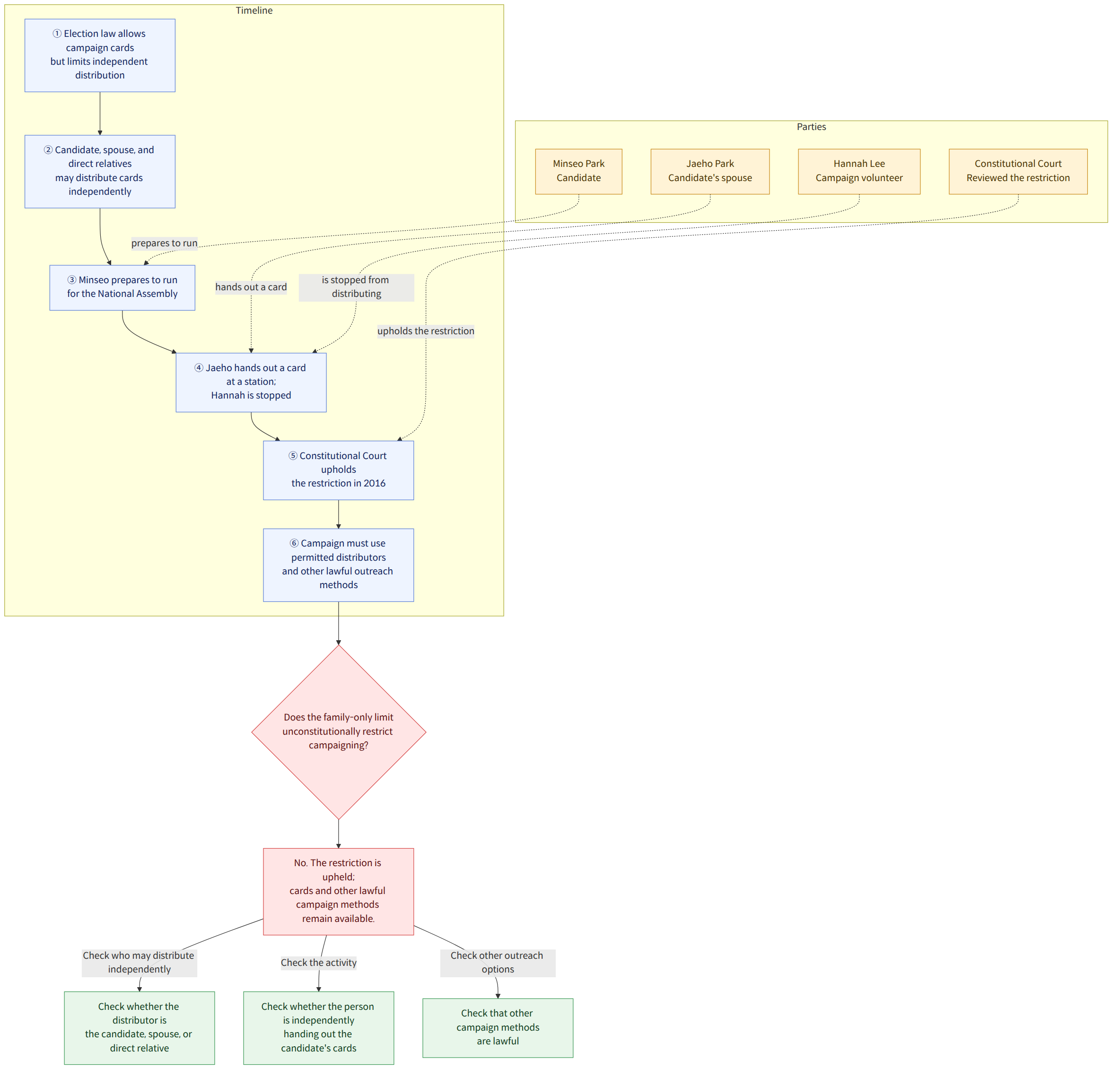
Minseo Park had spent months preparing to run for the National Assembly. At a busy station entrance, she watched her husband, Jaeho, hand a campaign card to a passerby. Beside him stood Hannah Lee, a longtime volunteer who had helped build the campaign from its earliest days. Hannah reached for a stack of cards, ready to do the same.
A campaign official stopped her. Under the election rules, Hannah could not independently hand out Minseo’s campaign cards. Minseo was troubled: Hannah knew the campaign’s message, had earned voters’ trust, and was offering her time freely. Why, she wondered, should the Constitution protect her freedom to campaign but allow the law to reserve this simple task for a candidate’s family?
2. The Legal Question
May Korean election law limit the people who can independently distribute a candidate’s campaign business cards to the candidate’s spouse and direct ascendants and descendants, or does that restriction unconstitutionally infringe the freedom of election campaigning?
3. What Korean Law Says
The relevant rules of the Public Official Election Act allow campaign-card distribution as an election activity but restrict who may carry it out independently on a candidate’s behalf. The permitted family category is the candidate’s spouse and lineal relatives—that is, direct ancestors and descendants. A friend or campaign volunteer does not become eligible merely by being trusted or acting without pay.
The rule at issue does not prohibit campaign cards as a form of campaigning. It limits who may independently distribute them for the candidate.
The Constitutional Court upheld this restriction in 2016. Its reasoning rested on several considerations:
- A limited purpose: Campaign cards are meant to convey the candidate’s information directly and simply, not to become a vehicle for unlimited campaign activity by a large group of supporters.
- Fairness between candidates: Allowing an unrestricted number of people to distribute cards could advantage candidates with greater political or financial resources.
- A restrained boundary: The law selects a small group—the candidate’s spouse and direct relatives—who may reasonably be treated as closely identified with the candidate.
- Other routes remain open: The restriction does not ban card distribution itself, and candidates may use other lawful campaign methods.
The Court concluded that the restriction did not violate the freedom of election campaigning, because the activity remained available within the permitted limits and other campaign methods remained open.
4. How Korean Courts Approach This
Korean constitutional review weighs the importance of a protected freedom against the reasons for limiting it. In election cases, the balance includes not only a candidate’s ability to communicate with voters, but also the need to prevent excessive campaigning and preserve a fair opportunity for candidates with different levels of political and financial support.
The Constitutional Court treated the family limitation as a proportionate boundary, not as a general ban on campaign activity. It reasoned that a broad group of independent distributors could intensify campaigning and make a candidate’s resources—rather than the message itself—more decisive. At the same time, the rule left candidates able to distribute cards through the permitted people and to use other lawful methods.
5. Applying the Law to Minseo’s Campaign
First, Minseo herself could distribute her campaign cards. The restriction was not a ban on her speaking to voters or handing them a card.
Second, Jaeho, as her spouse, fell within the category of people allowed to distribute the cards independently. Hannah, however, was a volunteer and not Minseo’s spouse or direct ascendant or descendant. Her dedication to the campaign did not change that legal distinction.
Third, the constitutional objection had already been considered by the Court. The Court accepted that the rule limited who could perform one form of campaigning, but found that it served legitimate election-related aims and left other means of campaigning available. On that reasoning, the restriction did not violate Minseo’s freedom to campaign.
Finally, the practical answer was not that Hannah could take over the same independent distribution role. Rather, the campaign needed to keep card distribution within the legally permitted category and plan its other voter outreach using lawful campaign methods. The precise boundaries of any activity can depend on what people do and how the campaign organizes it, so the campaign should not assume that every volunteer role is interchangeable.
If you are unsure whether a proposed volunteer role or campaign instruction fits the rule, attorney Ji-sun Ahn of Ijun Law Firm could review the written campaign plan and any notice or guidance you received, and offer general advice based on those documents.
6. Conclusion: What Happened, and What Should You Do?
Minseo could not secure a constitutional right for Hannah to independently hand out her campaign cards. The Court’s approach recognizes the value of campaign freedom but permits this particular limit to help curb excessive campaigning and unequal advantages. Minseo’s campaign therefore kept independent card distribution to Minseo and her husband, while organizing other outreach through methods permitted by election law.
For anyone planning a similar campaign:
- Check the current election rules before assigning someone to distribute campaign materials; a personal relationship with the candidate does not by itself create permission.
- Keep written campaign instructions and any guidance or notice received from election officials, so the actual conduct and the campaign’s understanding can be reviewed together.
- If uncertain about a proposed activity, ask the relevant election authority or obtain legal advice before proceeding rather than treating a volunteer’s role as automatically permissible.

















