

A Human Story
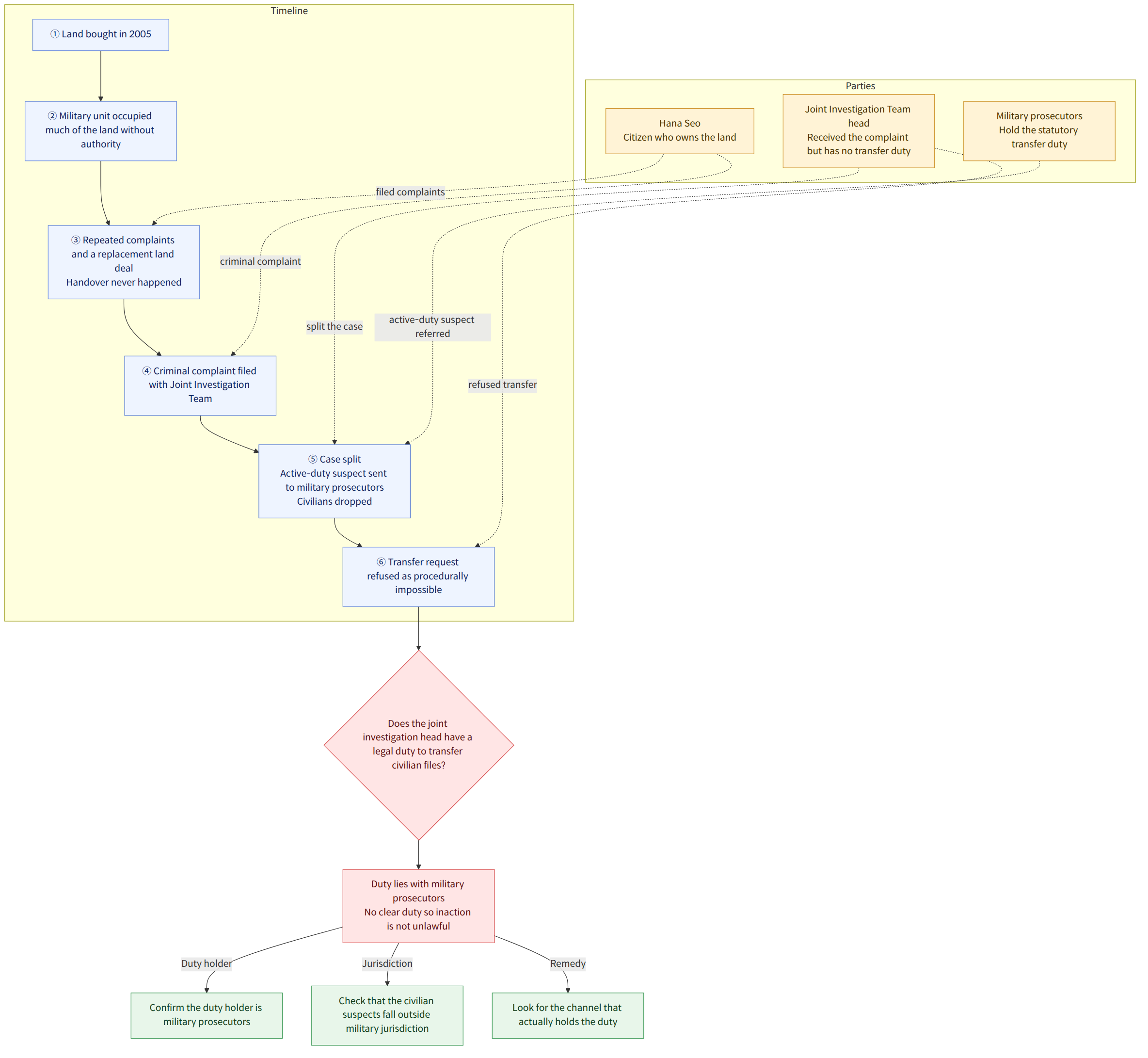
Hana Seo bought fifty thousand pyeong of mountain land in 2005, planning to build a quiet retreat for her aging parents in the countryside. Years later, she discovered that a military unit had occupied much of the property without authority. Only a portion had been formally expropriated, and the rest remained in military hands, with no clear timeline for return.
Hana filed repeated complaints and eventually reached an agreement to receive replacement military land in exchange for the disputed parcel. Still, the handover never happened. Frustrated, she filed a criminal complaint against several officials for abuse of authority and related offenses, directing it to the Joint Investigation Team of the Ministry of National Defense.
The investigators split the case. The active-duty suspect was referred to military prosecutors. But the civilian suspects, who had no military status, were dropped because the team said it had no power to investigate them. Hana asked the team head to send those civilian files to a civilian prosecutor's office. The answer was that such a transfer was procedurally impossible. Hana now wonders whether this silence violates her basic rights.
The Legal Question
Does the head of a military joint investigation team have a legal duty to transfer a case involving civilian suspects to a civilian prosecutor, and if not, can a citizen challenge that inaction through a constitutional complaint?
What Korean Law Says
The starting point is the Military Court Act. Its provision on transferring cases is clear about who carries the duty.
Under Article 286 of the Military Court Act, a military prosecutor must transfer a case, together with the records and evidence, to the corresponding civilian prosecutor's office when military courts do not have jurisdiction over it.
This rule matters because Korean military courts do not handle every case involving a military setting. Their jurisdiction generally covers Korean service members, certain military crimes committed by specified foreign nationals, and prisoners held by military units. Civilians who are not covered by that jurisdiction must have their cases handled by ordinary courts and prosecutors.
The key points are:
- The transfer duty is placed on military prosecutors, not on every military investigator.
- The duty applies when the case falls outside military court jurisdiction.
- Actions taken before transfer remain valid after transfer.
How Korean Courts Approach This
The Constitutional Court has examined this question directly. In a 2001 decision, it reasoned that the legal transfer obligation belongs to military prosecutors. A joint investigation head is not bound by that same statutory duty.
A failure to act can violate a constitutional right only where the law or the Constitution imposes a clear duty to act on the public authority concerned. Where no such duty exists, the inaction is not an unlawful non-exercise of public power.
The Court therefore treats a constitutional complaint about inaction as viable only when the complained-of body had a specific, legally required duty. General dissatisfaction with how an investigation is handled is not enough.
Applying the Law to Hana's Case
We can break Hana's situation into steps.
- Identify the duty holder. The statute assigns the transfer obligation to military prosecutors. Hana's request was directed to the joint investigation head, who does not carry that statutory obligation.
- Assess the jurisdictional split. The active-duty suspect was properly referred to military prosecutors. The civilian suspects fall outside military jurisdiction, which is exactly the situation the transfer rule addresses. The problem is not the law itself but the institutional channel through which it should operate.
- Evaluate whether inaction equals a constitutional violation. Because no clear legal duty bound the joint investigation head to transfer the civilian files, his failure to do so cannot be treated as an unlawful omission. Under the Constitutional Court's reasoning, a constitutional complaint on this basis would likely fail.
- Consider what remains available. Hana's grievance is not without remedy in principle. The proper step is to pursue the matter through the channel that holds the duty, rather than through the investigator who lacked it.
Conclusion: What Happened, and What Should You Do?
Hana's constitutional complaint about the stalled transfer would most likely be rejected. The reason is not that her grievance lacks merit, but that the legal duty to transfer civilian cases sits with military prosecutors, not with the joint investigation head she addressed. Without a clear legal duty, the inaction does not qualify as an unlawful exercise, or non-exercise, of public power.
For readers facing a similar bottleneck, three practical points stand out:
- Identify who legally holds the duty before choosing a remedy. Address requests to the official the statute actually names.
- Keep a complete paper trail of every complaint, referral request, and written reply, with dates.
- Review the specific notices and referral decisions you receive, since their wording often reveals which office is responsible for the next step.
If you are dealing with a similar split between military and civilian jurisdiction, you may want to ask attorney Ji-sun Ahn of Ijun Law Firm to review the referral notices and written replies you received, especially any statement that a transfer was procedurally impossible, to confirm which office holds the duty in your situation. Bringing your complaint filings and dated correspondence would allow a general review of the documents, though the analysis would be limited to what those papers show.
















