

A Human Story (Opening)
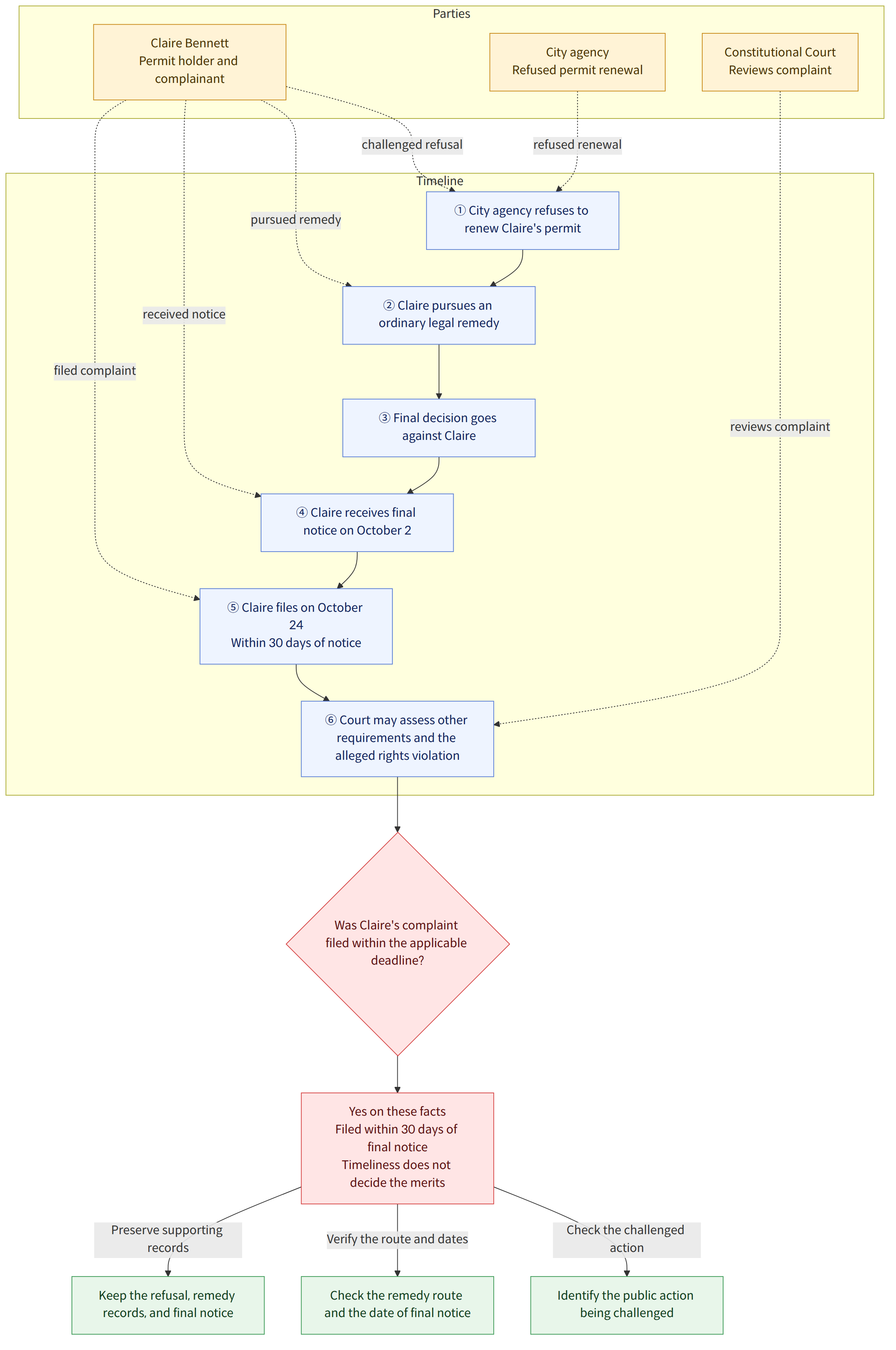
When a city agency refused to renew Claire Bennett’s business permit, the decision threatened more than her income. She had spent years building a small neighborhood café, and the refusal meant she could no longer operate it. Claire believed the agency had acted unlawfully and that the decision had violated her basic rights.
She did not go straight to the Constitutional Court. Claire first challenged the decision through the legal remedy available under ordinary law. Months later, she received notice that the final decision in that process had gone against her. She began preparing a constitutional complaint—but was unsure whether the time she had spent pursuing the earlier challenge had already used up her chance.
The Legal Question
How long does a person have to file a constitutional complaint in Korea, and which date controls when the person has first pursued another legal remedy?
What Korean Law Says
Article 68(1) of the Constitutional Court Act allows a person to seek constitutional review when an exercise or failure to exercise public authority infringes that person’s basic rights. Article 69(1) sets filing periods for this type of complaint.
In general, the complaint must be filed within 90 days from the day the person learns of the reason for the complaint, and within one year from the day that reason occurred. If the person has pursued a remedy provided by another law, the complaint must be filed within 30 days from the day the person is notified of the final decision on that remedy.
In practical terms, the relevant deadlines are:
- 90 days from knowledge: When did the person learn that public action or inaction had allegedly infringed a basic right?
- One year from the event: When did the alleged infringement occur? This is an outside limit in the general rule.
- 30 days after the final notice: If the person pursued a remedy provided by another law, when were they notified of the final decision?
The “reason” for a complaint is not simply a person’s later realization that a legal argument might be available. It refers to the alleged basic-rights infringement caused by the exercise or non-exercise of public authority. The actual dates and the route taken matter, so a person should not assume that the longest period applies in every situation.
How Korean Courts Approach This
Korean courts and the Constitutional Court generally treat these filing periods as an important threshold question. Before considering whether a public authority actually violated someone’s rights, the Court may examine whether the complaint was filed on time and whether the statutory requirements for using the constitutional-complaint process were met.
The inquiry is therefore practical and date-focused: what public action or inaction is being challenged, when did the person learn of it, whether another statutory remedy was pursued, and when notice of its final decision was received. A late filing may prevent the Court from reaching the underlying constitutional arguments, even if the complainant believes those arguments are strong.
A person who has pursued another remedy should pay particular attention to the 30-day period that begins with notice of the final decision. Waiting for the one-year outside limit to expire—or relying on the original 90-day period—may not protect the right to file.
Applying the Law to the Case
- Identify the challenged government action. For Claire, the starting point is the city agency’s refusal to renew her permit. Her complaint would need to concern an alleged infringement of basic rights caused by public authority, not merely disagreement with the agency’s decision.
- Check whether another legal remedy was used. Claire pursued the remedy available under ordinary law before considering a constitutional complaint. Because she took that route, the 30-day period tied to notice of the final decision is central to her timeline.
- Pin down the date of notice. Claire received the final decision notice on October 2. She filed her constitutional complaint on October 24, within 30 days of that notice. On the facts of this fictional example, her filing was within the stated time limit.
- Do not treat timeliness as a decision on the merits. Filing within the period answers only the deadline question. The Constitutional Court would still have to consider whether the complaint meets the other legal requirements and whether the alleged rights infringement is established.
Claire should preserve the agency’s refusal, the documents showing the remedy she pursued, and the final decision notice. Those records help identify what is being challenged and establish when the relevant deadlines began.
If you are in Claire’s position, a lawyer can review the agency decision, the record of the remedy you pursued, and the final notice to help identify the dates relevant to the filing period. You could ask attorney Ji-sun Ahn of Ijun Law Firm to examine those documents and the timeline before deciding what steps to take.
Conclusion: What Happened, and What Should You Do?
Claire filed within 30 days after receiving notice of the final decision, so her complaint was timely on the facts described. That does not guarantee that the Constitutional Court will accept her arguments or rule in her favor; it means only that the filing-period obstacle described here does not appear to bar her complaint.
If you are considering a constitutional complaint:
- Record the date you learned of the alleged infringement and the date the government action or inaction occurred.
- If you pursued another legal remedy, keep the final decision and proof of when you received notice; do not assume the general 90-day or one-year periods replace the 30-day rule.
- Seek prompt review of the relevant decisions and notices, because a missed filing period can keep the Court from considering the substance of your claim.

















