

1. A Human Story
For Hannah Lee, a public servant in Seoul, the decision to adopt was made with care and hope. She had spent months preparing a room, meeting with adoption professionals, and imagining the ordinary routines she wanted to share with a child. But as the process advanced, another question grew harder to ignore: how would she manage the added costs of raising a child on her own?
Hannah was unmarried, and she knew that adoption would change more than her family life. It could affect her taxes, time away from work, and access to public services. She began looking for a clear answer—not a promise that every cost would be covered, but a reliable account of what support might actually be available.
2. The Legal Question
What financial and practical support can an adoptive parent receive under Korean law, and which benefits may apply to someone who is both a single parent and a public servant?
3. What Korean Law Says
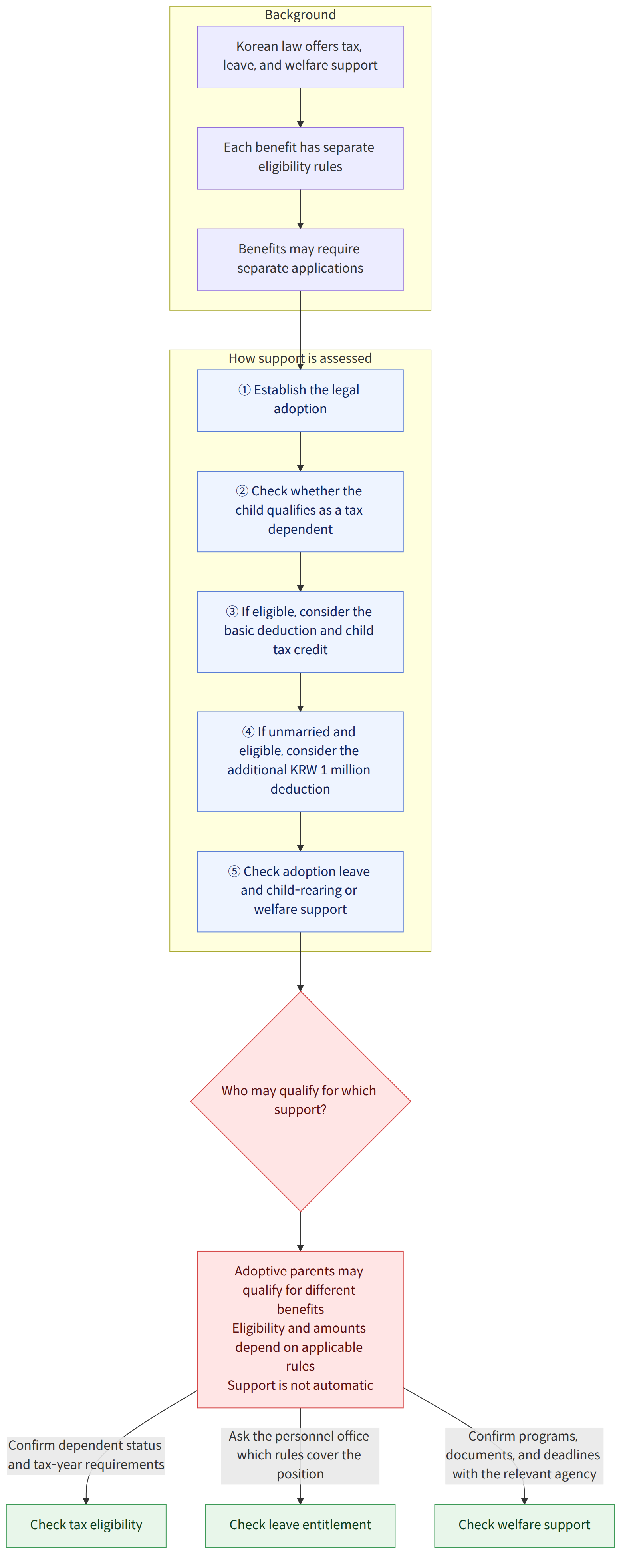
Korean law provides several distinct forms of support. They do not all work in the same way: some reduce a tax bill, some provide time away from work, and others may be delivered as child-rearing or welfare services.
Tax deductions and credits depend on the adopted child meeting the relevant tax-law requirements. A parent should not assume that every benefit applies automatically or that the same rules apply regardless of income, household circumstances, or the child’s eligibility as a dependent.
The main possibilities include:
- Basic deduction and child tax credit: Under the Income Tax Act, an adopted child who qualifies as a basic-deduction dependent may be included in the parent’s tax deductions and may qualify for the child tax credit. The available credit and its conditions should be checked against the rules for the relevant tax year.
- Additional deduction for some unmarried parents: The Act provides an additional annual deduction of KRW 1 million for a qualifying taxpayer who has no spouse and has a basic-deduction-eligible child or adopted child. This is an additional deduction from income, not a KRW 1 million cash payment, and eligibility must be verified.
- Adoption leave for national civil servants: The State Public Officials Service Regulations provide 20 days of adoption leave for eligible national civil servants. Other public employees may be governed by separate rules, so their employer’s personnel office should confirm the applicable entitlement.
- Child-rearing and welfare support: Adoptive families may be eligible for child-rearing assistance, medical-cost support, counseling, and other services provided through public agencies, local governments, or relevant adoption and welfare organizations. The type and amount of support can depend on the family’s circumstances and the program in force.
These benefits are not necessarily automatic. A parent may need to establish the adoption, submit tax or employment documents, and apply separately for local or welfare support.
4. How Korean Courts Approach This
The benefits described here are primarily governed by statutes, regulations, and administrative eligibility rules rather than by a broad judicial test. In practice, the central questions are whether the adoption and parent-child relationship are legally recognized, whether the child meets the relevant tax definition of a dependent, and whether the parent falls within the covered employment or welfare category.
Courts generally interpret statutory tax benefits by applying the conditions written into the legislation. A taxpayer cannot claim a deduction simply because raising a child is costly; the legal requirements for that particular deduction must be met. Likewise, a leave entitlement depends on the rules applicable to the employee’s public-service position.
The practical lesson is to verify each benefit separately. Tax eligibility, employment leave, and welfare assistance may involve different agencies, documents, deadlines, and definitions.
5. Applying the Law to the Case
Hannah’s situation should be considered benefit by benefit.
- Her adopted child may qualify for tax treatment as a dependent. Once the legal adoption is established, Hannah should check whether the child meets the basic-deduction requirements for the relevant tax year. If so, she may be able to claim the applicable basic deduction and child tax credit. The exact credit depends on the law then in force and her circumstances.
- Her unmarried status may matter for the additional deduction. If Hannah has no spouse and the adopted child qualifies as a basic-deduction dependent, she may qualify for the additional KRW 1 million deduction described in the Income Tax Act. That amount reduces the income used to calculate tax; it is not paid to her as a grant. She should confirm how to report it when filing her annual tax return.
- Her public-service job may entitle her to adoption leave. Because Hannah is a national civil servant, she may apply for the 20-day adoption leave provided under the applicable service regulations. She should ask her personnel office what proof of adoption is required and how the leave must be scheduled. If she worked for a local government or a different public institution, a separate set of rules might apply.
- She should also ask about direct support and services. Tax relief does not cover every expense of raising a child. Hannah should contact the relevant local-government office and adoption or welfare service provider to ask about child-rearing assistance, medical-cost support, counseling, and any services for which her household may qualify. Availability and amounts can vary, so she should request current written guidance rather than rely on a general description.
Taken together, these programs could ease Hannah’s financial and practical burden, but none should be treated as a guaranteed, all-purpose adoption payment. Her best course is to document the adoption and make separate inquiries with the tax authority, her employer, and the local welfare office.
If you are dealing with a similar issue, attorney Ji-sun Ahn of Ijun Law Firm can review the birth and family registration records, any adoption order or consent, and the child’s current living arrangements with you. These details can help clarify which options apply to your situation.
6. Conclusion: What Happened, and What Should You Do?
After checking the rules with her personnel office and local welfare provider, Hannah applied for adoption leave and confirmed which tax benefits she could claim for her child. She also asked about available medical and child-rearing support rather than assuming that tax relief would cover those needs. The support did not remove every expense, but it gave her a more realistic budget—and the confidence to welcome her child without overlooking help she was entitled to seek.
If you are preparing to adopt in Korea:
- Ask a tax professional or the tax authority whether your adopted child qualifies as a basic-deduction dependent and which deductions or credits apply for the relevant tax year.
- Confirm leave rules with your employer’s personnel office, especially if you work for a local government or public institution rather than as a national civil servant.
- Contact your local government and adoption or welfare service provider about child-rearing, medical, counseling, and other support; ask what documents, deadlines, and eligibility conditions apply.

















