

A Human Story
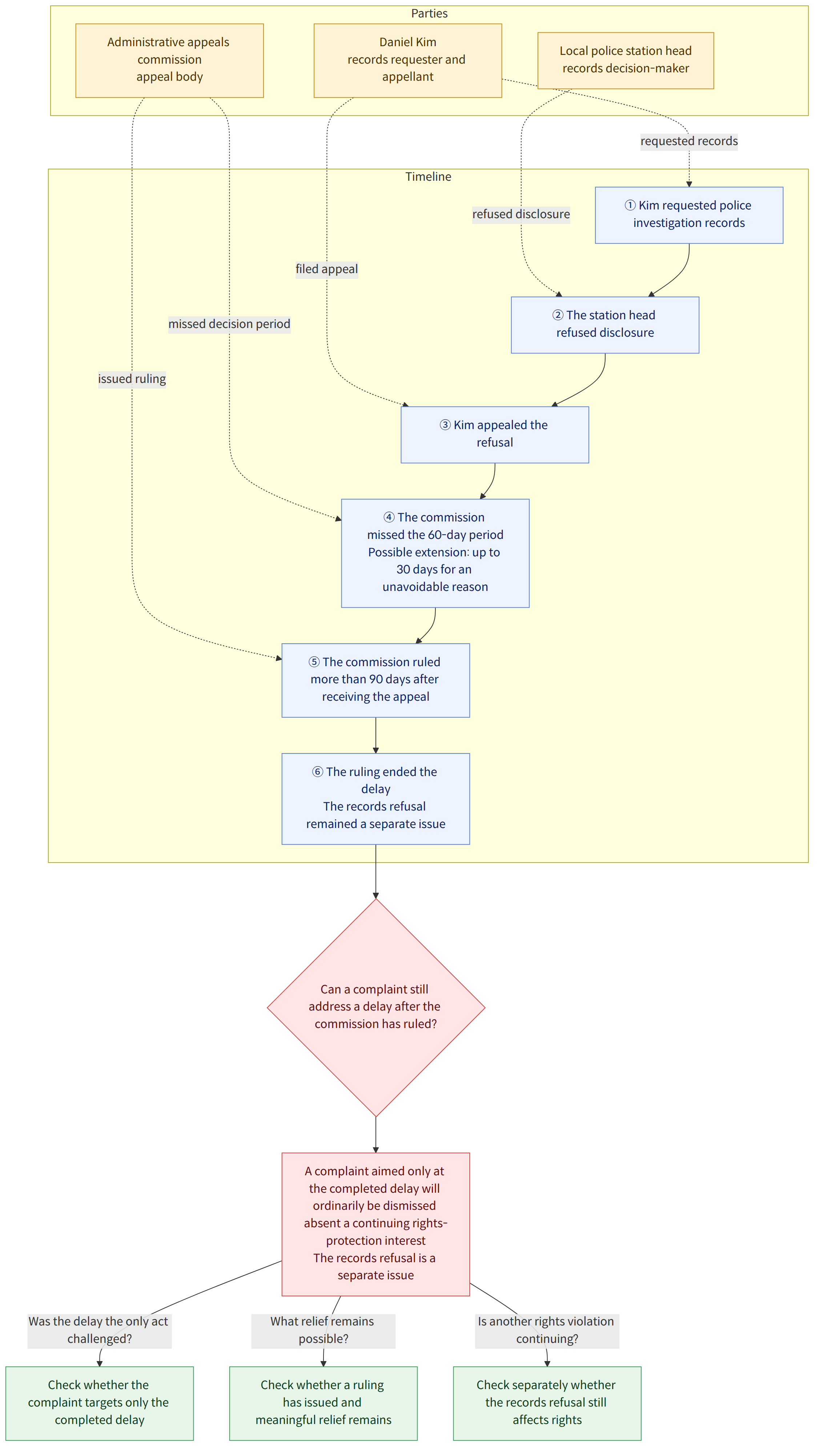
Daniel Kim had one document in mind when he sat down to prepare a request for a retrial: the police file from the investigation that had led to his final criminal conviction. He asked the head of a local police station to disclose records from that investigation. The request was refused, leaving Daniel without the material he hoped might help him challenge the judgment.
He appealed the refusal to an administrative appeals commission. The law set a period for the commission to issue its decision, but the days passed without one. More than 90 days after the commission received his appeal, it finally ruled. Daniel wanted to challenge not only the refusal of his records request, but also the commission’s failure to decide on time. Could a constitutional complaint still address that delay?
The Legal Question
Can a person bring a constitutional complaint over an administrative appeals commission’s failure to issue a decision within the statutory period when the commission has since issued its ruling?
What Korean Law Says
Korean constitutional complaints are intended to remedy violations of fundamental rights. They are not a general mechanism for obtaining an official declaration that a public body acted improperly in the past. The person bringing a complaint must have a rights-protection interest: in practical terms, a court must still be able to provide meaningful relief for a rights violation that affects that person.
The Constitutional Court has explained the timing requirement this way:
A rights-protection interest must exist when a constitutional complaint is filed and must continue to exist when the Court makes its decision. If a change in the facts or law ends the alleged rights violation while the case is pending, the complaint will generally lack that interest and be dismissed as inadmissible.
The Administrative Appeals Act also sets a timetable for decisions. Article 45 generally requires an administrative appeals commission to make its ruling within 60 days after receiving a petition, with a possible extension of up to 30 days when there is an unavoidable reason. The statutory timetable matters, but missing it does not by itself decide whether a constitutional complaint is admissible.
The key points are:
- A missed decision deadline may raise an issue under the administrative appeals process.
- A constitutional complaint requires more than proof that an agency acted late; the complainant must have a continuing rights-protection interest.
- Once the commission issues its decision, the delay itself has ended. A complaint directed only at that completed delay will ordinarily be dismissed if no ongoing rights violation remains.
- The separate merits of the underlying dispute—for example, whether access to particular police records was properly refused—are not automatically resolved by a challenge to the delay.
How Korean Courts Approach This
The Constitutional Court generally asks what relief remains possible and whether the alleged infringement is still affecting the complainant’s rights. A constitutional complaint is meant to protect rights in a concrete situation, not simply to pronounce on whether an authority should have acted sooner.
If an appeals commission has already issued its ruling, the specific failure to decide within the prescribed period has usually come to an end. If the complainant’s objective in challenging that delay was to obtain a ruling, that objective has also been met—even if the ruling came late. In those circumstances, a complaint seeking only to establish that the commission delayed is unlikely to have a present rights-protection purpose.
That does not mean every issue disappears when an agency eventually acts. A separate and continuing rights violation may still require examination. But the existence of such an issue must be shown; the fact of lateness alone does not keep a completed delay alive as a constitutional claim.
Applying the Law to Daniel’s Case
Daniel’s situation has two distinct parts: the police station’s refusal to disclose records and the appeals commission’s delay. Keeping them separate is essential.
- The commission missed the decision period. It received Daniel’s administrative appeal and did not rule within the statutory timetable. The later decision does not make the earlier wait disappear as a matter of fact.
- The delay ended when the commission ruled. Once the commission issued its decision, it was no longer withholding that decision. A constitutional complaint aimed specifically at the commission’s failure to decide on time would therefore concern a completed act.
- The requested ruling was eventually issued. If Daniel’s purpose in complaining about the delay was to make the commission decide, the commission’s eventual ruling fulfilled that immediate purpose. A declaration that it should have acted sooner would not, by itself, secure the police records or overturn Daniel’s conviction.
- The records dispute remains a separate question. Daniel may still have concerns about the refusal to disclose the investigation materials, but those concerns do not automatically make a complaint about the commission’s past delay admissible. The legal route and available remedy for the disclosure dispute must be assessed separately.
On these facts, Daniel would likely lack the required rights-protection interest in a constitutional complaint directed only at the delay. The complaint would therefore be at serious risk of dismissal as inadmissible, rather than a decision on whether the delay was justified.
If your situation resembles Daniel’s, a lawyer could review the appeal-receipt record, the refusal notice, and the date and contents of the eventual ruling to help distinguish a completed delay from any separate issue that may still be ongoing. attorney Ji-sun Ahn of Ijun Law Firm
Conclusion: What Happened, and What Should You Do?
Daniel’s commission eventually ruled, but too late for a constitutional complaint focused solely on the delay to offer meaningful relief. Under the general approach of the Korean Constitutional Court, the delay had ended, and Daniel had received the decision he had been waiting for. Unless he could identify a separate, continuing rights violation, his complaint about the missed timetable would likely be dismissed for lack of a rights-protection interest.
For anyone facing a similar situation:
- Keep a clear timeline of when the appeal was received, when the statutory period expired, and when the decision arrived.
- Separate the delay from the underlying dispute. Identify whether you need to challenge the late decision, the substance of the decision, or a different ongoing act such as a refusal to disclose records.
- Preserve the relevant documents, including the information-disclosure request, refusal notice, appeal filing, proof of receipt, and the eventual ruling. Those records can help clarify which remedy, if any, remains available.
















