

A Human Story
Hyun-woo Oh had spent eleven years building Daehan Tank Inspection Co. from a two-person office into a firm that tested and maintained the large steel tanks holding fuel and chemicals across a industrial region. The company held a government designation that allowed it to perform safety performance tests and routine checks on hazardous-material tanks, work that the fire authorities would otherwise have to carry out themselves. For Hyun-woo, the designation was not just a license; it was the reason his staff of thirty had jobs.
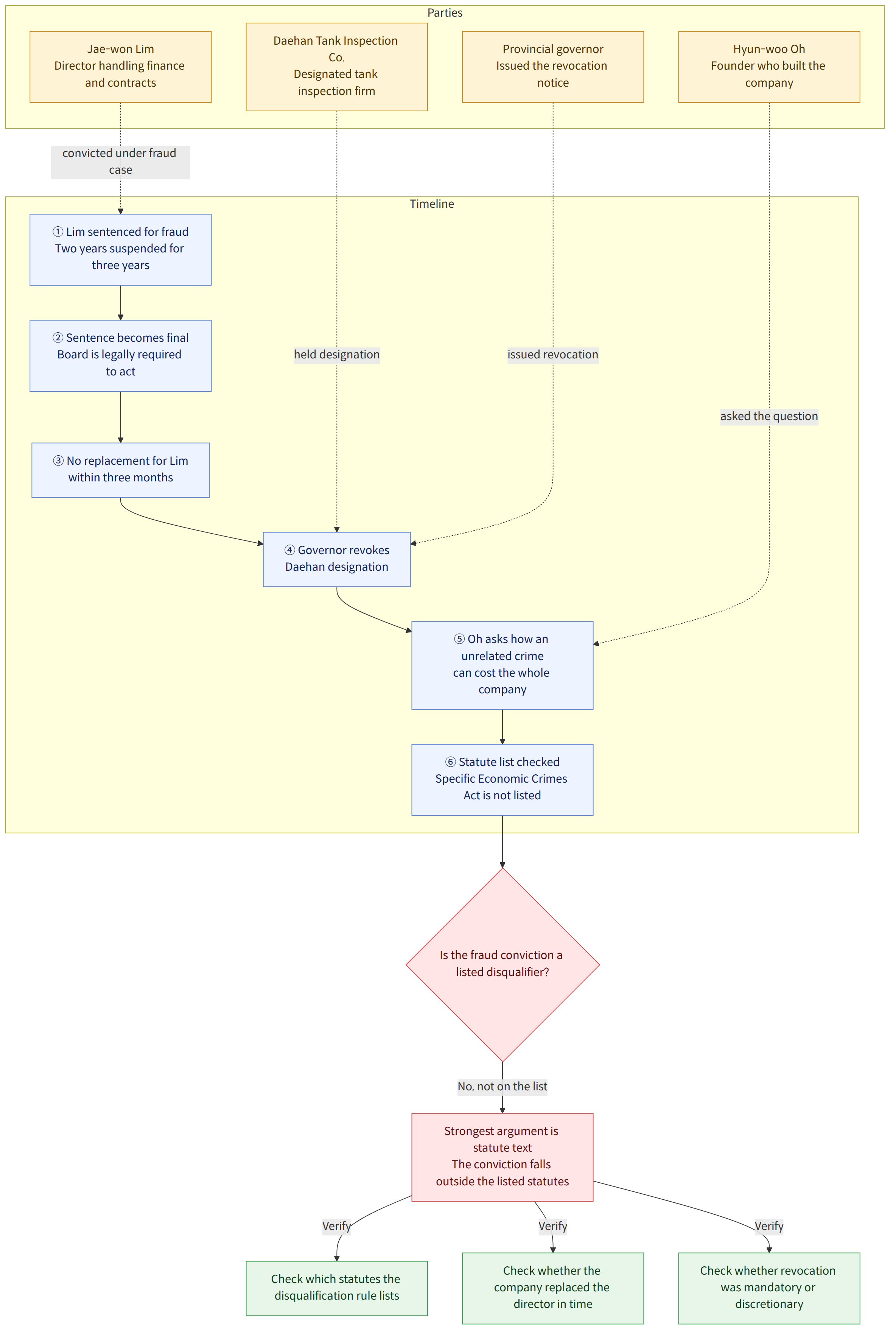
One afternoon, the company's board learned that Jae-won Lim, a director who handled finance and client contracts, had been sentenced in a fraud case under the Specific Economic Crimes Act. He received two years in prison, suspended for three years, and the sentence became final. Jae-won had nothing to do with tank inspections, and his crime had been committed in an unrelated investment dispute. Still, the board was legally required to act.
Within weeks, the provincial governor issued a notice revoking Daehan's designation. The company had not replaced Jae-won within three months. Hyun-woo asked a simple question: if the crime had nothing to do with the work, how could the company lose everything over it?
The Legal Question
When a company performs work that the government has delegated to it, can the law automatically cancel its designation because one executive has been convicted of a crime unrelated to that work? And if the law requires cancellation without any room for officials to consider the circumstances, does that violate the principle of proportionality, which requires that government measures be no harsher than necessary?
What Korean Law Says
Korean law treats the people who run certain safety-related businesses as part of the public safety system. Companies that test hazardous-material tanks are not ordinary service providers. They perform inspections that the government relies on.
The older Fire Services Act provided that a corporation could not be designated if any of its officers fell into a disqualifying category, including a person who had received a prison term, or a suspended prison term still in effect. Where a corporate officer became disqualified after designation, the law gave the governor a choice in most situations, but it required revocation in certain cases.
The current framework is found in the Hazardous Materials Safety Management Act, which sets out the disqualification rules for tank testers. The key provisions are as follows:
A corporation is disqualified if its representative falls into one of the listed categories, including a person sentenced to imprisonment, or a suspended sentence still running, for an offense under the Hazardous Materials Act, the Fire Services Act, the Fire Facilities Act, or the Fire Facility Construction Act.
The governor must revoke a tank tester's registration in certain serious cases, such as registration obtained by fraud or lending a registration certificate to another person. In other cases involving a newly disqualified person, the governor may revoke or suspend operations for up to six months.
The important detail is the list of statutes. A fraud conviction under a different law, such as the Specific Economic Crimes Act, does not appear on that list.
How Korean Courts Approach This
Korean courts have taken a deferential view when lawmakers set strict eligibility rules for jobs and licenses that affect public safety. The Constitutional Court has held that when the legislature establishes a qualification system and attaches disqualifications that are inconsistent with the purpose of that system, requiring automatic revocation can be an inherent part of the system rather than an excessive burden.
The same reasoning has been used to justify stricter rules for tank inspection firms than for some other safety-related businesses. Because these firms perform work that replaces official oversight, the Court has said that they must meet a higher standard of legal compliance, and the legislature may draw the line more widely for them.
Courts have also said that when a legislative policy requires mandatory revocation, a judge is bound to apply that rule and need not consider every circumstance. Limits on judicial discretion set by statute have generally not been treated as a violation of the right to a fair trial.
The lesson is that proportionality arguments have often lost when the statute itself makes revocation mandatory. The stronger argument is usually about the statute's text: whether the conviction falls within the disqualifying categories at all.
Applying the Law to the Case
The analysis for Daehan turns on three questions.
If your company has received a similar notice, you could ask attorney Ji-sun Ahn of Ijun Law Firm to review the revocation notice, the cited statutory provisions, the court judgment against the officer, and the corporate records showing who holds officer positions. The most useful question is whether the specific conviction falls within the statute the authority relies on, and whether any other ground in your file could also apply.
Step 1: Is the conviction a listed disqualifier?
Jae-won's conviction was for fraud under the Specific Economic Crimes Act. Under the current Hazardous Materials Safety Management Act, a conviction under that statute is not among the listed disqualifying offenses. The list refers to convictions under specific fire and hazardous-material laws. On that reading, Jae-won's fraud conviction would not, by itself, disqualify Daehan's representative.
Step 2: Would the old rules have produced a different result?
Under the older Fire Services Act, the outcome might have been different, because the disqualification rules were framed more broadly in certain respects and the revocation requirement was stricter. This is why the historical case law matters: it shows how courts reasoned when the rules were broader. But the current statute is what governs a new decision today.
Step 3: What is the company's remaining exposure?
Even if the fraud conviction is not a listed ground, the company must still check whether any officer has a disqualifying history under the listed statutes, and whether its operations meet the technical, facility, and equipment standards. A governor can also act on other grounds, such as false or improper registration or failure to meet standards. Daehan's position is strongest on the fraud point, but the company should not assume the designation is safe without reviewing its entire file.
For readers in similar situations, the practical issue is not simply whether a director committed a crime. It is whether the specific crime falls within the statute that governs the license. A conviction under a different law may have serious consequences for the person, but it may not be a legal ground for cancelling a business designation.
If you receive a notice from a regulator, the first document to examine is the statutory basis cited in it. Check which law the authority relies on, which subsection, and whether the conviction described actually falls within the listed categories. Keep a copy of the court judgment, the notice, the corporate registry showing officers, and any replacement records. Those documents will show whether the authority applied the statute correctly and what options remain. In this instance, the designation cannot be justified by the fraud conviction alone, but a company that ignores the statutory deadlines or other compliance issues could still face action on other grounds.
As Daehan's documents are reviewed, [[lawyer]] could be asked to examine the governor's notice, check its cited statutory provisions against the fraud conviction, and confirm whether any other listed disqualification applies to the company's officers.
Conclusion: What Happened, and What Should You Do?
Hyun-woo's company was not in the same legal position as it would have been under the older rules. Under the current Hazardous Materials Safety Management Act, Jae-won's fraud conviction under the Specific Economic Crimes Act is not, on its own, a listed ground for revoking Daehan's tank-tester designation. The revocation based on that conviction therefore rests on a weak legal footing. Daehan's strongest response is to challenge the notice on the statutory text, while also checking whether any other disqualification applies.
The broader lesson is that Korean law takes the integrity of delegated safety work seriously, and courts have generally upheld strict rules for these firms. But strict rules still have to be applied according to their exact terms.
Three practical tips follow for readers facing a similar problem:
- Read the statute cited in the notice closely. Check the exact law, article, and subsection. The question is often whether the conviction falls within the listed categories, not whether it is serious.
- Document the timeline. Record when the conviction became final, when the officer was replaced or not replaced, and when you received notice. Clear records make it easier to challenge or correct the authority's position.
- Review the whole compliance file. A company may win on one ground and still face action on another. Check officer records, facility standards, and registration accuracy before deciding how to respond.
















