
A Human Story
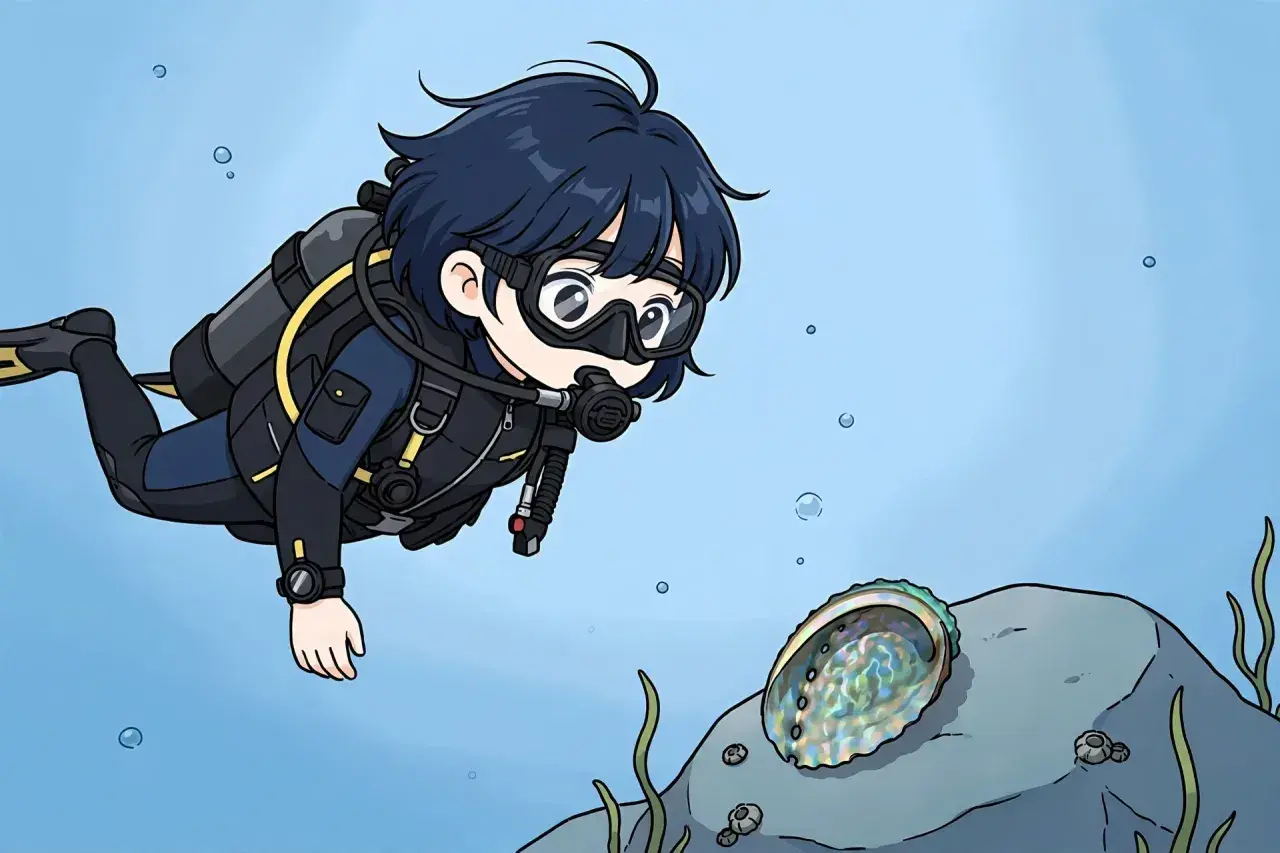
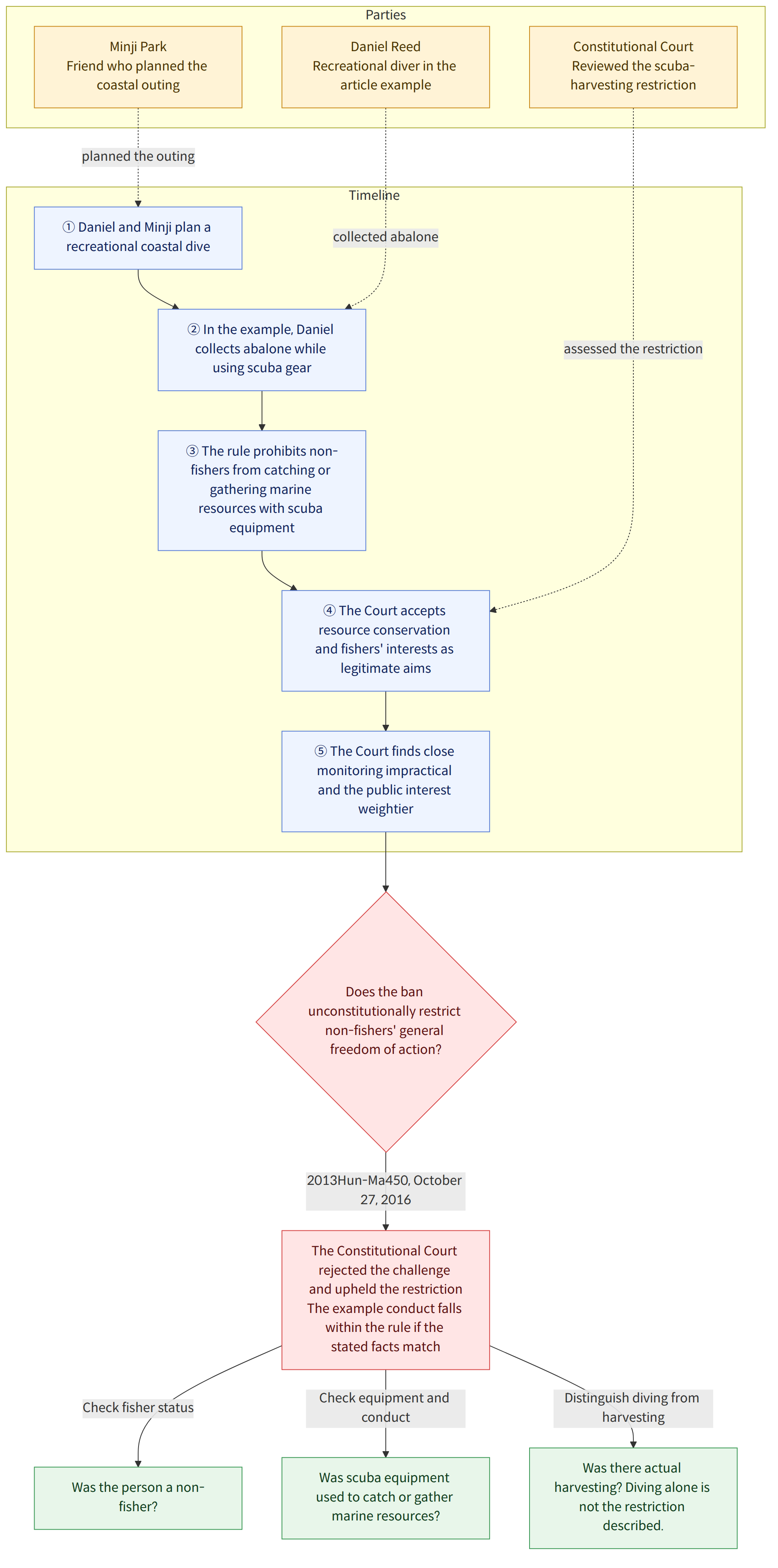
Daniel Reed had spent months looking forward to a weekend on Korea’s southern coast. He and his friend Minji Park planned to explore a rocky stretch of seabed, taking photographs of the fish and reefs. When Daniel spotted abalone, he picked a few up, thinking the catch would make a memorable addition to dinner.
On the way back to shore, Daniel learned that the problem was not how many shellfish he had collected or whether he intended to sell them. As a non-fisher using scuba equipment, he was subject to a prohibition on catching or gathering marine resources. He felt the rule treated a harmless hobby as an affront to his personal freedom—and wondered whether the Constitution protected his choice to dive and collect.
The Legal Question
Does prohibiting a person who is not a professional fisher from catching or gathering marine resources while using scuba equipment unconstitutionally restrict that person’s general freedom of action?
What Korean Law Says
The rule at issue prohibits non-fishers from using scuba diving equipment to catch or gather marine resources. The constitutional question is not whether recreational diving itself is lawful, but whether the law may forbid the additional act of harvesting resources underwater with that equipment.
Korean constitutional review asks, in broad terms, whether a restriction pursues a legitimate public purpose, is reasonably suited to that purpose, avoids unnecessary interference with individual freedom, and maintains a fair balance between public benefit and personal burden.
The Constitutional Court accepted the protection and preservation of marine resources, along with the protection of fishers’ property and livelihoods, as legitimate objectives. It concluded that the scuba-harvesting ban was an appropriate way to advance them.
The Court also considered why a more tailored control system might not work in practice:
- From the surface, it can be difficult to tell whether a scuba diver is underwater and what the diver is doing.
- Scuba equipment can allow longer periods underwater, making monitoring and enforcement harder.
- In the Court’s view, it would be practically very difficult to permit scuba use while reliably controlling the diver’s conduct, the species and quantity taken, and the location of harvesting.
The Court weighed the recreational diver’s inability to collect marine resources against the public interest in preserving those resources, and found the public interest significantly weightier.
How Korean Courts Approach This
In its decision of October 27, 2016 (2013Hun-Ma450), the Constitutional Court rejected the challenge to this restriction. It did not treat the general freedom of action as an unlimited right to engage in any activity a person finds enjoyable. Instead, it assessed the practical effects of the rule and the public interests it was designed to protect.
The Court’s reasoning followed the structure of proportionality review:
- Legitimate purpose: Conserving marine resources and protecting fishers’ property and livelihoods were proper public aims.
- Suitability: Preventing non-fishers from harvesting with scuba gear could help achieve those aims.
- Necessity in practice: The Court considered it unrealistic to supervise scuba harvesting closely enough to regulate each diver’s conduct, catch, and location through narrower rules.
- Balance: The loss of one recreational activity—collecting resources while scuba diving—did not outweigh the public interest in protecting marine resources.
The decision is specific to the restriction considered. It should not be read as saying that every act of diving or every kind of recreational fishing is prohibited. The relevant question is whether a person who is not a fisher is using scuba equipment to catch or gather marine resources under the rule at issue.
Applying the Law to the Case
Daniel’s claim would be difficult to sustain if the facts matched the restriction. He was not a fisher, he used scuba equipment, and he collected marine resources. Those facts place his conduct within the category the rule addresses, regardless of whether he intended to sell his catch or merely eat it with friends.
His argument that the rule interferes with personal freedom is understandable, but it is the same constitutional concern the Court considered. The Court accepted that the ban limits what a recreational diver may do underwater. It nevertheless found the restriction justified because the activity is hard to monitor and because uncontrolled harvesting can threaten resources and the interests of people who depend on fishing.
The amount Daniel collected or the fact that he was on a short recreational trip might matter to the details of an individual enforcement matter, but those facts do not, by themselves, remove the constitutional basis for the prohibition. The Court’s decision means that a general freedom-of-action challenge alone is unlikely to invalidate this restriction.
If Daniel received a written notice or other enforcement document, its wording and the facts it records would be important to understanding how the rule was applied to him. A lawyer could review those documents and the account of the dive to clarify what conduct the authorities identified and what issue, if any, remains open for challenge.
If you have received a written notice or other enforcement document, attorney Ji-sun Ahn of Ijun Law Firm can review its wording alongside your account of the dive to help clarify what conduct the authorities identified and what issue may remain open for challenge.
Conclusion: What Happened, and What Should You Do?
Daniel’s constitutional argument would not overturn the scuba-harvesting prohibition. Under the Constitutional Court’s 2016 ruling, the restriction does not violate the general freedom of action: the protection of marine resources and fishing livelihoods outweighs the recreational interest in collecting them while scuba diving. Daniel could still seek a careful review of how the rule was applied to his particular facts, but he should not assume that a small, non-commercial catch is exempt.
For anyone planning to dive in Korea:
- Check the applicable local and national rules before entering the water, and do not collect marine resources with scuba equipment if you are not a fisher.
- Keep any notice, record, or other enforcement document and note the location, equipment used, and what was collected.
- Ask for a review of the specific documents and facts if you need to understand how the prohibition applies to your situation.

















