
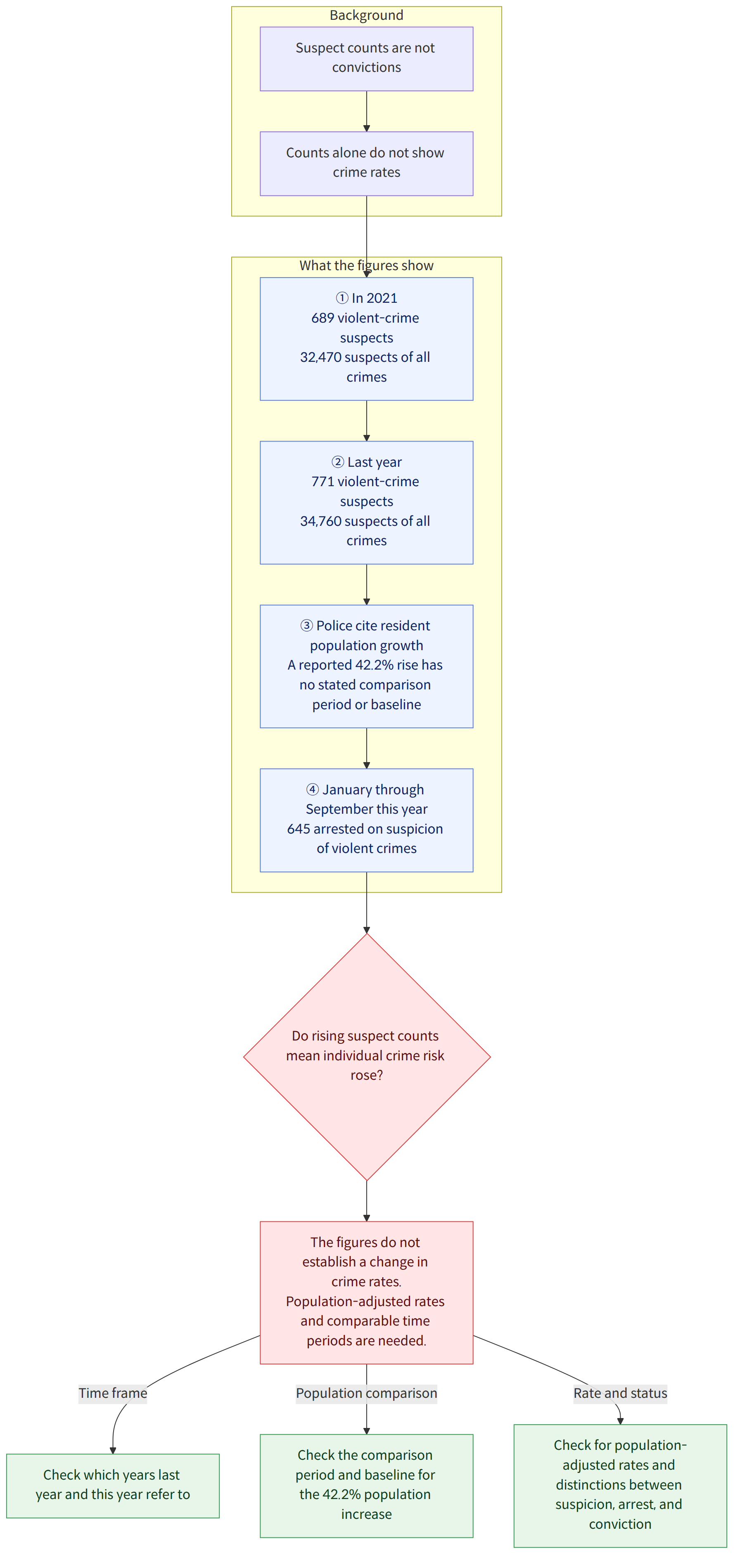
The number of foreign nationals suspected of committing violent crimes in South Korea rose from 689 in 2021 to 771 last year, an increase of about 12% over the past five years. According to the National Police Agency (경찰청), 645 foreign nationals were arrested on suspicion of violent crimes from January through September this year.
Among those suspected of violent crimes last year, Chinese nationals were the largest group, at 250, followed by 62 Uzbek nationals, 60 U.S. nationals and 53 Vietnamese nationals. These figures represent the number of people suspected of crimes; they should not be taken to mean the number of people whose guilt has been established.
Background and context
The number of foreign nationals suspected of all types of crimes, not just violent crimes, also increased. It rose from 32,470 in 2021 to 34,760 last year, an increase of more than 7%. By nationality, the number of Mongolian nationals rose by about 38%, from 1,007 to 1,397, while the number of Thai nationals fell by more than 20%, from 2,482 to 1,979.
Police see the growing number of foreign nationals living in South Korea as the main reason for the increase in foreign crime suspects. They say that an increase in the number of suspects alone does not establish that the likelihood of committing a crime—in other words, the crime rate—has also risen. The article also says that the number of foreign nationals living in South Korea increased by 42.2%, but does not provide the comparison period or baseline figures.
What this news means
The number of suspects and the crime rate answer different questions. The number of suspects shows how many people were suspected of crimes during a given period, while comparing crime rates requires looking at both the size of the foreign population and the number of suspects during that period. The figures in this article mention a 42.2% increase in the resident population, but the comparison period and baseline for that figure have not been established, making it difficult to compare directly with the rate of increase in the number of suspects.
For example, if the number of suspects rose in proportion to the foreign-resident population as that population grew, the increase in the number of suspects alone would not mean that the risk of crime for individuals had risen. This is a hypothetical explanation of one possible interpretation; it does not mean that the figures provided show an actual change in the crime rate. Differences in the number of people by nationality are also difficult to interpret as differences in crime rates without considering the size of each nationality group’s population.
What is known and what remains unknown
What is known
- The number of foreign nationals suspected of violent crimes rose from 689 in 2021 to 771 last year.
- From January through September this year, 645 foreign nationals were arrested on suspicion of violent crimes.
- The total number of foreign nationals suspected of crimes rose from 32,470 in 2021 to 34,760 last year.
- Police cited growth in the number of foreign nationals living in South Korea as the main reason for the increase in foreign crime suspects, and said this does not necessarily mean the crime rate has risen.
What remains unknown
- The article does not specify which years “last year” and “this year” refer to.
- The comparison period and baseline figures for the reported 42.2% increase in the number of foreign nationals living in South Korea have not been established.
- It is not known how the crime rate changed over the same period when the size of the foreign population is taken into account.
- The article provides no information that would distinguish population growth from other factors as reasons for the increase in the number of suspects.
What readers should check
- In follow-up statistics or reports, check which years “last year” and “this year” refer to so the figures can be compared using the same time frame.
- Look for disclosure of the comparison period and baseline figures for the 42.2% increase in the foreign-resident population.
- Check whether crime rates that account for population size are provided alongside the number of suspects, and whether suspicion, arrest and conviction are distinguished.