

1. A Human Story
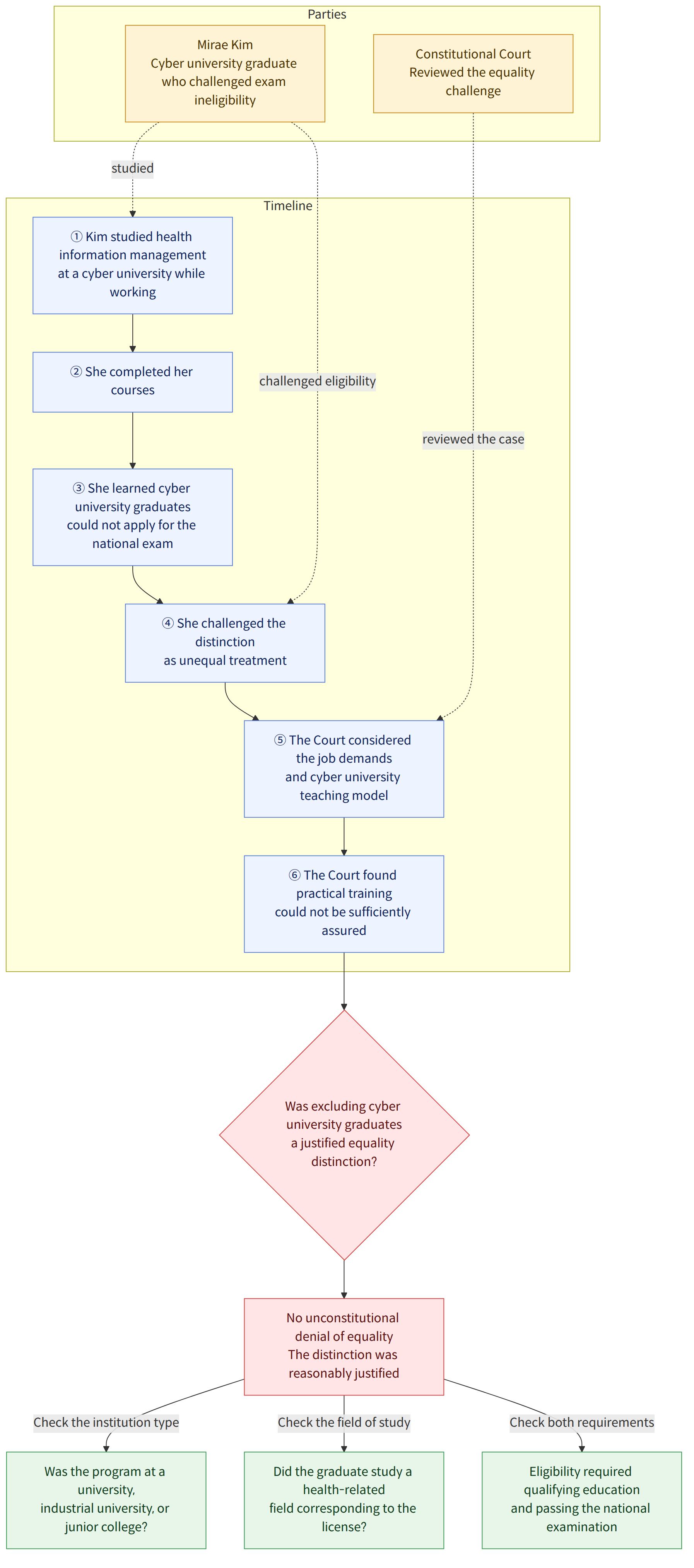
Mirae Kim had chosen a cyber university because its flexible schedule let her keep her job while studying health information management. She completed her courses, learned how medical records supported patient care and hospital administration, and pictured herself working in the field. The next step seemed clear: sit for the national Medical Records Technician exam.
Then Mirae learned that graduates of conventional universities and junior colleges could qualify for the exam, while graduates of cyber universities could not—even if they had studied the same subject. She believed her coursework had prepared her for the same professional path. With the exam door closed, she considered challenging the law on the ground that it treated her differently because of the kind of institution she attended.
2. The Legal Question
Did denying a cyber-university graduate access to the Medical Records Technician national exam, while allowing graduates of other higher-education institutions who studied the same subject to apply, violate the constitutional right to equality?
3. What Korean Law Says
The relevant provision of the Medical Service Technologists, Etc. Act links eligibility for a professional license to both education and examination. In broad terms, it requires a person to graduate from a university, industrial university, or junior college after studying a health-related field corresponding to the license sought, pass the national examination, and obtain a license from the Minister of Health and Welfare.
The statutory route combines relevant higher education with success in the national examination; passing the exam alone is not enough if the education requirement is unmet.
The Medical Records Technician system is intended to ensure that medical records are maintained and managed professionally, efficiently, and safely, and that health-related statistics can be prepared and managed for policy purposes. The work increasingly involves electronic medical records and systems that connect with hospital information networks. Those responsibilities call for technical ability as well as theoretical knowledge.
The legal distinction at issue was therefore not simply between people who had studied the subject and those who had not. It concerned whether the type of institution and instruction provided a sufficient foundation for professional practice. In the Court’s analysis, relevant education and the national exam served different purposes:
- Education and training were meant to build the knowledge and practical skills needed for the work.
- The national exam was meant to assess whether a candidate met the required professional standard.
- A license followed only after the applicable education and examination requirements were satisfied.
4. How Korean Courts Approach This
Korean constitutional equality does not mean that every person in a broadly similar situation must be treated identically. A legal distinction may be permissible when it rests on a reasonable basis connected to the purpose of the law. The question is whether the difference in treatment is justified, not merely whether it exists.
In evaluating an equality challenge, the Constitutional Court considers whether the distinction has a reasonable connection to the legitimate aim of the rule and whether the groups being compared are alike in the respects that matter to that aim.
Here, the aim was to ensure that Medical Records Technicians had adequate professional preparation. The Court considered the practical demands of the job and the structure of cyber-university teaching at the time: distance learning was the norm, and in-person classes were limited to no more than 20 percent of instruction. It concluded that the law could reasonably distinguish between graduates whose programs were expected to provide substantial practical training and graduates of programs where that training could not be sufficiently assured.
5. Applying the Law to the Case
- Mirae’s comparison was understandable, but not conclusive. She and graduates of conventional universities might have studied the same broad subject. But equality analysis also considers whether the programs provided comparable preparation for the particular work the law regulates.
- The profession involved hands-on competence. Medical records work required more than familiarity with health information concepts. As records became electronic and systems more interconnected, practical experience with relevant processes and technology became increasingly important.
- The Court looked at the teaching model then in place. Because cyber-university instruction was principally remote and in-person attendance was capped, the Court was not satisfied that these programs could be expected to provide effective and sufficient practical training for the profession.
- The exam did not replace the education requirement. The Court treated education and examination as complementary safeguards. A national exam could test knowledge, but it did not necessarily supply the practical preparation that the education requirement was intended to ensure.
- The distinction was linked to the public purpose. The rule aimed to protect the quality and safe management of medical records. On the Court’s reasoning, limiting exam eligibility to graduates of the specified types of institution was a reasonable way to pursue that aim, rather than an arbitrary penalty on cyber-university students.
A reader in Mirae’s position could ask [[lawyer]] to review the degree transcript, course syllabus, practical-training records, and the wording of a proposed constitutional complaint to assess how the individual facts relate to the legal issue.
6. Conclusion: What Happened, and What Should You Do?
Mirae’s equality challenge failed. The Constitutional Court held that the statutory exclusion did not violate her right to equality. It accepted that practical instruction was an essential part of preparation for Medical Records Technician work, and that the cyber-university format described in the case did not reliably ensure enough of that instruction. The Court therefore found a reasonable basis for treating those graduates differently for exam eligibility.
For anyone facing a similar eligibility barrier:
- Check the exact statutory requirements for the license and the relevant version of the law; the required institution type and education can matter as much as the subject studied.
- Keep detailed education records, including syllabi, attendance information, laboratory or practical work, and any supervised training. These documents may help explain what preparation a program actually provided.
- Get an individual review before filing a constitutional challenge. A strong argument must address not only unequal treatment, but also whether the difference has a reasonable connection to the law’s professional and public-protection goals.
If you are considering a challenge to an eligibility rule, attorney Ji-sun Ahn of Ijun Law Firm can review your transcript, course descriptions, practical-training records, and draft complaint to help assess how those documents bear on the issue.

















