

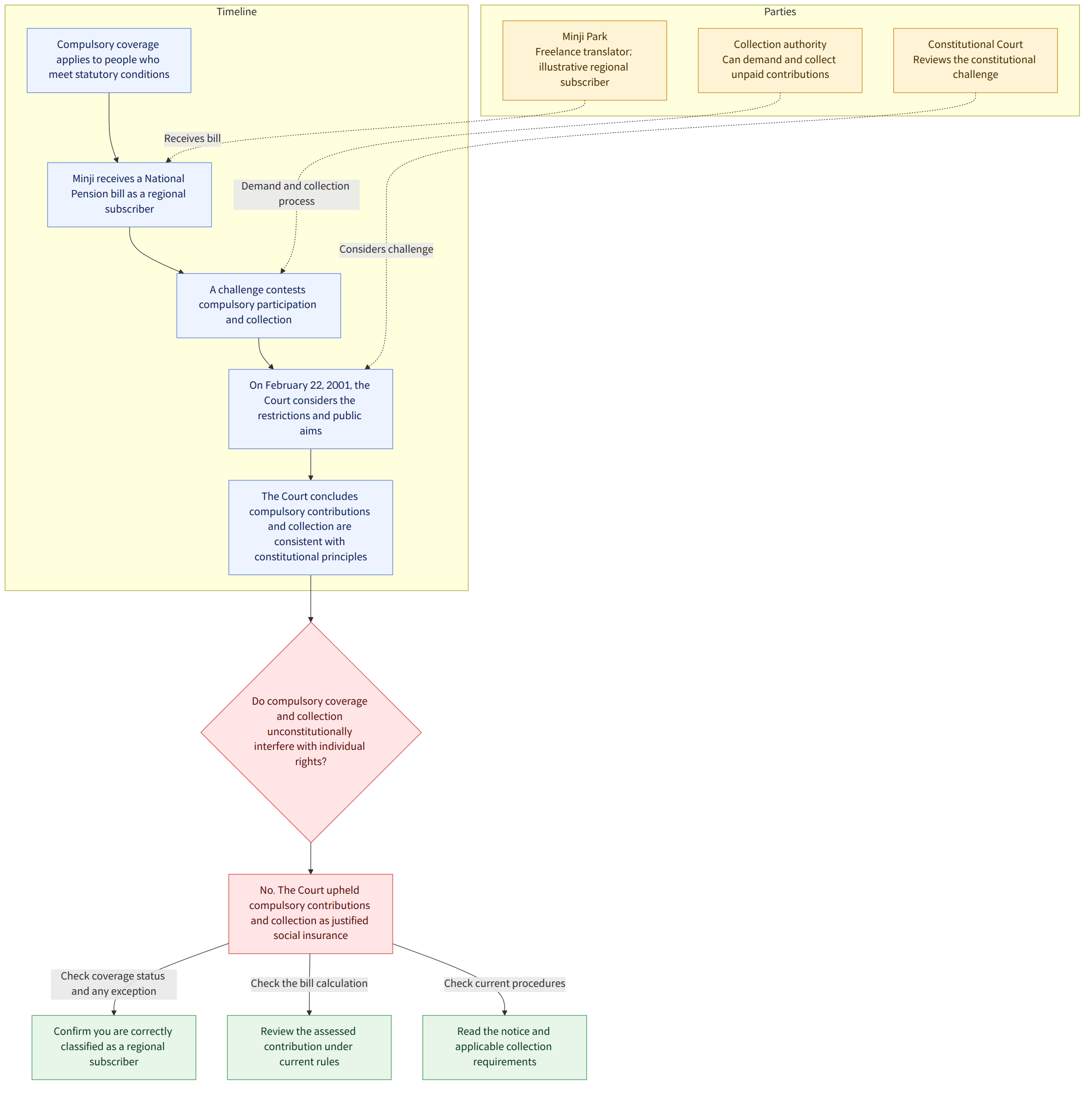
1. A Human Story
Minji Park had built her freelance translation business one client at a time. Her income rose and fell from month to month, so she watched every regular expense. Then a notice arrived requiring her to pay National Pension contributions as a regional subscriber. Minji had never signed up. She had not chosen a pension plan, and she was not convinced that the bill reflected the uneven rhythm of freelance work.
She wondered whether the government could make her participate and collect the money if she refused. The notice made the question feel immediate: was this simply a public pension contribution, or an unwanted taking of her savings? Minji considered challenging the system itself, arguing that compulsory enrollment and collection violated her constitutional rights.
2. The Legal Question
Can a person who falls within the National Pension Act’s compulsory coverage rules refuse to join as a regional subscriber, or challenge mandatory contributions and their collection as unconstitutional interference with property, personal freedom, or the right to pursue happiness?
3. What Korean Law Says
The National Pension system is a form of social insurance. In general, people who meet the statutory conditions are covered by the scheme even if they would personally prefer to make their own arrangements. The law imposes contributions to fund pension benefits and the broader operation of the system.
The Act provides for contributions to be assessed during a person’s coverage period. It also provides a collection process when contributions are unpaid. In broad terms, the statutory framework allows the collection authority to issue a demand for payment and, if the debt remains unpaid, to use collection procedures comparable to those used for delinquent national taxes, subject to the law’s requirements and approvals.
Compulsory coverage is not the same as voluntary enrollment. If someone falls within a mandatory category under the Act, lack of consent alone does not ordinarily remove the obligation to contribute.
Key points include:
- Coverage comes first. The person’s age, work and income circumstances, and any applicable statutory exclusion or exception may matter to whether they are properly treated as a regional subscriber.
- Contributions are legally imposed. The amount is assessed under the National Pension Act and related rules; it is not simply a private contract price chosen by the individual.
- Nonpayment can lead to collection action. The Act provides for a formal demand and, if payment is still not made, compulsory collection under the applicable statutory process.
- The constitutional challenge is different from a billing dispute. A person may have a reason to question their coverage classification or the calculation of a particular bill without proving that the pension system itself is unconstitutional.
The precise contribution rates, administrative arrangements, and procedures can change through amendments and implementing rules. A person should therefore check the law and the details of their own current notice rather than rely on an old rate or a description of an earlier administrative structure.
4. How Korean Courts Approach This
Korean constitutional analysis has treated the National Pension as a public social insurance scheme, not as an ordinary tax. A tax is generally collected without a specific pension benefit being linked to the payer’s contribution history in the same way. National Pension contributions, by contrast, form part of a system under which benefits are determined according to statutory rules, including a person’s period of participation and other factors.
The Constitutional Court considered a challenge to compulsory participation and collection in its decision of February 22, 2001. It accepted that the system restricts individual choice and that its redistributive features can mean that people do not receive benefits in a simple, one-to-one relationship with every amount they paid. But it concluded that those features serve legitimate public aims: helping protect people against old age, disability, and death, and sharing social risks across individuals and generations.
The Court’s general approach: A restriction on individual choice can be constitutional where it is grounded in law, reasonably connected to an important public purpose, and proportionate to that purpose. The Court regarded compulsory contributions and collection as consistent with those principles and with the constitutional framework for a social-market economy.
The Court also reasoned that some redistribution is inherent in social insurance. The legislature has room to decide how much redistribution the scheme should involve, provided the design remains within constitutional limits. On that reasoning, compulsory contributions did not become unconstitutional merely because an individual would rather save privately or because the scheme did not operate like a personal savings account.
5. Applying the Law to Minji’s Case
Minji’s case turns on two separate questions: whether she is correctly classified as a regional subscriber, and whether the constitutional objection she has in mind can invalidate the system.
- Is she within mandatory coverage? Minji is a freelancer, and the notice treats her as a regional subscriber. If she falls within the Act’s coverage rules and no exclusion or exception applies, the fact that she never applied to join is not, by itself, a defense. The legal duty arises from the statute, not from her signature on a pension contract.
- Is the contribution a tax or a pension contribution? Minji’s concern about losing control of her money is understandable. But the Constitutional Court has distinguished National Pension contributions from an ordinary tax because they belong to a statutory social insurance arrangement that provides pension benefits. The fact that the scheme also redistributes income does not automatically change that legal character.
- Does compulsory payment violate her rights? The system limits Minji’s freedom to decide how to use some of her income. The Court nevertheless accepted the public purposes of protecting people against major social risks and spreading those risks across society. It found compulsory participation and collection proportionate in light of those aims, and considered the public benefit greater than the individual interest in choosing a wholly private savings arrangement.
- What if this particular bill is wrong? That is a different issue. If Minji’s coverage status, income information, or contribution calculation is inaccurate, she should raise that specific issue through the applicable administrative process and support it with relevant records. The constitutional decision does not establish that every individual bill is correctly calculated; it means that a general objection to compulsory participation is unlikely, on its own, to defeat collection.
Minji checks the notice against her work and income records and finds no apparent mistake in the assessment. Her argument that she never consented to join is therefore unlikely to cancel the contribution. She decides to address the payment obligation rather than rely on a broad constitutional challenge, while keeping her records in case a later assessment does not match her circumstances.
If the notice’s coverage classification, income basis, or calculation is unclear, Minji—or another recipient—could ask [[lawyer]] to review the notice alongside relevant income and work records, and help identify whether the concern is about the individual assessment rather than the constitutionality of compulsory coverage.
If the notice’s coverage classification, income basis, or calculation is unclear, Minji—or another recipient—could ask attorney Ji-sun Ahn of Ijun Law Firm to review the notice alongside relevant income and work records, and help identify whether the concern is about the individual assessment rather than the constitutionality of compulsory coverage.
6. Conclusion: What Happened, and What Should You Do?
Minji’s constitutional objection does not, by itself, remove her obligation to contribute. Korean constitutional law has upheld the basic model of compulsory National Pension participation and collection, reasoning that the scheme is social insurance serving important public purposes—not an ordinary tax or an optional private investment. On the facts of her case, the bill remains payable because she has found no specific error in her coverage or assessment.
For anyone who receives a similar notice:
- Check the basis of the bill. Review your coverage category, reported income, and the period for which contributions are assessed.
- Challenge a concrete error with documents. If information is wrong or your circumstances may affect coverage, raise that issue with the responsible agency and keep copies of the notice and supporting records.
- Do not rely on non-consent alone. A general argument that you did not choose to join is unlikely to defeat a contribution obligation under the current constitutional approach.
















