

1. A Human Story
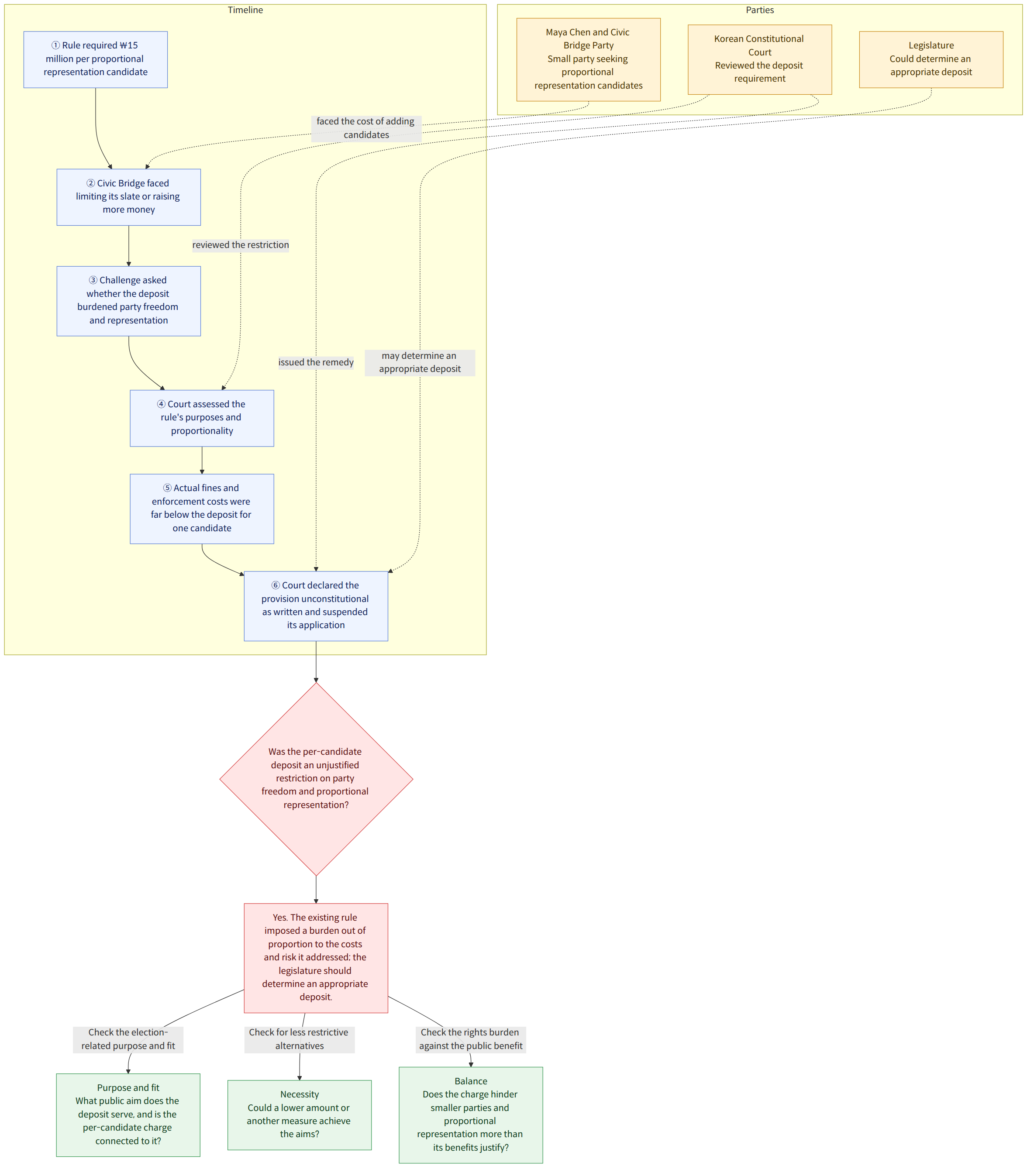
When Maya Chen sat down to finalize her party’s candidate list, the paperwork was not the hardest part. The hardest part was the arithmetic. Her small party, the Civic Bridge Party, wanted to put forward several candidates for the National Assembly’s proportional-representation ballot. Under the rule then in force, it had to pay a ₩15 million deposit for each candidate.
The party had volunteers, a modest campaign fund, and support from voters who rarely saw their concerns reflected in the larger parties’ platforms. But every additional name on the list added another large payment. Maya and her colleagues faced a stark choice: narrow the slate to what they could afford, or leave some potential candidates—and the communities they hoped to represent—off the ballot altogether.
Maya wondered whether a rule designed to keep elections orderly could lawfully make meaningful participation depend on a party’s ability to raise millions of won for each nominee.
2. The Legal Question
The central question is whether requiring a political party to pay a separate, substantial deposit for every proportional-representation candidate unjustifiably restricts the freedom of political parties and the constitutional role of proportional representation.
3. What Korean Law Says
Korean constitutional review applies the principle of proportionality when the state restricts a fundamental right. In broad terms, a restriction must pursue a legitimate aim, be reasonably suited to that aim, go no further than necessary, and strike a fair balance between the public benefit and the burden on rights.
The deposit requirement had legitimate purposes. It was intended to encourage parties to nominate candidates seriously, reduce unnecessary election-administration work and expense, and provide advance security for certain fines and costs of administrative enforcement arising from election violations.
A measure may pursue a legitimate public purpose and still be unconstitutional if it burdens a protected right more than is necessary to achieve that purpose.
The proportional-representation ballot also differs in an important way from a district-based contest. A district election centers on individual candidates competing to represent a particular constituency. A proportional-representation election is primarily a contest among parties, with seats allocated in light of their support. That difference matters when assessing whether the same kind of per-candidate deposit is justified in both settings.
In evaluating the rule, the key considerations include:
- Purpose: Does the deposit serve a legitimate election-related objective?
- Fit: Is charging a deposit for each candidate reasonably connected to that objective?
- Necessity: Could the objectives be achieved through a less restrictive approach or a lower amount?
- Balance: Is the public benefit worth the burden placed on parties’ ability to participate?
4. How Korean Courts Approach This
The Korean Constitutional Court examines not only the government’s stated objective but also how the rule operates in practice. A restriction that appears sensible in the abstract may fail if its burden is excessive in relation to the actual risks or costs it addresses.
In proportionality review, the Court considers whether a less restrictive measure could protect the public interest and whether the burden on constitutional rights is excessive compared with the benefit achieved.
For proportional-representation elections, the Court recognized that permitted campaigning creates less potential for disorder or excessive competition than campaigning in individual district contests. It also considered the real financial consequences of the deposit rule: the total fines and costs of administrative enforcement actually imposed on parties in proportional-representation elections were far below the ₩15 million required for even one candidate. Requiring the deposit to rise with every additional candidate therefore demanded far more than the relevant costs appeared to justify.
The Court also considered the function of proportional representation. It is intended, in part, to help reflect a wider range of public views and to reduce the distortions associated with winner-take-all district contests. A steep per-candidate charge that favors well-funded parties can work against that purpose.
The Court’s remedy was significant but carefully framed. It declared the provision unconstitutional in its existing form, while issuing a constitutional-nonconformity decision and suspending its application rather than simply erasing the provision immediately. The Court considered it preferable for the legislature to determine an appropriate deposit after weighing the nature of the election, its administration, and related costs.
5. Applying the Law to the Case
Maya’s party would not automatically win the constitutional argument merely because it was small or found the deposit difficult to pay. The question was whether the rule, as applied to proportional-representation candidates, imposed a constitutionally excessive burden.
- The objectives were legitimate. Requiring parties to demonstrate seriousness and helping cover election-related costs are proper public aims. The Court accepted that the deposit had a rational connection to those aims.
- The electoral setting was different. Maya’s candidates were running on a party list, not competing individually for a district seat. The Court viewed proportional-representation elections as less likely than district elections to produce the kind of disorder or heightened campaigning that might justify substantial candidate-by-candidate deposits.
- The amount and structure were disproportionate. A ₩15 million charge for each candidate could quickly become a major barrier for a small party seeking to present a broad slate. Yet the actual total of relevant fines and enforcement costs imposed on parties in these elections fell considerably short of even one candidate’s deposit. That gap weakened the case for multiplying the charge by the number of nominees.
- The burden affected more than the party’s budget. The rule could limit which parties were able to compete and which political viewpoints voters could see on the ballot. That concern was especially serious because proportional representation is intended to give a wider range of political opinion a route into elected office.
- The public benefit did not justify the rights burden. The Court concluded that the rule failed the least-restrictive-means requirement and the overall balancing requirement. The restriction on party activity and political participation outweighed the benefits the particular deposit structure was shown to deliver.
6. Conclusion: What Happened, and What Should You Do?
Maya’s concern was constitutionally sound. The Constitutional Court held that the per-candidate deposit provision for proportional-representation elections violated the principle of proportionality and infringed the freedom of political parties. But the Court did not simply strike the provision from the statute with immediate, unconditional effect. Instead, it issued a constitutional-nonconformity decision and suspended application of the challenged provision, leaving the legislature to design an appropriate replacement in light of the election system and its actual administrative costs.
That distinction matters: the decision did not guarantee every party the right to register any number of candidates without conditions. It meant that the challenged deposit rule, in its existing form, could not continue to operate while its application was suspended, and that the legislature had to address the constitutional defect.
For parties or candidates facing a similar barrier:
- Check the current law and election timetable early. Constitutional rulings and later legislative changes can affect what requirements apply at the time of registration.
- Document the practical burden. Keep records of the amount demanded, the number of candidates affected, the party’s resources, and any evidence about the costs or risks the deposit is meant to cover.
- Get specialist advice before a deadline passes. Election-registration deadlines are strict, and a constitutional challenge may not by itself resolve the immediate procedural steps needed to preserve a party’s position.

















