

A Human Story
For years, Daniel Reed had built a loyal customer base at a wholesale rice market in Seoul. He knew which customers wanted the fragrance of freshly harvested rice and which were looking for a lower-priced option. To meet different budgets, he sometimes blended older rice with newer rice. He also mixed a small quantity of domestic glutinous rice into imported rice, then sold the finished product as a convenient, ready-to-cook blend.
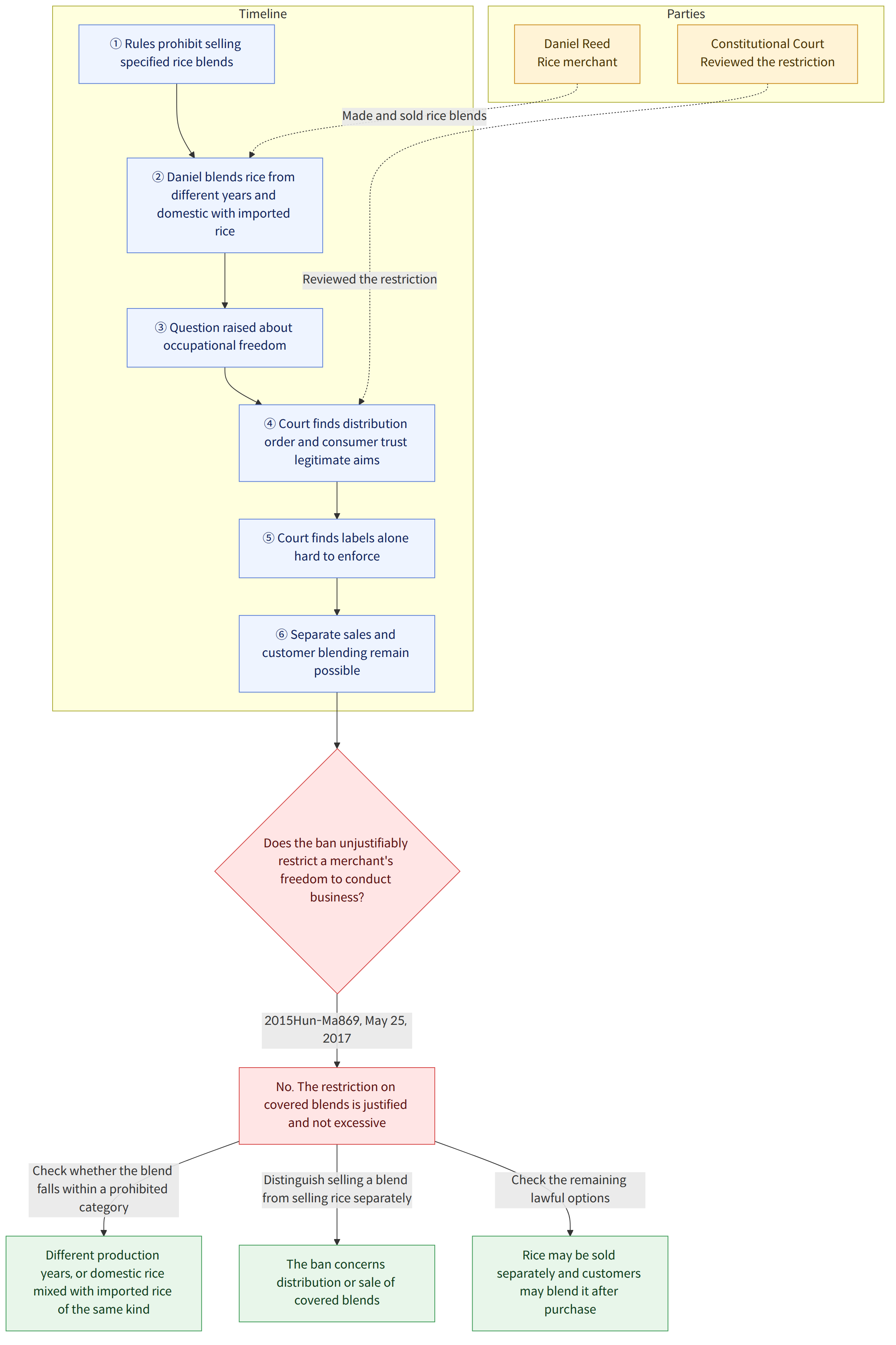
A change in the rules disrupted that routine. Daniel learned that rice merchants could no longer distribute or sell certain blends: domestic rice mixed with imported rice of the same kind, or rice from different production years. He worried that the restriction would take away a practical tool of his trade. If he could sell each kind separately but not combine them for customers, had the law crossed the line into an unconstitutional restriction on his freedom to work?
The Legal Question
The central question is whether banning the distribution and sale of these mixed rice products unconstitutionally limits a rice merchant’s freedom to conduct a business—or whether the restriction is a justified way to protect fair rice distribution and consumer confidence.
What Korean Law Says
The Constitution protects occupational freedom, which includes the freedom to carry on a chosen business. That freedom is important, but it does not prevent the legislature from regulating how a business operates when there is a legitimate public purpose and the restriction is proportionate.
The rules at issue target the sale and distribution of rice in a mixed state in specified circumstances. They do not prohibit selling imported rice, older rice, or domestic rice as separate products.
The Constitutional Court considered the aim of establishing order in rice distribution and securing consumer trust legitimate. It also concluded that requiring labels alone would not be enough where the proportion of ingredients in a blend is difficult to verify and police. (Principles drawn from Constitutional Court decision 2015Hun-Ma869, May 25, 2017.)
The practical distinction is between a merchant selling a finished blend and a merchant selling separate varieties. Under the approach upheld by the Court:
- A merchant may not distribute or sell a blend covered by the prohibition.
- The merchant may continue to sell the relevant rice varieties separately.
- The merchant may explain possible blending ratios, with the customer making the blend after purchase.
How Korean Courts Approach This
In reviewing a restriction on occupational freedom, the Constitutional Court generally considers whether the measure pursues a legitimate aim, whether it can help achieve that aim, whether a less restrictive approach would work sufficiently well, and whether the public benefit is reasonably balanced against the burden on the affected business.
In this dispute, the Court focused on the difficulty of enforcing a labeling-only system. Even if officials could establish that rice had been mixed, determining the precise proportions—and detecting improper sales consistently—could be difficult. A ban on selling the covered blend was therefore treated as a more effective way to prevent deceptive distribution and protect consumer confidence.
The Court also considered how much of the business remained possible. The rule did not remove imported or older rice from the market; it restricted selling specified rice varieties already blended together. Because merchants could sell the products separately and customers could blend them after buying, the Court found the limit on occupational freedom was not excessive.
The Court’s approach was not that business freedom is unimportant. Rather, it weighed the specific restriction against the consumer-protection purpose and the alternatives still available to merchants.
Applying the Law to Daniel’s Shop
- Identify the covered blends. Daniel’s practice involved both older and newer rice, and a blend of imported rice with a small amount of domestic glutinous rice. The rules described in this dispute cover mixing rice from different production years and mixing domestic rice with imported rice of the same kind. The exact product and category would matter when assessing any particular stock.
- Separate the act of blending from the act of selling. The constitutional ruling does not mean Daniel must stop selling imported, domestic, new, or older rice. It means he cannot distribute or sell a blend that falls within the prohibited categories. Merely describing the mixture or its ingredients would not necessarily cure the problem, because the Court found that labels alone could not adequately address the enforcement difficulty.
- Consider the lawful alternative. Daniel could sell each variety separately and explain how a customer might combine them for a desired taste or price. The customer could then mix the rice after purchase. That distinction was central to the Court’s conclusion that the restriction left meaningful ways for merchants to continue their trade.
- Apply the constitutional balance. The restriction serves the public interest in reliable information and orderly distribution. Daniel loses the convenience of selling certain pre-mixed products, but he is not barred from selling the component varieties. The Court concluded that this burden did not outweigh the public benefit and did not violate occupational freedom.
If you are unsure whether a product falls within the prohibited categories, attorney Ji-sun Ahn of Ijun Law Firm can review its ingredient and harvest-year records, labels, invoices, or any enforcement notice and help you assess the issue based on those documents.
Conclusion: What Happened, and What Should You Do?
Daniel could not continue selling the covered blends as finished products, but he could keep selling the rice varieties separately and advise customers about blending them at home. The Constitutional Court upheld the restriction, finding that it pursued legitimate consumer-protection goals and did not impose an excessive burden on rice merchants’ freedom to conduct business.
For merchants facing a similar issue:
- Check each product’s composition and production year. Keep clear records of the rice varieties and harvest years in your inventory.
- Review labels, invoices, and sales procedures. Do not assume that disclosure alone makes a prohibited pre-mixed product lawful.
- If a particular product or enforcement notice is at issue, have the relevant product records, labels, and notice reviewed so you can understand how the rule applies to those specific facts.

















