

1 — A Human Story
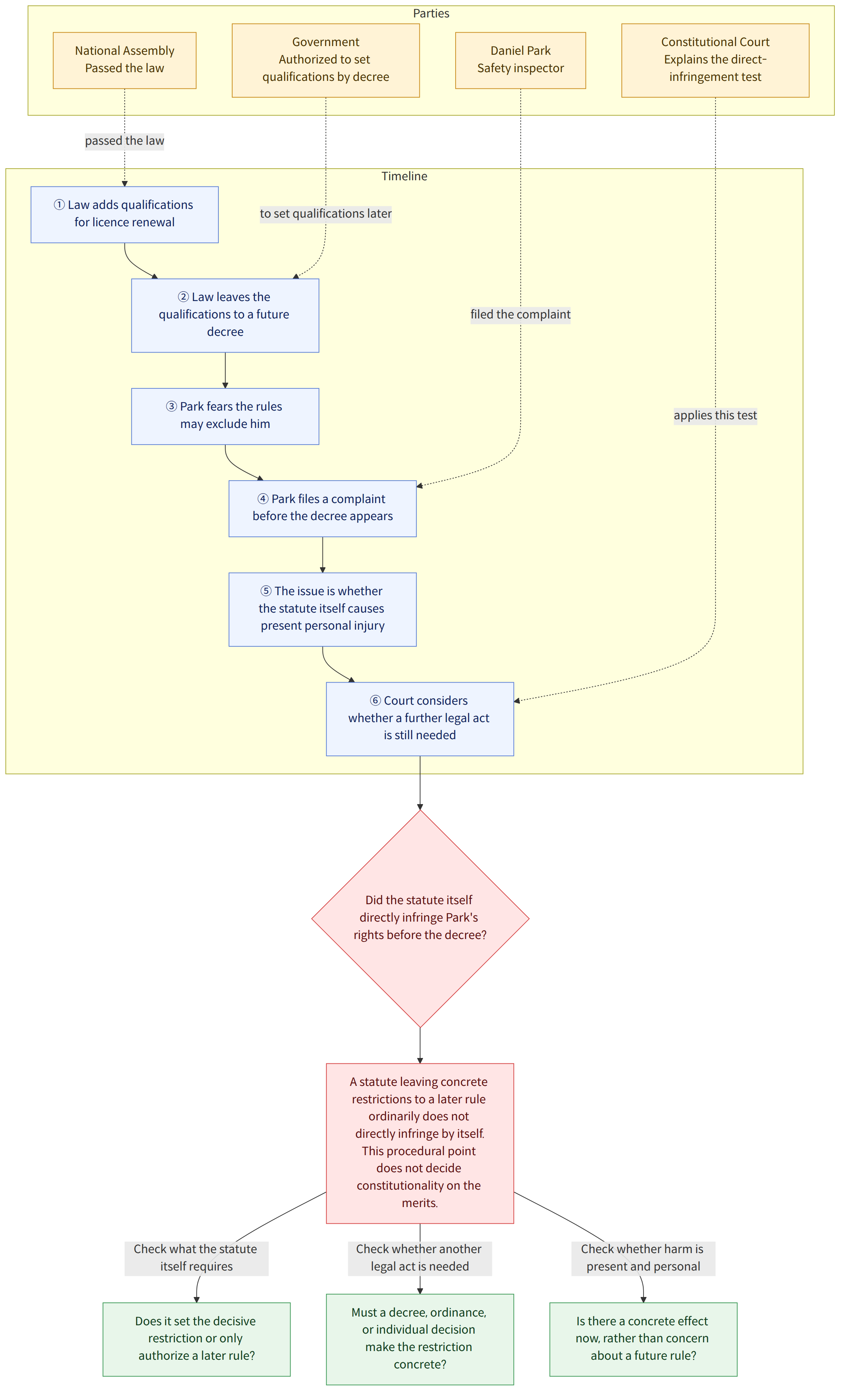
Daniel Park had spent years building a career as a safety inspector. Then the National Assembly passed a law saying that anyone wishing to renew an inspection licence would have to meet additional qualifications. The law did not identify those qualifications. Instead, it authorized the government to set them later by presidential decree.
Daniel worried that the forthcoming rules might exclude people with his training and experience. Before the decree appeared, he filed a constitutional complaint challenging the new statutory provision. He argued that the law had already put his livelihood at risk: the government had been given power to impose a barrier, and he could not know whether he would clear it.
His concern was real. But a constitutional complaint is not simply a way to ask whether a law might cause trouble in the future. Korean constitutional procedure asks a more precise question: has this particular legal provision itself already infringed this person’s fundamental rights, without another legal act still needed to make the harm concrete?
2 — The Legal Question
When a statute announces a restriction but leaves its concrete standards to a presidential decree, ministerial ordinance, or another subordinate regulation, can a person challenge the statute itself in a constitutional complaint before that later rule is made or applied?
The key issue is direct infringement: did the statute itself cause a present, personal injury, or must a further legal act first turn its broad instruction into a specific restriction?
3 — What Korean Law Says
Under Article 68(1) of the Constitutional Court Act, an individual may bring a constitutional complaint when a public authority’s exercise or failure to exercise power infringes that person’s fundamental rights. A challenge to a statute has an important additional requirement: the statute must itself cause the alleged injury.
A person challenging a statute must generally show that it directly, presently, and personally infringes their fundamental rights, without the need to wait for a separate implementing act.
“Directly” is the critical word in Daniel’s situation. If a statute sets out the restriction itself, it may be the immediate source of harm. But if it states only a general framework and leaves the operative criteria to a later regulation, the later rule may be the act that makes the restriction concrete.
For this purpose, an “implementing act” is not limited to a decision made by an administrative official. It can include a further act of legislation, such as the adoption of a presidential decree or ministerial ordinance.
Where a statute leaves its concrete content to a subordinate regulation that is expected to follow, the statute will ordinarily not be treated as directly infringing fundamental rights by itself.
In practical terms, the analysis often turns on these questions:
- What does the statute itself require or prohibit? Does it establish the decisive restriction, or merely authorize a later rule to do so?
- Is a further legal act needed? If a decree, ordinance, or individual administrative decision must still define or apply the restriction, the statute may not be the direct cause of the injury.
- Has the alleged harm become present and personal? A general concern about what a future regulation might say is different from a concrete effect on a particular person.
This is a question about whether the complaint is an appropriate vehicle for review. A finding that the statute is not directly challengeable at that stage is not a ruling that the statute or a later regulation is constitutional.
4 — How Korean Courts Approach This
The Korean Constitutional Court distinguishes between a legal provision that itself changes a person’s legal position and one that merely provides a framework for a later act. The Court has explained that the relevant implementing act can include legislation below the statute, not just an administrative decision applying the law to an individual.
When the statute leaves the substance of a restriction to a future decree or ordinance, the Court generally asks whether that lower-level rule is still needed before anyone’s rights are actually affected. If so, a challenge to the statute alone will ordinarily fail the direct-infringement requirement. The statute may have created the authority to regulate, but the later rule supplies the specific standard that produces the claimed impact.
That procedural conclusion should not be confused with a decision on the merits. The Court may dismiss a complaint because the alleged injury is not yet directly attributable to the challenged statute, without deciding whether the delegation or the eventual regulation violates the Constitution.
5 — Applying the Law to Daniel’s Case
Daniel’s complaint faces a problem at each step of the direct-infringement analysis.
- The statute did not state the qualifications Daniel feared. It announced that additional qualifications would be required, but left their content to a future presidential decree. On the facts of his complaint, the statute had not yet specified which training, experience, or other conditions would govern renewal.
- A further legislative act was still necessary. The government had to issue the decree before the new qualifications could be identified. Because that decree is itself a form of lawmaking, it counts as a possible implementing act for this analysis.
- Daniel’s feared exclusion was not yet established by the statute alone. He could reasonably worry that the future criteria would disadvantage him. But until those criteria were set, it was not clear that the law, by itself, had made him ineligible or otherwise concretely changed his legal position.
- The procedural issue does not answer whether the eventual rule is fair or constitutional. If the decree later sets a qualification that affects Daniel, the legal question will be more concrete. The proper object and route for a challenge would then depend on the content of the decree, how it operates, and whether any additional individual decision is required.
The distinction is between a law that has already imposed a specific burden and a law that instructs the government to decide later what that burden will be. Daniel was in the second position when he filed.
If you are dealing with a similar issue, attorney Ji-sun Ahn of Ijun Law Firm can review the provision applied in your case, the ruling or notice you received, and the dates relevant to challenging it with you. These details can help clarify which options apply to your situation.
6 — Conclusion: What Happened, and What Should You Do?
Daniel’s complaint against the statutory provision alone would ordinarily be dismissed because the statute left the decisive qualifications to a future presidential decree. That would not mean his concern was unfounded, nor would it settle the constitutionality of the decree once issued. It would mean only that the statute, at that stage, had not been shown to infringe his rights directly without a further legislative act.
For readers facing a similar situation:
- Read the operative rule, not just the enabling statute. Identify whether the statute itself imposes the restriction or leaves its substance to a decree, ordinance, or later decision.
- Keep track of when and how the rule takes effect. Save the regulation, notices, and any individual decision that applies it; these may show when the impact becomes concrete.
- Get advice promptly once the rule affects you. Constitutional complaints are subject to procedural requirements and time limits, and the right target for a challenge can depend on the exact sequence of legal acts.

















