

A Human Story
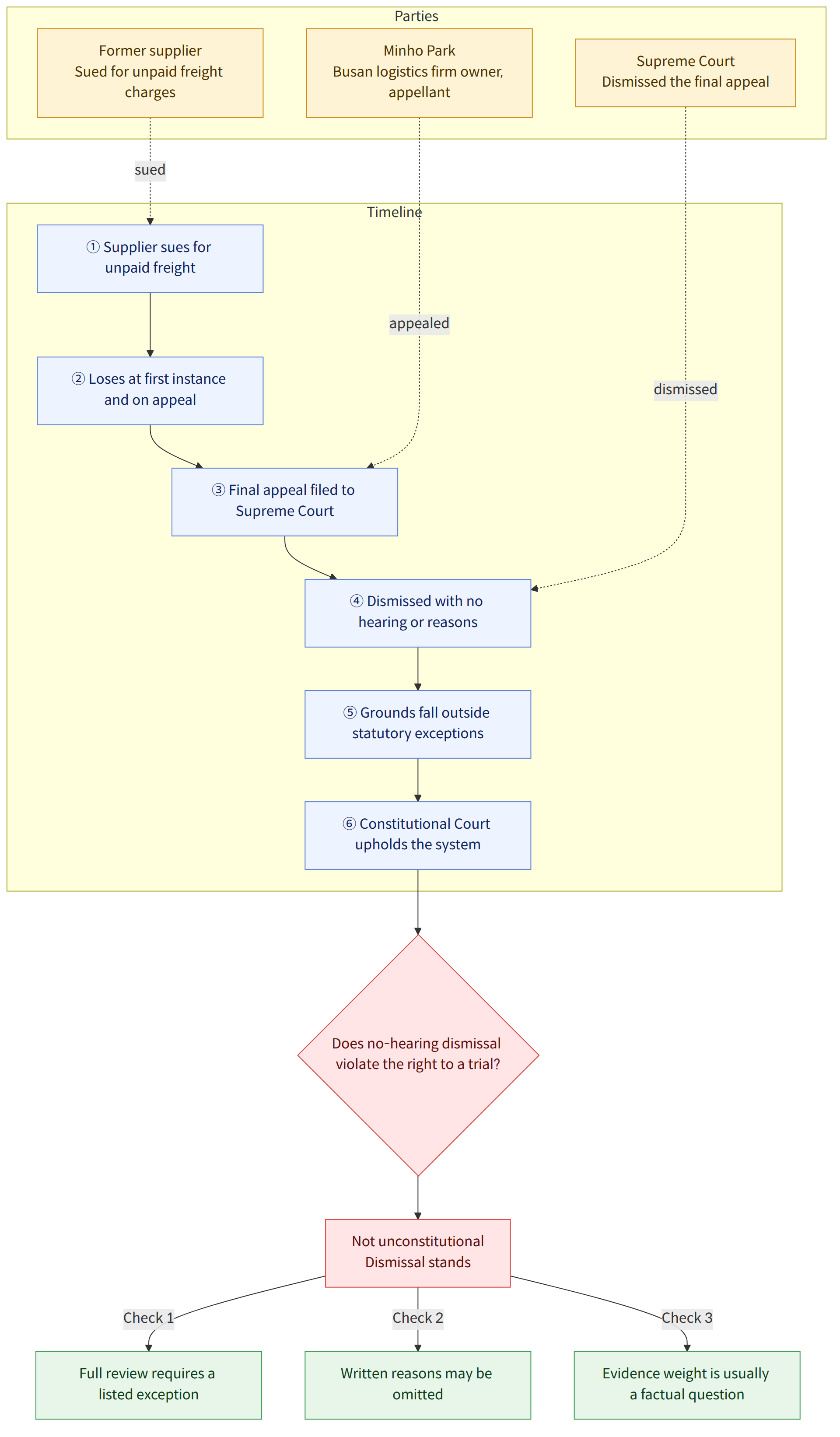
Minho Park ran a small logistics company in Busan. Two years ago, a former supplier sued him for unpaid freight charges worth several million won. Minho believed he had already paid most of the invoices, and he had bank transfer records to prove it. He lost in the first-instance court, then lost again on appeal. Each time, the judge's reasoning left him feeling that his evidence had been weighed too lightly.
He refused to give up. He hired a lawyer to file a final appeal to the Supreme Court, arguing that the appellate court had misread the rules on proof of payment. For months he waited, imagining that the nation's highest court would finally examine his case closely.
Instead, he received a short notice: the appeal was dismissed. There was no hearing, no oral argument, and no written explanation. Minho stared at the single page and asked the question many Korean litigants ask: how can my case be closed without anyone explaining why?
The Legal Question
Does Korea's law allowing the Supreme Court to dismiss civil appeals without a hearing or written reasons violate a citizen's constitutional right to a trial?
What Korean Law Says
Korea's appeals process is built around three levels of courts. Most civil cases can be heard by a district court, then an appellate court, and finally the Supreme Court. However, the Special Act on Procedures for Supreme Court Appeals lets the Supreme Court screen out appeals that do not raise significant legal questions. This screening is known as the "no-hearing dismissal" system.
The Supreme Court may dismiss an appeal by judgment without further hearing where the grounds of appeal do not fall under certain listed exceptions.
The listed exceptions are the core of the system. An appeal can proceed to a full review if it raises one of the following:
- A claim that the lower court's judgment violated the Constitution or interpreted it improperly.
- A claim that the lower court wrongly judged the legality of an order, regulation, or administrative disposition.
- A claim that the lower court interpreted a law or regulation in a way that conflicts with an existing Supreme Court precedent.
- A situation where no Supreme Court precedent exists on the interpretation, or where a precedent should be changed.
- Other serious violations of law.
- Specified procedural defects listed under the Civil Procedure Act.
The same Special Act also allows these dismissals to be issued without written reasons:
A judgment dismissing an appeal under this system may be issued without stating its reasons.
How Korean Courts Approach This
The Constitutional Court has examined this system more than once and has consistently found it constitutional. Its reasoning rests on several points:
- The Constitution makes the Supreme Court the highest court, but this does not mean every case must receive a Supreme Court review.
- The right to a trial guaranteed by the Constitution does not mean a right to appeal to the Supreme Court in every case.
- How many levels of courts a country uses is primarily a matter for the legislature to decide, because it involves a trade-off between fairness in individual cases and speedy, consistent justice.
- The exceptions are defined objectively, so the Court cannot dismiss an appeal based on random circumstances or arbitrary judgment.
In short, the Constitutional Court treats the system as a reasonable way to focus the Supreme Court on questions of legal uniformity, even if that means some individual litigants do not receive a detailed explanation.
Applying the Law to the Case
Minho's situation shows how these rules work in practice. His appeal was not rejected because the Supreme Court found his facts unconvincing. It was rejected because his legal arguments, as the Court saw them, did not fall within any of the statutory exceptions. Disputes about how to weigh bank records as evidence are usually treated as factual questions, and factual questions are generally outside the scope of a Supreme Court appeal.
Step by step, the reasoning runs like this:
- Was the appeal screened? Yes. The Supreme Court reviewed whether the grounds of appeal met one of the statutory exceptions.
- Did the grounds raise a legal question of wider importance? Minho's argument centered on how one case's evidence was assessed. Unless it challenged a legal interpretation that conflicts with precedent or raises an unsettled question of law, it would likely be seen as a dispute over facts.
- Is the lack of written reasons a constitutional violation? Under the Constitutional Court's reasoning, the omission of reasons is tied to the goal of speedy handling of cases that do not meet the exceptions. It does not by itself make the system unconstitutional.
This does not mean Minho's concerns are invalid. It means the system is designed to answer a specific question: whether the case belongs before the Supreme Court in the first place. His frustration is understandable, but the law treats the threshold screening as a legitimate institutional choice.
For readers in a similar position, the critical document is the Supreme Court's dismissal notice itself. Because the dismissal may come without reasons, the appellant's own appeal papers become the main record of what was argued. Minho's lawyer could review whether his grounds of appeal were framed as legal questions tied to an exception, or whether they simply repeated disagreement with the evidence. That distinction often determines whether an appeal reaches a full review.
If you have received a Supreme Court dismissal notice like Minho's, ask attorney Ji-sun Ahn of Ijun Law Firm to review that notice alongside your original grounds of appeal and the lower court judgments, to see whether your arguments were framed as legal questions tied to one of the statutory exceptions. Because the dismissal may come without written reasons, the appeal papers you filed are often the clearest record of what the court had before it.
Conclusion: What Happened, and What Should You Do?
Minho's appeal was dismissed without a hearing, and under Korean law and the Constitutional Court's rulings, this outcome is not, by itself, unconstitutional. The system is built to prioritize consistent interpretation of the law over the detailed review of every individual dispute. Minho's experience reflects a trade-off that the legislature has deliberately made, even though it can feel harsh to the person who loses.
If you face a similar situation, consider these practical points:
- Frame your appeal around legal questions. Identify whether your case involves a conflict with Supreme Court precedent, an unsettled legal issue, or a constitutional question, rather than only disagreeing with the factual findings.
- Keep every record. Because a dismissal may not explain its reasoning, your original filings and evidence are the best source for understanding what was and was not argued.
- Get a review early. A careful look at the lower court judgments and your appeal papers before filing can show whether your grounds fit the statutory exceptions.
















