

A Human Story
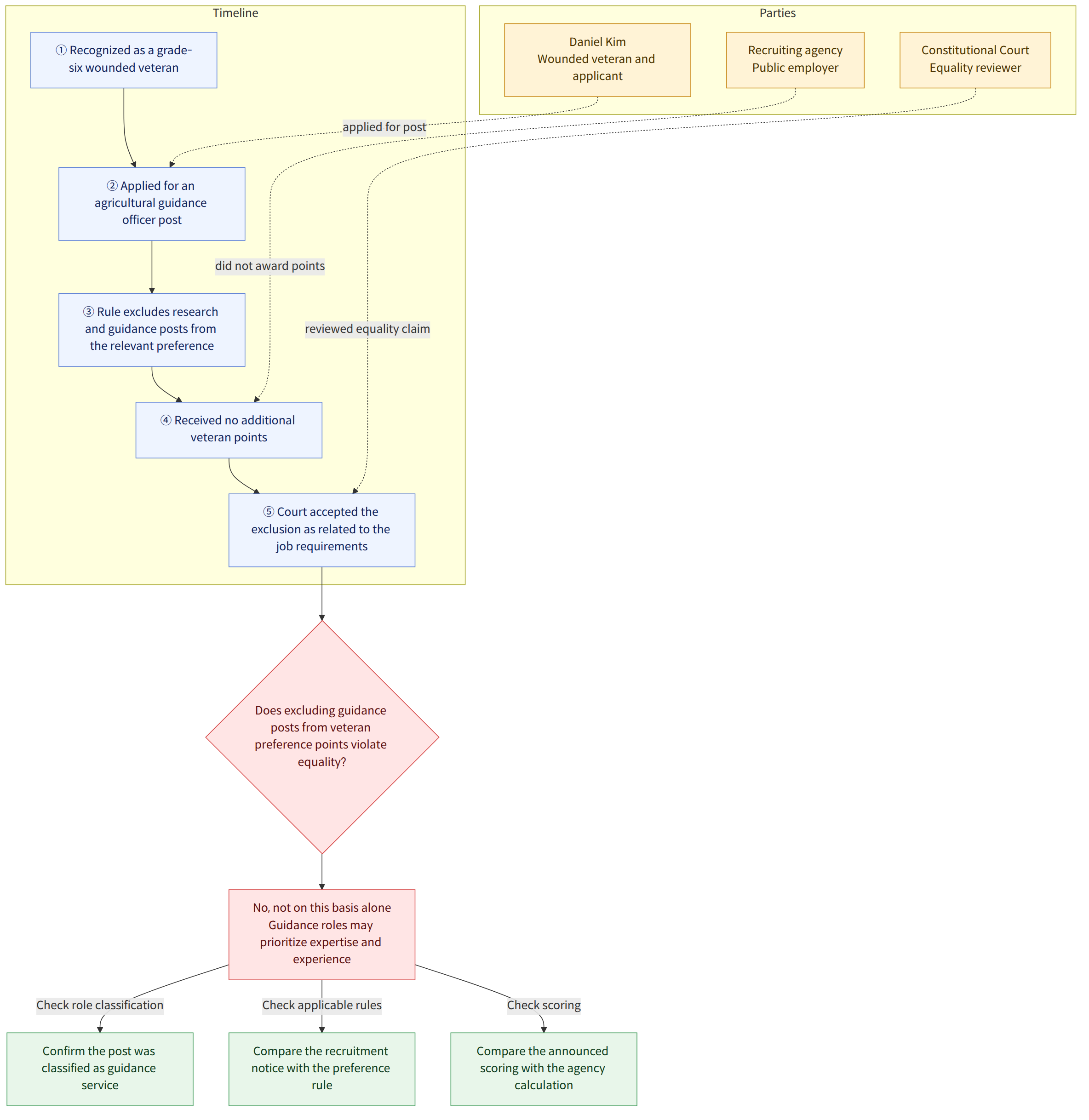
Daniel Kim kept his service papers in a folder beside his agricultural certificates. After being recognized as a grade-six wounded military veteran and registered as a person of national merit, he hoped to build a civilian career using his knowledge of farming. He applied for a post as an agricultural guidance officer, a public role devoted to bringing practical expertise to the countryside.
When the recruitment process ended, Daniel learned that his veteran status had not earned him additional points. The reason was not a missing certificate or an arithmetic error: the rules excluded research and guidance positions from the relevant preference. To Daniel, the distinction felt stark. He was a veteran applying for a government job, yet one kind of government job treated his status differently.
The Legal Question
Does excluding guidance-service positions from veteran hiring-exam preference points violate the constitutional right to equality, particularly when a registered wounded veteran applies for an agricultural guidance post?
What Korean Law Says
Korean law provides employment-related support for people recognized as persons of national merit, including preferential points in certain public recruitment examinations. But the preference does not operate identically for every public position. The applicable implementing rule excludes research and guidance posts from the specified category of government recruitment examinations that carry those points.
The distinction matters because an agricultural guidance officer is not simply a general administrative employee. The job is designed to use professional knowledge and relevant experience in a specialized field. The Constitutional Court’s reasoning can be summarized this way:
The fact that guidance-service posts are excluded from the relevant veteran preference does not, by itself, amount to arbitrary discrimination. For these positions, professional expertise—often reflected in relevant experience or education—is an important consideration in appointment, and the public employer may need to select someone whose expertise can be put to immediate use. The exclusion therefore does not violate equality.
For an applicant, the key points are:
- Veteran status alone does not guarantee preference points in every public-sector examination. The position and the governing recruitment rules matter.
- Research and guidance posts are treated differently under the rule at issue. Agricultural guidance positions fall within the guidance-service category.
- A refusal to award points should be distinguished from a mistake in applying the rule. An applicant can still check whether the role was classified correctly and whether other parts of the score were calculated as announced.
How Korean Courts Approach This
Korean constitutional review asks whether people in comparable situations have been treated differently without a sufficient reason. Not every difference is unconstitutional. The government may draw distinctions when they relate to a legitimate feature of the position, provided the line is not arbitrary.
In this setting, the Constitutional Court has focused on the nature of guidance work. Relevant expertise and experience can be central to appointment, and an employer may reasonably seek someone able to apply that expertise from the start. The Court has therefore accepted the exclusion as connected to the job’s requirements, rather than as an unjustified denial of veterans’ status.
That conclusion is specific to the preference rule and the kinds of positions it covers. It does not mean that every recruitment decision is beyond challenge, or that an agency may ignore its own announcement. It means that the equality argument, standing alone, does not make the exclusion unlawful.
Applying the Law to Daniel’s Case
- Daniel’s veteran recognition is not in dispute. His grade-six wounded-veteran status could qualify him for benefits in settings where the relevant preference applies.
- The position he chose is decisive. He applied for an agricultural guidance officer post, which is a guidance-service position rather than an ordinary general-administration post.
- The rule excludes that category from the relevant preference. If the recruitment was governed by that rule, the agency’s refusal to add veteran points followed the classification at issue.
- The equality claim is unlikely to succeed on that basis alone. The Court has considered the distinction rational because guidance roles place particular weight on specialized capability that can be used directly in the work.
- A separate scoring or classification error would be a different question. Daniel could still compare the recruitment notice with the agency’s score calculation to see whether the position was classified and the rest of his application assessed correctly.
Daniel may ask [[lawyer]] to review the recruitment notice, his application record, and the explanation of his score to check whether the agency applied the announced rules correctly. That document review would address a possible error in his individual recruitment process, not guarantee that the exclusion itself can be overturned.
Daniel may ask attorney Ji-sun Ahn of Ijun Law Firm to review the recruitment notice, his application record, and the explanation of his score to check whether the agency applied the announced rules correctly. That document review would address a possible error in his individual recruitment process, not guarantee that the exclusion itself can be overturned.
Conclusion: What Happened, and What Should You Do?
Daniel did not receive preference points, and the constitutional equality challenge to the exclusion would not succeed under the Court’s approach. The decisive point is that the post was a guidance-service position for which specialized expertise and relevant experience are central; veteran status does not override the rule that excludes this category from the preference.
For applicants in a similar position:
- Read the recruitment notice closely to identify the post category and the rules governing preference points.
- Keep the documents that show how your score was calculated, and compare them with the published criteria to spot any separate administrative error.
- If you believe the agency misclassified the post or miscalculated your score, seek advice based on the actual notice and decision; do not assume that veteran status alone makes the exclusion unconstitutional.

















