

1. A Human Story
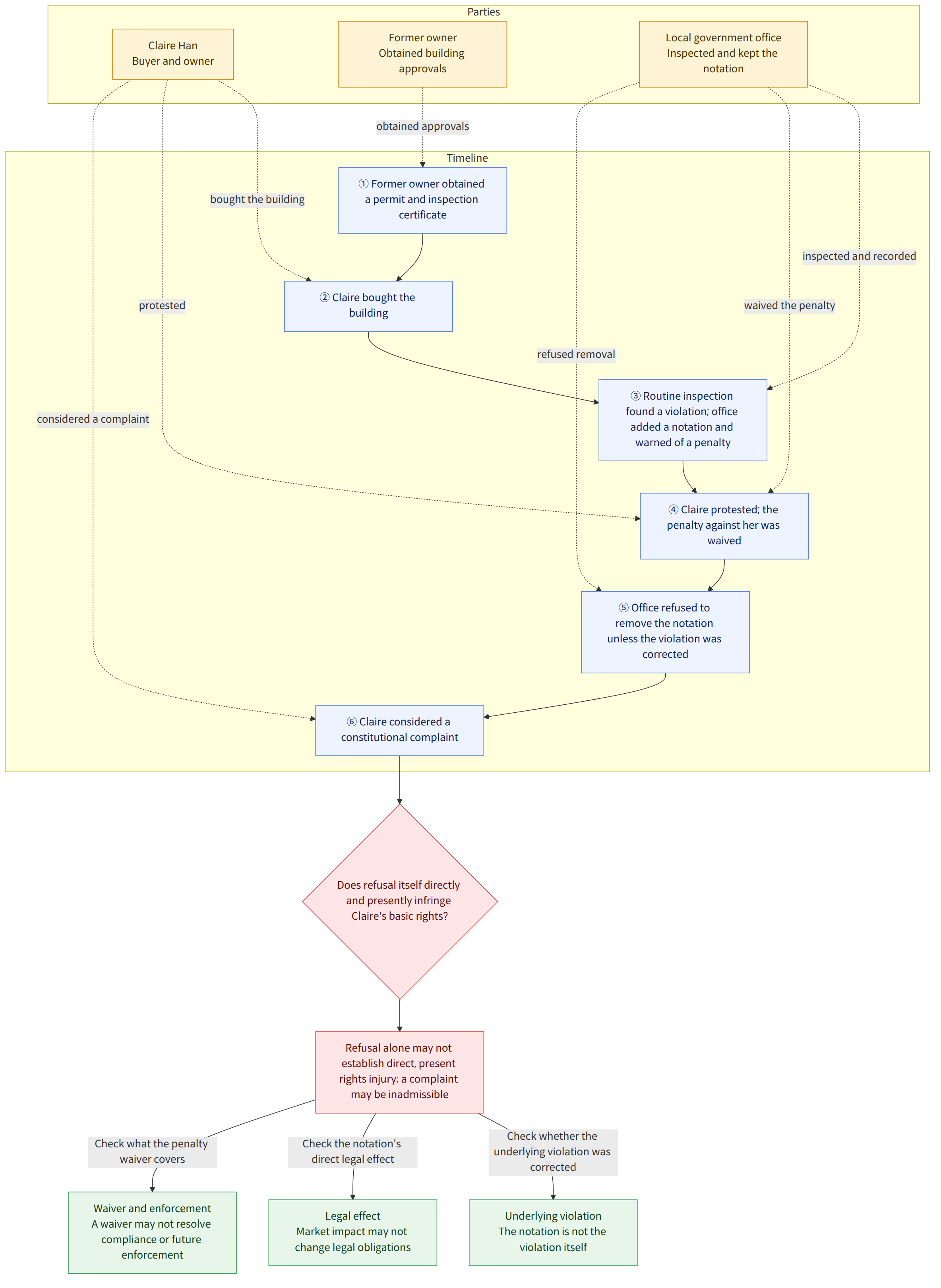
When Claire Han bought a small building, the documents looked reassuring. Its former owner had obtained a building permit, completed construction, and received the inspection certificate needed for use. Claire saw no reason to think the property had a serious compliance problem.
Months later, a routine inspection uncovered a building-law violation. The local government added an unlawful-building notation to the building register and warned Claire that she could face a monetary enforcement penalty if she did not correct the problem. Claire protested that she had bought the property in good faith. The office eventually waived the penalty against her, but it refused to remove the notation unless the violation itself was corrected.
Claire was relieved not to owe a penalty, yet worried about what the notation might do to the building’s resale value. She asked the office to erase it and, when it refused, considered taking the matter to the Constitutional Court. The difficulty was that the record entry and the underlying legal problem were not the same thing.
2. The Legal Question
Can a buyer bring a constitutional complaint simply because a local government refuses to remove an unlawful-building notation from the building register, even when the buyer has been excused from the immediate penalty and the underlying violation remains uncorrected?
The key issue is admissibility: has the refusal itself directly and presently affected the buyer’s constitutionally protected rights, or is the buyer seeking relief from a feared future consequence that the notation alone does not legally decide?
3. What Korean Law Says
Korean constitutional complaints are not a general way to correct every government decision a person considers unfair. A complainant must show that an exercise or failure to exercise public authority has directly and currently infringed the complainant’s own constitutionally protected basic rights.
Under Article 68(1) of the Constitutional Court Act, a person may seek constitutional review when an exercise or non-exercise of public authority infringes that person’s constitutionally guaranteed basic rights.
This requirement matters because a constitutional complaint is not simply an appeal against an unfavorable administrative response. The complaint must concern an act that affects the person’s legal position in a sufficiently direct way. If the challenged act creates no present possibility or risk of a basic-rights infringement, the complaint may be dismissed as inadmissible without the Court deciding whether the government acted correctly on the merits.
For an unlawful-building notation, several distinctions are important:
- The notation is not the violation itself. It records information about a suspected or established building-law problem; it does not make a compliant building unlawful or make an unlawful building compliant.
- Removing the notation does not cure the underlying problem. If the violation remains, the owner may still be subject to a corrective order or an enforcement penalty under the relevant building rules.
- A possible effect on sale price is not automatically a direct legal injury. A notation may influence whether a transaction proceeds or what price a buyer will pay, but that market effect does not necessarily mean the notation itself changes the owner’s legal obligations.
- A penalty waiver is limited in scope. It may protect the current owner from a particular penalty, but it does not necessarily resolve the building’s compliance status or future enforcement issues.
The practical question, then, is not merely whether the notation is upsetting or commercially damaging. It is whether refusing to erase it has itself changed the owner’s legal rights or obligations—or whether the owner must instead deal with the uncorrected violation and any specific enforcement action.
4. How Korean Courts Approach This
Korean courts and the Constitutional Court generally examine the real legal effect of the government action being challenged, rather than relying only on the label attached to it. In this kind of dispute, the Court asks what the owner is actually trying to achieve and whether the disputed notation is the source of the claimed legal harm.
A building-register entry can matter in the real-estate market. It may discourage prospective purchasers or affect negotiations. But, in the approach reflected in the Constitutional Court’s reasoning, the entry does not itself determine whether the structure violates building law. Nor does deleting the entry, while leaving the violation untouched, prevent the authorities from issuing a corrective order or imposing a penalty where the law allows it.
A constitutional complaint requires more than concern about a future disadvantage: the challenged public act must have a current, direct effect on the complainant’s own legal position or basic rights.
If the owner’s underlying aim is to ensure that the building is treated as lawful for all future purposes, a request to erase the notation does not achieve that aim. The Court may therefore conclude that the refusal to remove the notation has not itself caused the kind of direct constitutional injury required for a complaint. The result is a dismissal on admissibility grounds, not a ruling that the building is lawful or that the local government’s handling of every aspect of the matter was correct.
5. Applying the Law to the Case
Claire’s situation has to be separated into the record entry, the building’s condition, and the potential enforcement consequences.
- The building’s history does not settle the later compliance finding. The former owner obtained a permit and an inspection certificate, but a later inspection found a violation. Those earlier documents may be relevant evidence, but they do not, by themselves, erase a later-discovered problem.
- The penalty waiver addresses Claire’s immediate exposure, not the building’s status. The local government’s decision not to impose an enforcement penalty on Claire is favorable to her. But it does not necessarily mean that the violation has been corrected or that the building must be treated as lawful in the future.
- The notation is not what creates the underlying violation. Even if Claire persuaded the office to delete the register entry, the physical or legal condition that led to the finding would remain. The authorities could still rely on the applicable building rules when considering a corrective order or other enforcement action.
- Her feared resale loss may be real but is not necessarily a direct constitutional injury caused by the refusal. The notation could make a future sale more difficult or affect the price. But the constitutional question is narrower: did the refusal itself change Claire’s legal position or directly infringe a protected right? If the entry merely reflects an unresolved violation and does not determine the building’s legal status, the required direct effect may be missing.
- The requested remedy does not match the practical objective. Claire wants assurance that neither she nor a later buyer will face enforcement consequences and that the building will be treated as lawful. Erasing the notation alone cannot provide that assurance. The central issue is the underlying violation, not just how the register describes it.
On these facts, a constitutional complaint challenging only the refusal to delete the notation would likely be dismissed as inadmissible. That conclusion would not decide whether the original construction complied with the law, whether the inspection was accurate, or whether a particular enforcement decision could be challenged on its own grounds. It would mean only that this particular refusal, standing alone, did not sufficiently affect Claire’s constitutional rights for the complaint to proceed.
If Claire has the inspection report, the penalty-waiver notice, the office’s refusal letter, or the building’s permit and completion records, [[lawyer]] could review those documents to clarify what violation was recorded and whether a separate government decision—not merely the register notation—affects her legal position.
6. Conclusion: What Happened, and What Should You Do?
Claire’s constitutional challenge would likely fail at the threshold. Although the notation could create a genuine commercial worry, it does not itself decide whether the building is lawful. Because Claire’s penalty was waived and the underlying violation remained unresolved, a request to erase the notation alone was unlikely to show a current, direct infringement of her constitutional rights. The complaint would therefore likely be dismissed as inadmissible, without a decision on the building’s ultimate compliance.
For readers facing a similar problem:
- Identify the underlying violation. Obtain the inspection findings and ask the local office what specific condition must be corrected; do not assume that deleting a register entry will resolve the building-law issue.
- Keep the full paper trail. Preserve the purchase agreement, building-register records, permits, inspection documents, notices, penalty decisions, and written correspondence with the local government.
- Focus on the decision that changes your legal position. If you receive a corrective order or penalty decision, assess that specific action and the available response rather than relying on a constitutional complaint aimed only at the notation.
A warning on a property record can matter in a sale. But the legal question is whether the warning changes the owner’s rights—or simply records a problem that still needs to be addressed.
If you have an inspection report, a notice refusing to remove a building-register notation, or a decision waiving or imposing a penalty, attorney Ji-sun Ahn of Ijun Law Firm could review those documents to help distinguish the record entry from any separate decision affecting your legal position.
















