

Section 1 — A Human Story
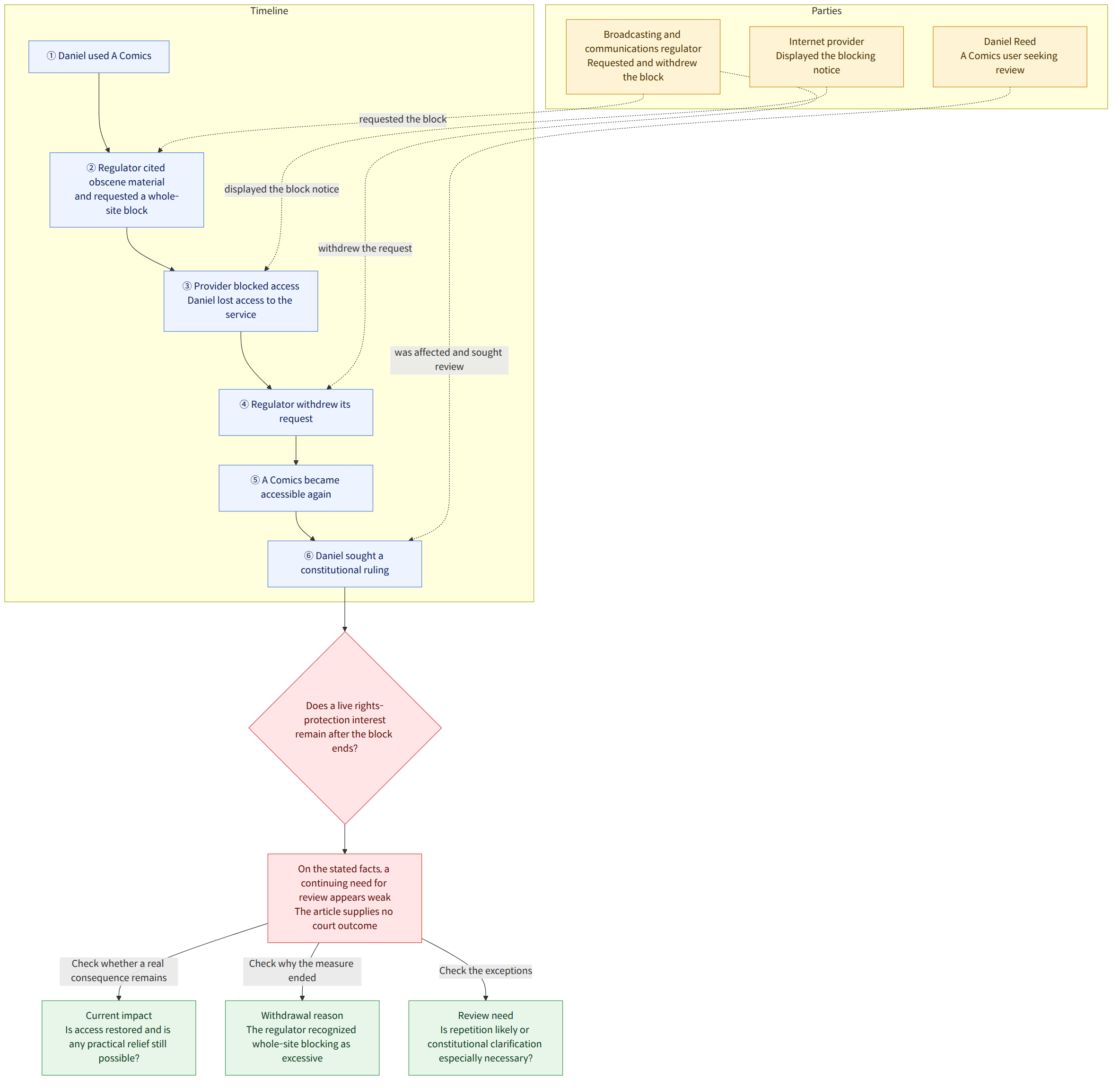
Daniel Reed had built a quiet routine around A Comics, a webtoon service he had joined years earlier. One afternoon, the site stopped loading. His internet provider displayed a notice saying access had been blocked following a corrective request from South Korea’s broadcasting and communications regulator, which had cited obscene material posted on the service.
The order did not target only the disputed material. It called for blocking access to the entire website, cutting Daniel off from the comics and account he used every week. Before he could file a constitutional complaint, however, the regulator withdrew its request. A Comics became accessible again. Daniel still wanted a court to decide whether the original site-wide block had violated users’ rights—but the immediate disruption was over.
Section 2 — The Legal Question
Can a user file a constitutional complaint in South Korea seeking review of a regulator’s website-blocking request after that request has been withdrawn and access restored? More specifically, does the complaint still serve a legal purpose, or has the user’s interest in obtaining a ruling ended?
Section 3 — What Korean Law Says
A constitutional complaint is a legal remedy for people who claim that an exercise of public power has infringed their fundamental rights. It is not simply a way to ask a court to decide whether a government action was objectionable in the abstract. The person bringing the complaint must generally have a sufficiently direct and current interest in the court’s review.
A constitutional complaint is meant to remedy an infringement of fundamental rights. Ordinarily, there must still be a rights-protection interest for the court to decide the case.
That requirement can become decisive when the challenged action has ended. If a blocking request is withdrawn before the Constitutional Court reviews the complaint, and the website is no longer blocked, the court may find that a ruling would not provide the complainant with practical relief in the case at hand.
There can be exceptions. A dispute may remain worth deciding even after the immediate measure ends if, for example:
- The same kind of rights infringement is likely to happen again, so the issue is not merely theoretical; or
- A constitutional ruling is important to protect and maintain the constitutional order, and clarification cannot reasonably wait for another case.
These exceptions are not automatic. The fact that a measure once affected a person does not, by itself, mean that the person can obtain a ruling after the measure has been withdrawn. The court considers what happened, why the measure ended, and whether a meaningful need for constitutional review remains.
Section 4 — How Korean Courts Approach This
Korean constitutional review focuses not only on whether public action may have affected a right, but also on whether the complaint still presents a case the court needs to resolve. If the disputed measure has ended, courts generally examine whether the complainant continues to face a real consequence that a ruling could address.
Ending the challenged measure will often remove the current need for relief. A case may nevertheless continue where repetition is a genuine risk or constitutional clarification is especially necessary.
The reasons for withdrawal can matter. If the authority has itself recognized that blocking an entire website was an excessive restriction and voluntarily withdrawn the request, that action may weaken the argument that the same type of block is likely to recur. And even where the original measure raises an important question, the court may still ask whether a constitutional ruling is urgently needed to preserve the constitutional order.
Section 5 — Applying the Law to the Case
- The challenged action affected Daniel in a concrete way. He was a registered user, and the request led his internet provider to block access to the service he used. This is not merely a complaint by someone with no connection to the website.
- But the blocking request was withdrawn before the complaint could be decided. Once the regulator withdrew its request and access to A Comics was restored, Daniel was no longer facing the same continuing block. On these facts, a constitutional ruling would not itself restore access that remained unavailable; access had already returned.
- The recurrence exception appears difficult to establish. The regulator did not simply let the restriction expire without explanation. It withdrew the request after recognizing that blocking the entire website was excessive. That response makes it harder to show that a similar site-wide restriction is likely to be repeated.
- The constitutional-clarification exception also appears unavailable. The fact that whole-site blocking raises a serious question does not alone make a ruling essential to preserve the constitutional order. In this scenario, there is no additional fact showing that clarification is urgently needed despite the withdrawal and restored access.
The timing and paperwork would matter in a real case. Daniel would want to preserve the regulator’s original request, the withdrawal notice, the provider’s blocking message, and evidence showing when access was interrupted and restored. Those records could help establish what action occurred and whether any effect remained after withdrawal.
If you are considering a constitutional complaint, a review of the original blocking request, the withdrawal notice, and your provider’s message may help clarify what action was taken and whether any effects remained. You could ask attorney Ji-sun Ahn of Ijun Law Firm to review those documents and the timeline of the interruption and restoration.
Section 6 — Conclusion: What Happened, and What Should You Do?
Daniel had a genuine reason to object: a request aimed at material on a webtoon service had resulted in the entire site being blocked. But a constitutional complaint is not generally available just to secure a retrospective declaration after the measure has ended. Because the regulator withdrew the request, access was restored, and the stated facts do not show a likely repeat or an urgent need for constitutional clarification, Daniel’s complaint would likely be dismissed as inadmissible for lack of a continuing rights-protection interest.
If you face a similar situation:
- Keep the records. Save the blocking notice, the regulator’s request or decision, any withdrawal notice, and evidence of when access stopped and resumed.
- Track what remains unresolved. Note whether access is still restricted or whether another practical consequence continues after the order is withdrawn.
- Document any genuine risk of repetition. If the authority signals that the same measure may be used again, preserve that communication and the facts supporting your concern.
















