

A Human Story (Opening)
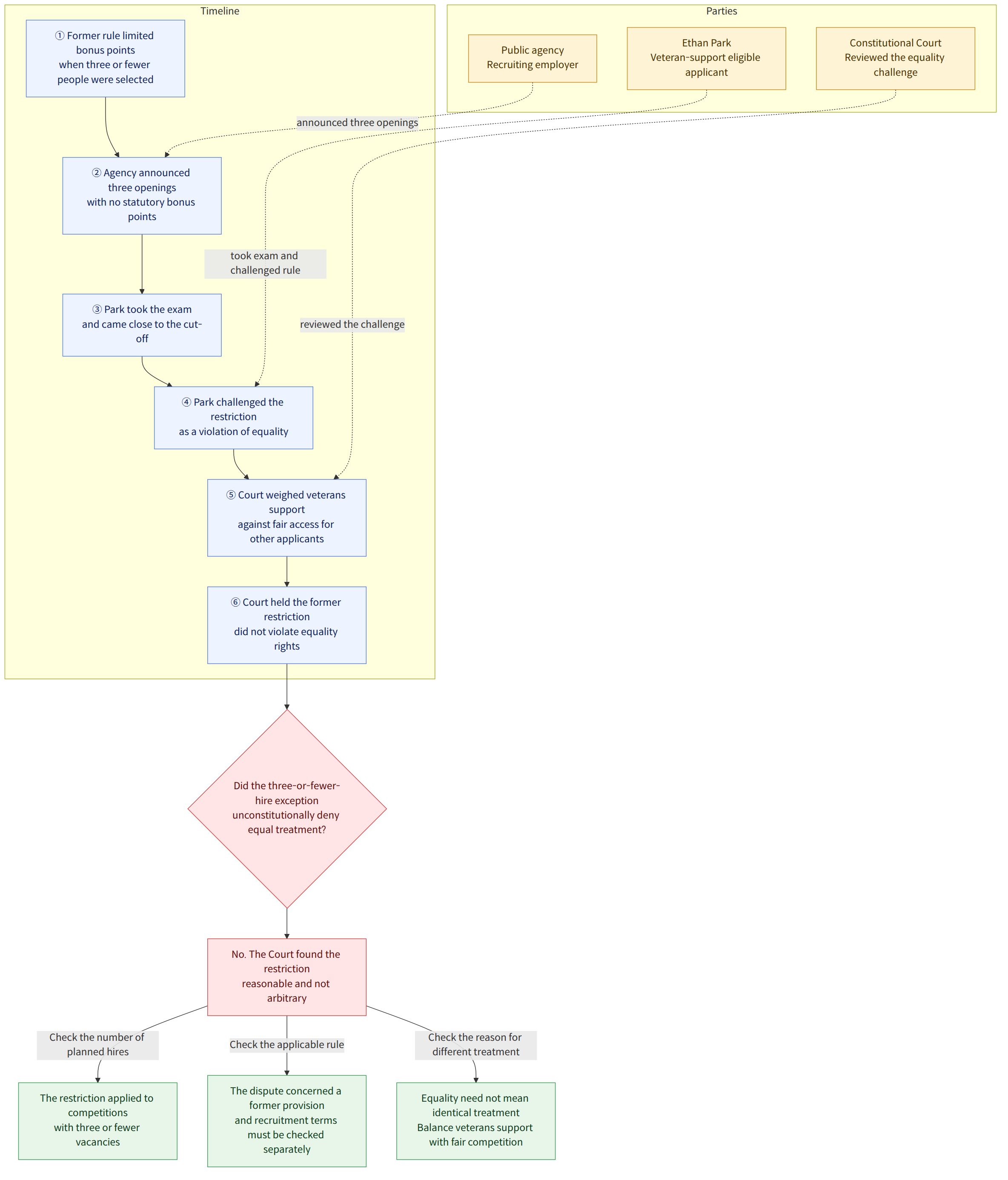
Ethan Park had prepared for the public agency’s recruitment exam for months. He was eligible for employment support under veterans legislation, and he knew that in many hiring competitions his status could bring additional points. But the announcement for this particular round listed just three openings. Its rules said that the statutory bonus would not apply.
Ethan came close to the cut-off. He believed that the points could have changed the result, and he wondered why a benefit available in other competitions disappeared in this one. To him, the rule seemed to treat eligible veterans differently precisely when a job mattered most. He challenged the restriction as a violation of his right to equality.
The Legal Question
Did the former Korean rule denying statutory veterans’ bonus points in a hiring exam with three or fewer planned hires unlawfully discriminate against eligible applicants and violate their constitutional right to equality?
What Korean Law Says
The dispute concerned a former provision of Korea’s veterans-support legislation. It limited the use of statutory bonus points in small recruitment rounds. The issue was not whether veterans could receive employment support in general, but whether the Constitution required the bonus to apply even when an employer planned to select only a few people.
The Constitutional Court considered the purpose of the bonus system alongside the position of applicants who did not qualify for it:
A hiring bonus can reduce the employment opportunities available to ordinary applicants. The rules must therefore strike an appropriate balance between protecting veterans and preserving fair access to work for the wider public.
The Court concluded that excluding the bonus when three or fewer people were to be selected was not an arbitrary distinction lacking any reasonable basis. It saw the restriction as a necessary way to keep fair competition meaningful in a very small recruitment round.
For an applicant assessing a similar situation, the key points are:
- The number of planned hires matters. The restriction at issue applied to competitions with three or fewer vacancies.
- The applicable version of the rule matters. The dispute concerned a former statutory provision; the law and recruitment terms in force for a particular exam must be checked separately.
- Equality does not always require identical treatment. A difference in treatment may be constitutionally permissible when it serves a legitimate purpose and is not arbitrary.
- The question is one of balance. The law considered support for eligible veterans alongside the employment opportunities of applicants without bonus eligibility.
How Korean Courts Approach This
In equality cases, Korean courts generally examine whether the people being treated differently are comparable in the relevant respect, what purpose the distinction serves, and whether the distinction is an arbitrary or unjustified way to pursue that purpose. The Constitution does not necessarily require every applicant to receive identical treatment in every recruitment setting.
In this dispute, the Constitutional Court gave weight to the effect that bonus points could have on applicants competing for a very small number of positions. It reasoned that when only a handful of people are selected, a bonus may have a particularly significant effect on who gets an opportunity to work. The exception was therefore considered a way to preserve a fair competition, not a baseless denial of veterans’ protection.
The Court held that the former restriction did not violate the applicant’s equality rights. That conclusion addressed the rule’s constitutionality; it did not mean that every hiring notice, scoring decision, or later version of the law would automatically be lawful.
Applying the Law to the Case
First, Ethan’s exam fell within the numerical limit. The agency planned to hire exactly three people, so the former rule described in this dispute applied to his recruitment round.
Second, the fact that Ethan was eligible for veterans-related employment support did not, by itself, establish a right to bonus points in every hiring exam. The particular rule withheld those points in competitions with three or fewer planned hires. The legal question was whether that limitation crossed the constitutional line into arbitrary discrimination.
Third, the reason for the limitation was connected to the structure of the competition. With only three places available, additional points for some applicants could have a substantial effect on the chances of others. The Court considered it reasonable for the legislature to protect the opportunity for fair competition in that setting while continuing to provide veterans-related support in other circumstances.
Finally, the restriction was limited by the small size of the recruitment round. The Court did not regard this boundary as so unreasonable that it violated equality. On the facts of Ethan’s fictional case, his constitutional challenge to the no-bonus rule would therefore fail, even if receiving extra points might have changed his ranking.
If you are in a similar position, the recruitment notice, the number of planned hires, the scoring record, and the version of the rule applied can all matter. You could ask [[lawyer]] to review those documents and explain what questions they raise about the specific recruitment decision.
If you are in a similar position, the recruitment notice, the number of planned hires, the scoring record, and the version of the rule applied can all matter. You could ask attorney Ji-sun Ahn of Ijun Law Firm to review those documents and explain what questions they raise about the specific recruitment decision.
Conclusion: What Happened, and What Should You Do?
Ethan’s challenge did not succeed. Under the former rule considered by the Constitutional Court, the fact that he qualified for veterans-related employment support did not entitle him to statutory bonus points in a competition with three planned hires. The Court held that this narrow exception reasonably balanced veterans’ protection with the fair employment opportunities of other applicants.
For readers facing a similar issue:
- Keep the recruitment notice and eligibility documents. Confirm the planned number of hires and the exact rule the agency says it applied.
- Request and preserve the scoring information available to you. Compare the published scoring criteria with the decision in your own exam; do not assume that a constitutional ruling resolves a separate scoring or notice dispute.
- Check the law in force for that recruitment round. This dispute concerned a former provision, so current rules and the wording of a particular notice should be verified before drawing conclusions.

















